Teams searching for the best AI agent framework in 2026 are usually trying to answer a practical question, not a theoretical one: what should we actually build on?
That question matters more now because the agent stack has started to split into clear layers. Some tools focus on lightweight agent loops. Some focus on stateful orchestration and durable execution. Some are opinionated around enterprise governance. Others are optimized for multi-language developer adoption.
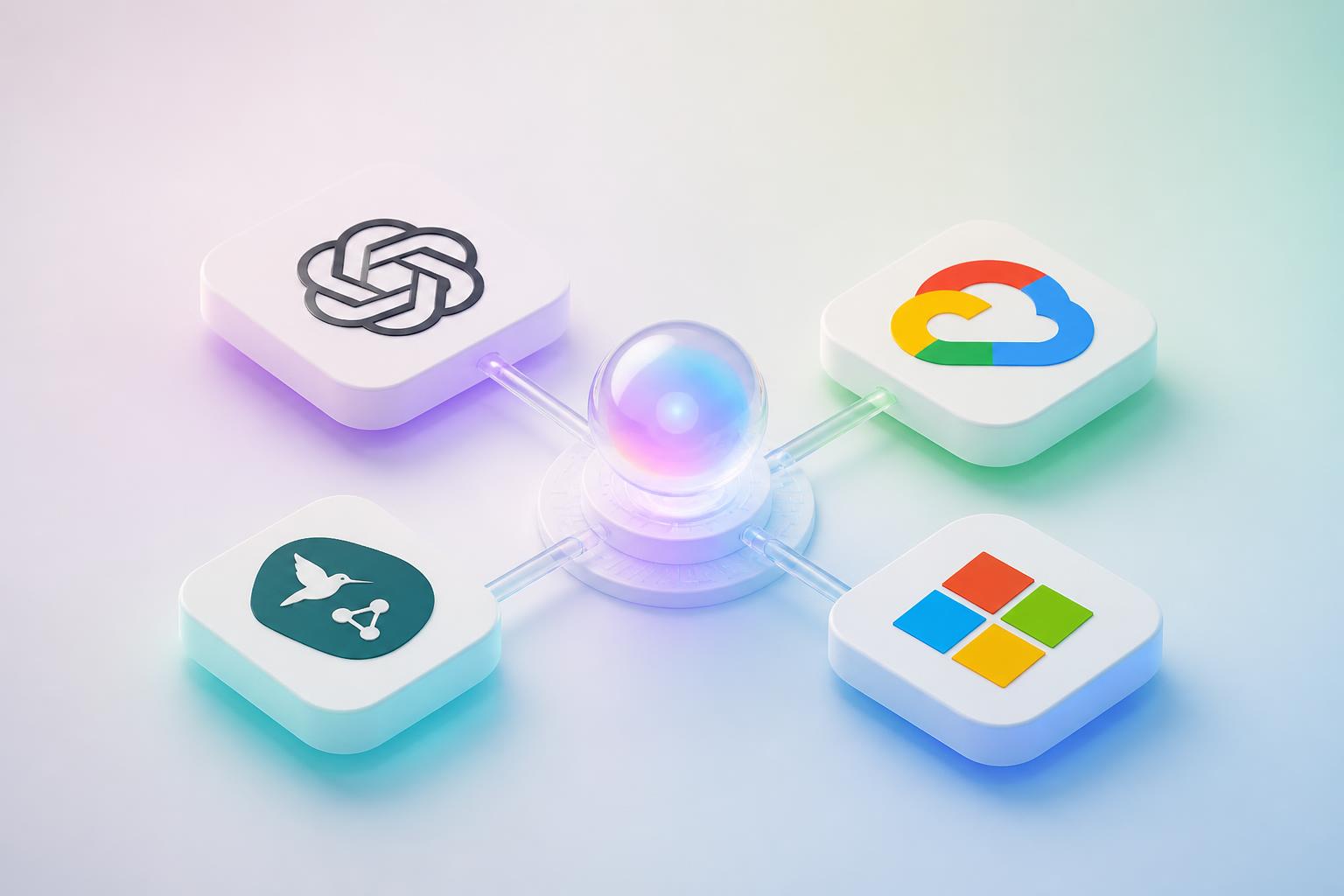
For most business teams, four names now come up repeatedly: OpenAI Agents SDK, LangGraph, Google Agent Development Kit (ADK), and Microsoft Agent Framework. Each is credible. Each solves a real problem. But they are not interchangeable.
If you want the short version, here it is: OpenAI Agents SDK is strong when you want a clean model-native way to build agents fast; LangGraph is strong when you need deep control over stateful long-running workflows; Google ADK is attractive for teams that want a flexible multi-agent framework with strong Google ecosystem alignment; and Microsoft Agent Framework is the clearest fit for organizations that want multi-agent patterns plus Microsoft-style enterprise integration.
This guide breaks down where each framework fits, where it does not, and how to choose without getting trapped by the wrong abstraction too early.
How to evaluate an AI agent framework
A lot of framework comparisons over-focus on demos. Production teams should look at a smaller set of questions:
- How does the framework handle state? Can an agent resume, preserve context, and survive long workflows?
- How does orchestration work? Are you mostly wiring tool calls, or designing real multi-step execution paths?
- How much control do you get? Can you shape handoffs, branching, approvals, and failure handling?
- What is the deployment model? Local library, managed runtime, or both?
- How much governance do enterprise teams get? Identity, observability, policy, tracing, and auditability matter fast once agents touch real systems.
- How much vendor gravity comes with the choice? Some frameworks stay relatively open. Others pull you toward a broader platform.
That lens matters because most organizations do not fail on prompt quality first. They fail on workflow reliability, approval paths, state recovery, and operational visibility.
OpenAI Agents SDK: best for fast model-native agent builds
OpenAI’s Agents SDK is intentionally lightweight. Its core primitives are simple: agents, tools, handoffs, and guardrails. The goal is not to force a large new abstraction layer. The goal is to give developers a straightforward way to build agentic applications that can call tools, delegate to specialized agents, keep sessions, and trace runs.
That design is a real advantage if your team wants to move quickly. The framework already includes built-in agent loops, function tools, MCP server tool calling, human-in-the-loop patterns, sessions, and tracing. OpenAI has also continued to strengthen the surrounding runtime picture, including background execution for long-running tasks and newer sandbox and computer-use infrastructure in the broader OpenAI agent stack.
The tradeoff is that OpenAI Agents SDK is usually strongest when you want to stay fairly close to OpenAI’s model-native workflow. It is less opinionated about complex graph-style orchestration than LangGraph, and less explicitly enterprise-governed than Microsoft’s broader stack.
Best fit: startups, product teams, and developer groups that want to launch agent features quickly without building an orchestration layer from scratch.
Watch for: teams that actually need workflow durability, heavy approval routing, or more explicit multi-agent control than a lightweight SDK naturally gives them.
LangGraph: best for stateful, long-running, production agent workflows
LangGraph has become one of the most important agent runtimes because it is built around a problem many teams discover the hard way: agents break once they need durable state, long-running execution, or human checkpoints.
Its core value is not “AI magic.” It is control. LangGraph focuses on durable execution, checkpointing, persistence, human-in-the-loop interruption, memory, and production deployment for long-running stateful workflows. If an agent needs to pause, wait for approval, recover after a failure, or resume from a known checkpoint, LangGraph is designed around that reality.
That makes it especially attractive for business processes that look more like workflow systems than chat demos: claims review, case operations, research flows, compliance steps, engineering automation, and multi-stage support work.
LangGraph also increasingly acts like a lower-level runtime beneath higher-level tools. LangChain’s newer agent abstractions run on top of LangGraph, which reinforces its role as a control layer rather than just another prompt framework.
Best fit: teams building stateful agents that need explicit orchestration, resumability, and operational control.
Watch for: teams that do not actually need that much control. If your use case is narrow and lightweight, LangGraph can be more infrastructure than you need.
Google ADK: best for flexible multi-agent development with Google ecosystem leverage
Google’s Agent Development Kit is one of the more interesting framework efforts because it tries to balance flexibility with production-minded structure. Google positions ADK as model-agnostic and deployment-agnostic, even though it is naturally optimized for Gemini and Google Cloud.
ADK distinguishes between different agent types instead of collapsing everything into one generic loop. It includes LLM agents for reasoning-heavy tasks, workflow agents such as sequential, parallel, and loop agents for deterministic control, and custom agents for specialized logic. It also includes structured session and memory services for managing context across conversations and systems.
That architecture is useful because it maps well to how real business systems evolve. Some steps need flexible reasoning. Some steps need deterministic control. Some need both.
Google has also kept expanding ADK’s language reach. Recent releases have added and strengthened TypeScript, Java, and Go support, and Google’s March 31, 2026 ADK Go 1.0 update pushed the framework further into production territory with YAML-based agent definitions, OpenTelemetry integration, plugin-driven recovery logic, and human-in-the-loop confirmations.
Best fit: teams that want a modern multi-agent framework with strong Google alignment, multi-language momentum, and a useful split between reasoning agents and workflow agents.
Watch for: organizations that need the deepest ecosystem maturity around stateful orchestration and deployment operations today.
Microsoft Agent Framework: best for enterprise-oriented multi-agent systems
Microsoft Agent Framework is one of the clearest examples of the agent market maturing beyond demos. Microsoft positions it as the direct successor to Semantic Kernel and AutoGen, combining AutoGen’s simpler multi-agent patterns with Semantic Kernel’s enterprise-oriented features such as state handling, type safety, filters, telemetry, and broader model support.
That matters because many organizations already learned from those two earlier worlds. AutoGen helped popularize multi-agent experimentation. Semantic Kernel appealed to teams that cared about enterprise integration. Microsoft Agent Framework is the attempt to unify those paths.
The framework adds workflows for more explicit control over multi-agent execution, long-running state management, and integrations that connect it to the rest of Microsoft’s agent stack. Microsoft also announced Agent Framework Version 1.0 in April 2026, but Microsoft Learn still labels the framework public preview, which is a useful signal for teams that need maximum platform stability before standardizing on it.
Best fit: enterprises, especially Microsoft-centric ones, that want multi-agent development with strong telemetry, workflow structure, and alignment to a broader governed platform strategy.
Watch for: teams that want a neutral lightweight framework with minimal platform pull.
A quick comparison table
| Framework | Best at | Core strength | Main tradeoff |
|---|---|---|---|
| OpenAI Agents SDK | Fast model-native agent apps | Simple primitives, handoffs, guardrails, sessions, tracing | Less opinionated for deep workflow orchestration |
| LangGraph | Stateful production workflows | Durable execution, checkpoints, human approval, long-running control | Can feel heavy for simpler use cases |
| Google ADK | Flexible multi-agent architecture | LLM agents plus workflow agents, multi-language support, Google alignment | Ecosystem still maturing relative to older orchestration-heavy patterns |
| Microsoft Agent Framework | Enterprise multi-agent systems | Successor to AutoGen and Semantic Kernel, workflows, telemetry, state | More platform gravity and preview-stage caution |
Which agent framework should most teams choose?
There is no universal winner. There is usually a best fit for the operating model you expect.
Choose OpenAI Agents SDK if…
- you want the fastest path from prototype to working agent feature,
- your team is already standardized on OpenAI models,
- and you do not yet need a heavy orchestration runtime.
Choose LangGraph if…
- your agents will run across multiple stages, tools, or approvals,
- you need checkpointing and resumability,
- or you expect operations and observability to matter as much as prompt quality.
Choose Google ADK if…
- you want flexible multi-agent patterns,
- you value a clean split between reasoning agents and deterministic workflow agents,
- or your stack is already moving toward Gemini and Google Cloud services.
Choose Microsoft Agent Framework if…
- you are building in a Microsoft-heavy enterprise environment,
- you care about multi-agent orchestration plus platform integration,
- and you want a framework that connects cleanly to Microsoft’s broader agent direction.
The mistake to avoid
The biggest mistake is not picking the “wrong” framework on a feature checklist. It is choosing a framework that mismatches the workload.
If your use case is mostly a single-agent product feature, do not overbuild with a graph runtime too early. If your use case is a real business workflow with retries, approvals, branching, and long-lived state, do not pretend a thin wrapper around tool calls is enough.
In other words: choose for the operating reality, not the demo.
Bottom line
The best AI agent frameworks in 2026 are starting to separate by job.
OpenAI Agents SDK is a strong default for fast model-native builds. LangGraph is the standout choice for stateful production orchestration. Google ADK is increasingly credible for flexible multi-agent development across languages and workflows. Microsoft Agent Framework is becoming an important enterprise option, especially for organizations already committed to Microsoft’s agent stack.
If you are evaluating agent infrastructure more broadly, it is also worth reading our guides on AI agent orchestration and Microsoft Agent Framework.
The framework decision should not be about which brand is loudest. It should be about which runtime gives your team the cleanest path to reliable, governable, high-value agent work.