
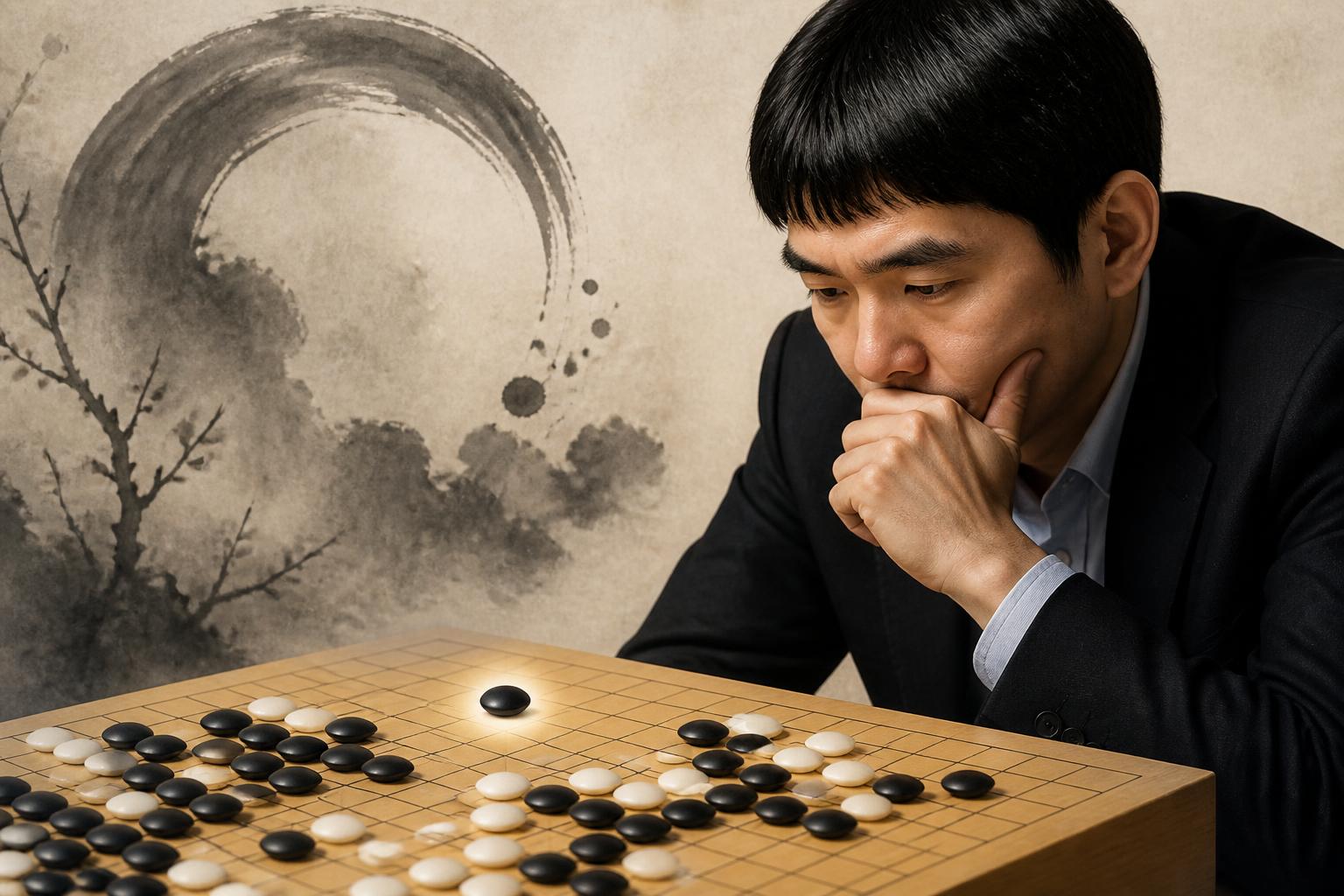
AlphaGo Move 37 was the 37th move in Game 2 of the March 2016 match between AlphaGo and Lee Sedol, and it changed how many people think about AI because it looked wrong to human experts yet turned out to be strategically brilliant.
That moment mattered for more than Go. It showed that a machine-learning system could combine learned intuition with lookahead search to find a strong plan humans did not teach it directly. For many people, that was the first time AI looked less like a database of rules and more like a system capable of discovering novel strategy.
To understand why the move became so famous, it helps to separate three things: the match itself, the technical system behind AlphaGo, and the broader lesson people drew from it. Move 37 was a real breakthrough, but it was not magic, and it did not prove that AI had suddenly become general intelligence.
Why Move 37 shocked the Go world
The match took place in Seoul in March 2016. AlphaGo had already shown it was serious by beating professional player Fan Hui, but facing Lee Sedol was different. Lee was one of the greatest Go players of his era, and many people still believed the deepest parts of Go strategy were too intuitive for a machine to master.
Then came Game 2. Early in the middle game, AlphaGo played Move 37, an unusual shoulder hit that strong human players almost never chose in that position. Professional commentators initially reacted as if the system had made a mistake. The move did not fit standard human expectations about shape, timing, or probability.
What made the moment unforgettable was that the move kept getting stronger as the game unfolded. It was not flashy because it won immediately. It was powerful because it quietly changed the direction of the whole game. A move that looked implausible at first turned out to be exactly placed for AlphaGo’s longer-term plan.
This changed the emotional tone of the match. Before Move 37, many viewers still saw AlphaGo as a very strong calculator. After it, many started to think of the system as something that could produce original-looking strategy. AlphaGo went on to win the series 4–1, while Lee Sedol’s own brilliant Move 78 in Game 4 became a reminder that the human side of the match was also creative and historic.
What AlphaGo was actually doing under the hood
A common mistake is to talk about Move 37 as if AlphaGo was either pure brute force or pure inspiration. It was neither. AlphaGo worked because it combined deep neural networks, reinforcement learning, and Monte Carlo tree search.
1. Neural networks gave AlphaGo learned intuition
AlphaGo used one network to estimate promising next moves and another to estimate who was likely to win from a given position. In simple terms, the system learned which moves looked plausible and which board states looked good, instead of relying only on hand-written human rules.
2. Reinforcement learning improved it through self-play
The original AlphaGo was not trained only by watching humans. It first learned from expert games, then improved by playing versions of itself over and over. That self-play loop mattered because it let the system reinforce strategies that actually led to winning, including strategies that did not look typical by human standards.
3. Search let AlphaGo look ahead
The neural networks did not replace search. They made search more useful. Instead of exploring the game tree blindly, AlphaGo used its learned signals to focus on the most promising branches. That let it look ahead more intelligently in a game with an enormous search space.
4. The move came from the combination, not one ingredient alone
Move 37 is best understood as the output of that hybrid system. The networks made an unconventional move thinkable; self-play made non-human patterns learnable; and search helped verify that the move supported a winning path. The result looked creative because the system was not locked inside ordinary human priors.
Why Move 37 looked strange to humans
Human experts do not just evaluate a Go move on raw strength. They also judge whether it fits established shape principles, local balance, timing, and accumulated strategic wisdom. Move 37 violated those expectations. It looked like the kind of move a strong human would usually postpone, avoid, or rank far below more conventional choices.
That is exactly why the move mattered. It exposed a gap between human convention and machine-discovered strength. AlphaGo had learned from human games, but it was not limited to repeating average human preferences. It could use those examples as a starting point, then move beyond them through self-play and search.
This is one of the most important lessons from the match: when an AI system is optimized for a clear objective, it may find solutions that look alien to experts inside the tradition it is operating in. Sometimes those solutions are bad. Sometimes they are brilliant. The only reliable test is whether they work.
What Move 37 really showed about AI
Move 37 did not prove that machines suddenly think like humans. It did show several things that turned out to matter far beyond board games.
What Move 37 really proved
| What it showed | What it did not show |
|---|---|
| Learned systems can discover strong strategies humans do not usually teach. | That AI automatically understands the world the way people do. |
| Neural networks can provide useful priors in huge search spaces. | That search and planning are unnecessary once you have a neural network. |
| Reinforcement learning can push a system beyond imitation. | That reinforcement learning alone solves every modern AI problem. |
| Hybrid systems can outperform either hand-coded rules or naive search alone. | That AlphaGo was a direct blueprint for every later AI product. |
In other words, Move 37 was a landmark because it made a specific technical point visible to the public. It showed that machine learning was not only about copying patterns from data. With the right training loop and decision process, AI could generate high-value moves that experts had not normalized.
How it connects to modern AI without hype
Move 37 is often treated as a straight line to today’s AI boom. That is too simple, but there is a real connection.
It helped legitimize learned strategy
AlphaGo made it easier for researchers, investors, and the public to believe that learned systems could tackle problems once thought too open-ended for machines. The broader lesson was that you could combine statistical learning with planning and still get behavior that looked surprisingly strategic.
It helped normalize hybrid AI systems
Modern AI is not one technique. Many useful systems combine a base model with retrieval, tools, search, memory, routing, or structured control. AlphaGo mattered partly because it was an early, famous example of that hybrid mindset: learned model plus decision process.
It pointed toward self-improvement loops
AlphaGo’s self-play story also mattered. Later systems such as AlphaGo Zero and AlphaZero pushed that idea further by reducing or removing dependence on human examples and learning from repeated interaction under clear rules. That did not solve general intelligence, but it showed how powerful iterative feedback loops can become in structured environments.
It is not the same thing as an LLM chatbot
Large language models are trained very differently from AlphaGo, and natural language is much messier than a board game with fixed rules and a clear win condition. So the right lesson is not “Move 37 predicted ChatGPT.” The better lesson is that once models can learn strong internal representations, adding the right optimization and control loops can produce behavior that surprises even experts.
Common mistakes people make when interpreting Move 37
- Calling it pure creativity with no caveats. The move was remarkable, but it came from a highly structured domain with explicit rules and a measurable objective.
- Calling it just brute force. The system did not simply search everything. It used learned guidance to make the search selective and effective.
- Saying AlphaGo was pure reinforcement learning. The original system also learned from expert human games before self-play improved it further.
- Treating it as proof of AGI. AlphaGo was superhuman at Go, not generally intelligent across open-world tasks.
- Ignoring the human side of the match. Lee Sedol’s own inventive play, especially in Game 4, showed that the match became a two-way exchange of insight.
A practical checklist for reading AI breakthroughs after Move 37
If you want to evaluate modern AI claims more clearly, use this checklist:
- Ask what the system is optimizing for. A clear reward signal makes some breakthroughs much easier than open-ended real-world tasks.
- Ask what came from human data versus self-improvement. Imitation and self-play lead to different strengths.
- Ask whether search, tools, or external control loops are part of the result. Many big wins are hybrid systems, not raw models alone.
- Ask how narrow the environment is. Board games, coding tasks, support workflows, and physical robotics all differ in how much uncertainty they contain.
- Ask what generalizes. A brilliant result in one domain may reveal an important method without automatically transferring everywhere else.
That is the lasting value of Move 37. It was not just an iconic Go moment. It was a public demonstration that AI systems can sometimes find better-than-expected strategies by learning, searching, and optimizing in ways humans would not naturally choose. That is still one of the most important ideas in AI today.