
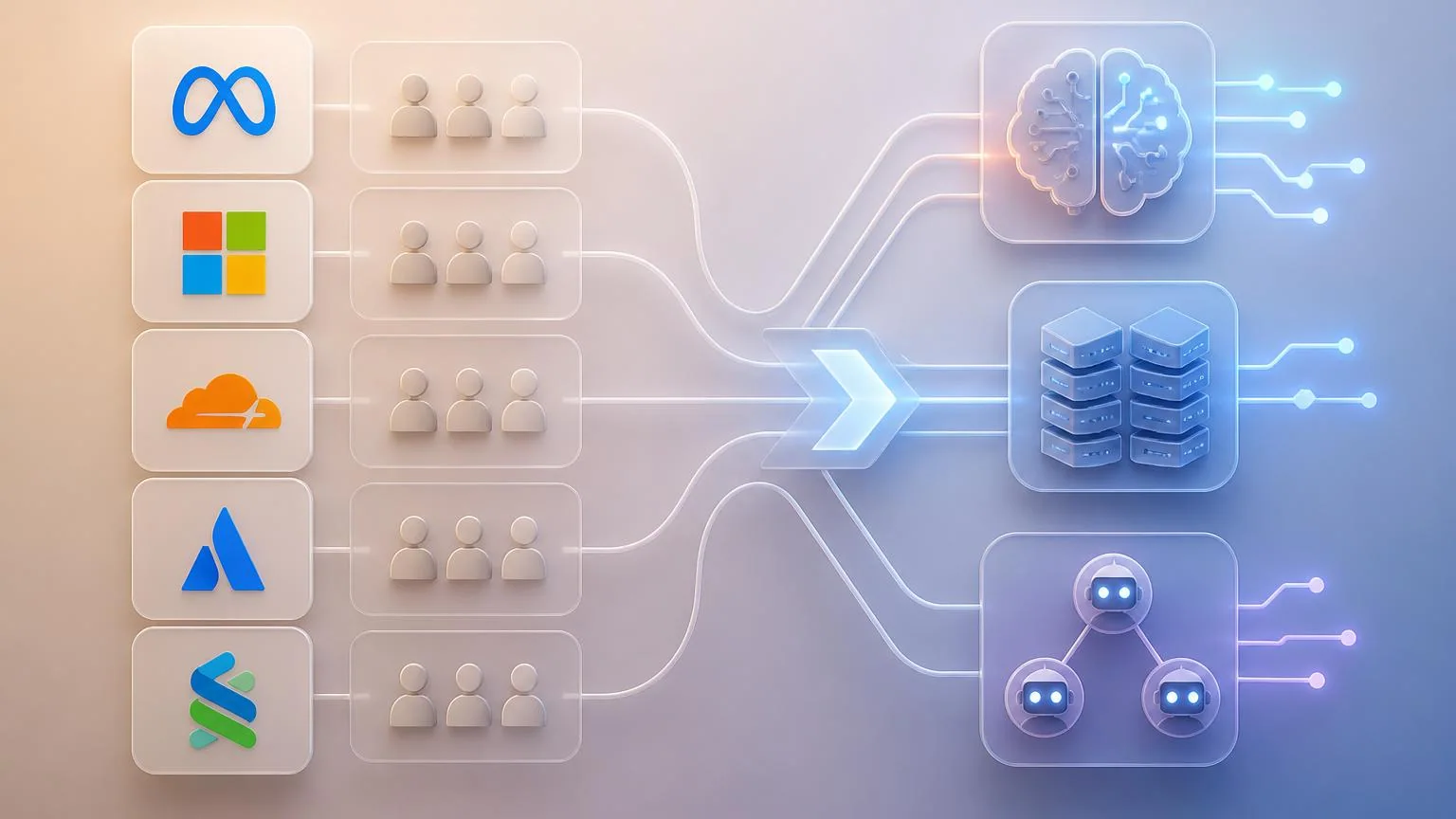
On May 23, 2026, the clearest way to read the latest wave of AI-linked layoffs is as three different stories hiding under one headline. Recent moves from Meta on May 18 and May 20, Standard Chartered on May 19, and earlier announcements from Cloudflare on May 7, Microsoft on April 23, and Atlassian on March 11 all invoked AI in some way. But they do not show the same thing. Some companies are saying AI is already changing how much work needs to be done by people, some are trimming or reshaping headcount to free budget for AI infrastructure and AI talent, and some are using AI language inside a broader restructuring story.
That distinction matters because “AI layoffs” is now doing too much work as a phrase. If leaders treat every cut as proof that agents are broadly replacing white-collar work right now, they will misread both the labor signal and the automation opportunity.
The three buckets inside the 2026 AI layoff story
- Task replacement: the company explicitly argues that AI systems, automation, or agents have changed the amount of human labor required in a workflow.
- Budget reallocation: the company reduces hiring or headcount while spending heavily on data centers, compute, chips, model access, or AI specialist talent.
- AI as layoff narrative: AI is part of the public explanation, but the underlying move also reflects margin pressure, sales priorities, org simplification, or investor messaging.
Most of the current headlines sit in the second or third bucket. Only a smaller number look like clean, immediate evidence that AI itself is directly displacing a defined set of tasks.
Which recent companies fit each bucket
Cloudflare is the clearest recent task-replacement case
Cloudflare paired strong first-quarter 2026 results with a plan to cut about 1,100 employees as part of what it called an agentic AI-first operating model. In its May 7 founder letter, the company said its internal AI usage had increased by more than 600% in the prior three months and that employees across engineering, HR, finance, and marketing were running thousands of AI agent sessions each day. Cloudflare also said the move was not a cost-cutting exercise, which makes this one of the clearest public cases where a company is arguing that AI-driven productivity changed the headcount it needs.
That still does not prove every eliminated role was fully automated end to end. But among recent examples, Cloudflare is closest to saying that AI has already altered internal labor demand in a measurable way.
Standard Chartered looks like slower, more structured automation
Standard Chartered said on May 19 that it would eliminate more than 7,000 jobs over the next four years as it increased AI adoption and automation, especially across corporate functions and back-office centers. Its CEO framed the plan as replacing some lower-value human capital with technology and investment capital, while also offering reskilling options. That makes Standard Chartered another real displacement story, but with a longer runway and a more process-heavy banking context than Cloudflare.
If Cloudflare is the fast software-company version of AI labor substitution, Standard Chartered is the slower banking version: more staged, more operational, and more concentrated in repeatable internal work.
Meta looks more like capital reallocation plus org redesign
Meta’s May restructuring is harder to read as a pure replacement story. Reuters reported that Meta’s May 20 layoffs of 10% of the workforce were paired with plans to move 7,000 employees into AI-related initiatives and to close 6,000 open roles. Separately, Meta raised its 2026 capital expenditure forecast to $125 billion to $145 billion on April 29 as it doubled down on AI infrastructure. That combination points less to a simple “AI did this job already” explanation and more to a payroll-and-structure reset designed to support a much larger AI buildout.
In other words, Meta appears to be reallocating organizational capacity toward AI workflows, flatter teams, and capital-intensive infrastructure rather than offering clean evidence of one-for-one AI replacement across the company. The transfers into AI teams are the giveaway.
Microsoft is also better read as spend redirection than direct replacement
Microsoft’s April 23 move was not framed as a broad layoff but as the company’s first voluntary employee buyout program. Even so, it landed in the middle of a period when Microsoft was under pressure to keep funding very large AI investments. In its fiscal Q3 2026 performance update, Microsoft said gross margin was pressured by continued investments in AI infrastructure and growing AI product usage, operating expenses rose because of research-and-development compute capacity, AI talent, and data, and total company headcount declined year over year.
That puts Microsoft in the budget-reallocation bucket more than the task-replacement bucket. The signal is not that Microsoft publicly proved AI had taken over a specific class of jobs. The signal is that AI infrastructure and AI product economics are now important enough to shape workforce size and staffing mix.
Atlassian is the best mixed-motive example
Atlassian said on March 11 that it would cut about 1,600 jobs, or roughly 10% of staff, to self-fund further investment in AI and enterprise sales while strengthening its financial profile. Importantly, the company’s own message said the move was not primarily “AI replaces people,” even while acknowledging that AI changes the mix of skills required and the number of roles needed in some areas.
That makes Atlassian the cleanest example of why some “AI layoffs” headlines are really mixed-motive restructurings. AI matters in the story. But so do go-to-market priorities, profitability targets, org speed, and portfolio focus. Treating this as pure automation would oversimplify what the company itself said.
What the trackers show
The company-by-company ambiguity does not mean the broader trend is fake. Challenger, Gray & Christmas said AI was the top cited reason for U.S. job cuts for the second straight month in April 2026. Employers announced 83,387 cuts in April, and 21,490 of them were tied to AI, or 26% of the monthly total. Through April, Challenger counted 49,135 AI-cited cuts in 2026, about 16% of all announced job cut plans, while technology led all sectors with 85,411 cuts year to date.
Layoffs.fyi’s live tracker, meanwhile, showed 114,210 tech employees laid off across 150 tech companies in 2026 at the time of the latest crawl. That does not mean all of those cuts were AI-driven. It does mean AI is now arriving in a labor market that is already structurally softer than many executives were willing to admit a year ago.
Why the label matters for AI buyers
For operators and enterprise buyers, the practical lesson is that the mechanism matters more than the headline. If a company looks like Cloudflare or Standard Chartered, the question is whether a specific workflow really can be absorbed by agents, automation, or smaller AI-augmented teams. If it looks more like Meta or Microsoft, the question is financial: are payroll, management layers, and hiring plans being compressed to make room for compute, chips, data-center capacity, and specialist AI talent. If it looks like Atlassian, the honest answer is often both: AI is part of the reason, but not the whole reason.
This is where many businesses go wrong. They copy the optics of an AI-first workforce move before they have measured where AI actually creates throughput, where it only changes budget priorities, and where human oversight becomes more important rather than less. A board can save money by cutting staff. That is not the same as proving it has built a reliable agentic operating model.
What to watch next
- More companies will separate AI-native roles and AI-adjacent capital spending from ordinary headcount reporting.
- Infrastructure-heavy firms will keep testing whether payroll savings are meaningful against rising model, cloud, and data-center costs.
- The most credible AI displacement stories will come from narrow functions with measurable throughput gains, not blanket company-wide rhetoric.
- Enterprises will face more pressure to prove automation ROI in workflow metrics, not just in anecdotal productivity claims.
The bottom line is that 2026’s AI-linked layoffs do not yet prove that AI is broadly replacing white-collar labor at scale. They do prove something narrower but still important: AI is already changing org design, budget allocation, and how executives justify workforce decisions. For teams building AI agents and automation, the next advantage will come from knowing which work can truly move to software, which costs are really moving to infrastructure, and which companies are using AI language to describe a broader restructuring that would likely have happened anyway.