
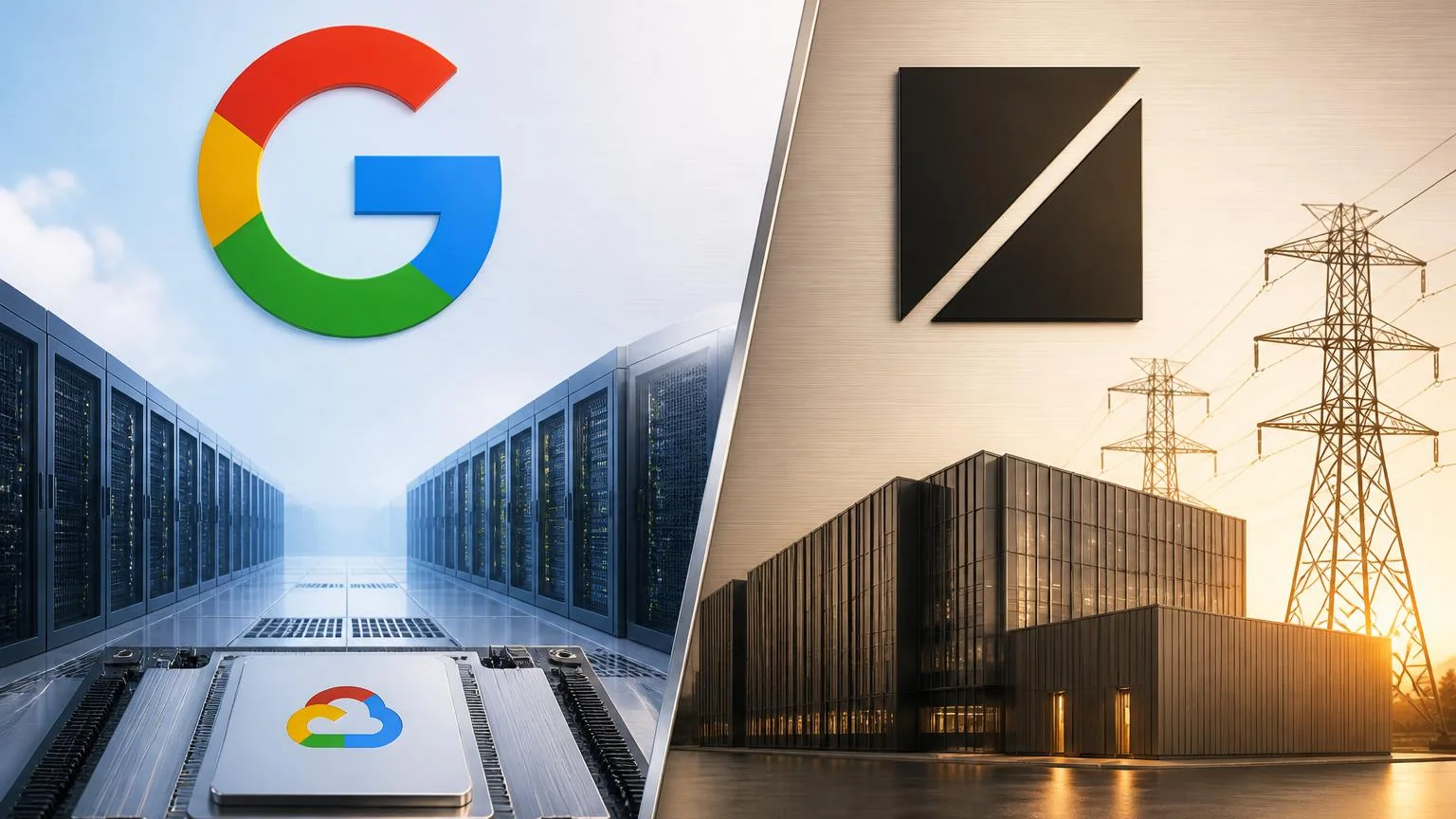
On May 18, 2026, Blackstone and Google announced a new U.S.-based joint venture that will offer data center capacity, networking, operations, and Google Cloud Tensor Processing Units as a compute-as-a-service business. Blackstone said it will make an initial $5 billion equity commitment, target the first 500 megawatts of capacity in 2027, and scale the company over time, with longtime Google infrastructure executive Benjamin Treynor Sloss named as CEO.
This is bigger than a financing headline. Google is effectively creating a new distribution path for TPUs outside the standard Google Cloud buying motion, while Blackstone is using its capital and data center footprint to turn AI compute into a dedicated infrastructure platform. For businesses building AI agents, large-scale inference systems, or custom model programs, that is a meaningful market shift.
What Google and Blackstone actually announced
According to Blackstone’s announcement, the new company will provide customers with another way to access cloud TPUs in addition to using them through Google Cloud directly. Google will supply the hardware, including TPUs, along with software and services, while Blackstone funds and helps scale the physical infrastructure behind the business.
The core terms disclosed so far are unusually concrete for an AI infrastructure launch. Blackstone committed an initial $5 billion in equity capital, said the first 500 MW of capacity is expected to come online in 2027, and framed the platform as a long-term build rather than a narrow pilot. That matters because the AI infrastructure market is moving from one-off chip deals toward full-stack supply arrangements that bundle land, power, cooling, networking, software, and accelerator access into one offering.
The venture also sharpens Google’s TPU strategy. Instead of keeping TPUs only as an internal advantage and a Google Cloud feature, Google is now helping create a separate vehicle that can package TPU access as a standalone compute business.
Why this matters more than another cloud partnership
The most important signal is not simply that Google found another capital partner. It is that TPU access is becoming a product category with its own operating model. That suggests demand for Google’s custom silicon is now large and durable enough to support a dedicated external platform.
Google has already been positioning its latest TPU generation for what it calls the agentic era, where AI systems have to reason through problems, execute multi-step workflows, and serve latency-sensitive inference at scale. Its recent TPU roadmap split training and inference into specialized designs, which reflects a market that now cares less about raw model demos and more about sustaining production workloads efficiently.
This new venture fits that shift. Agent workloads do not just need benchmark-winning models. They need dependable power, dense inference capacity, high memory bandwidth, orchestration-friendly infrastructure, and procurement paths that enterprises can actually buy through. A separate TPU cloud company gives Google another way to meet that demand without forcing every customer into the same commercial and operational model.
Business impact for AI infrastructure buyers
For buyers, the practical takeaway is choice. Companies that want Google silicon may soon have a route that looks more like dedicated AI infrastructure procurement and less like a conventional public-cloud purchase. That could appeal to organizations with very large recurring inference demand, custom deployment requirements, or longer planning horizons around capacity.
It also raises the competitive pressure on the rest of the market. NVIDIA-powered clouds, hyperscaler AI stacks, sovereign infrastructure projects, and private-capital-backed data center platforms are all racing to secure the same thing: durable demand from enterprises and labs that expect AI usage to keep growing. Google and Blackstone are now making the case that TPUs deserve a bigger share of that market.
There is a second-order implication for enterprise AI teams as well. As infrastructure providers separate training, inference, networking, and deployment models more aggressively, AI architecture choices will increasingly affect finance and operations decisions, not just engineering ones. Teams may need to think earlier about whether a workload belongs on general cloud, reserved accelerator capacity, or a more dedicated AI infrastructure arrangement.
What to watch next
The next questions are straightforward but important. First, how broadly will this new TPU cloud be sold: to frontier labs and very large buyers only, or to a wider enterprise market over time? Second, how much of the value proposition will come from pricing and access, versus bundled infrastructure services and operational support? Third, will Google use this structure as a template for expanding TPU distribution further beyond its traditional cloud channels?
The 500 MW target is also worth watching closely. If the venture brings that capacity online on schedule in 2027, it will reinforce a broader point that now keeps showing up across the AI market: compute is no longer just a supplier issue. It is becoming a strategic product in its own right.
For AI agents and enterprise automation, that matters because infrastructure constraints increasingly shape what can be deployed reliably in production. The more agent systems move from chat interfaces to persistent, tool-using, high-volume workflows, the more valuable specialized compute distribution becomes. Google and Blackstone are betting that this demand is now large enough to justify an entirely new business around it.