
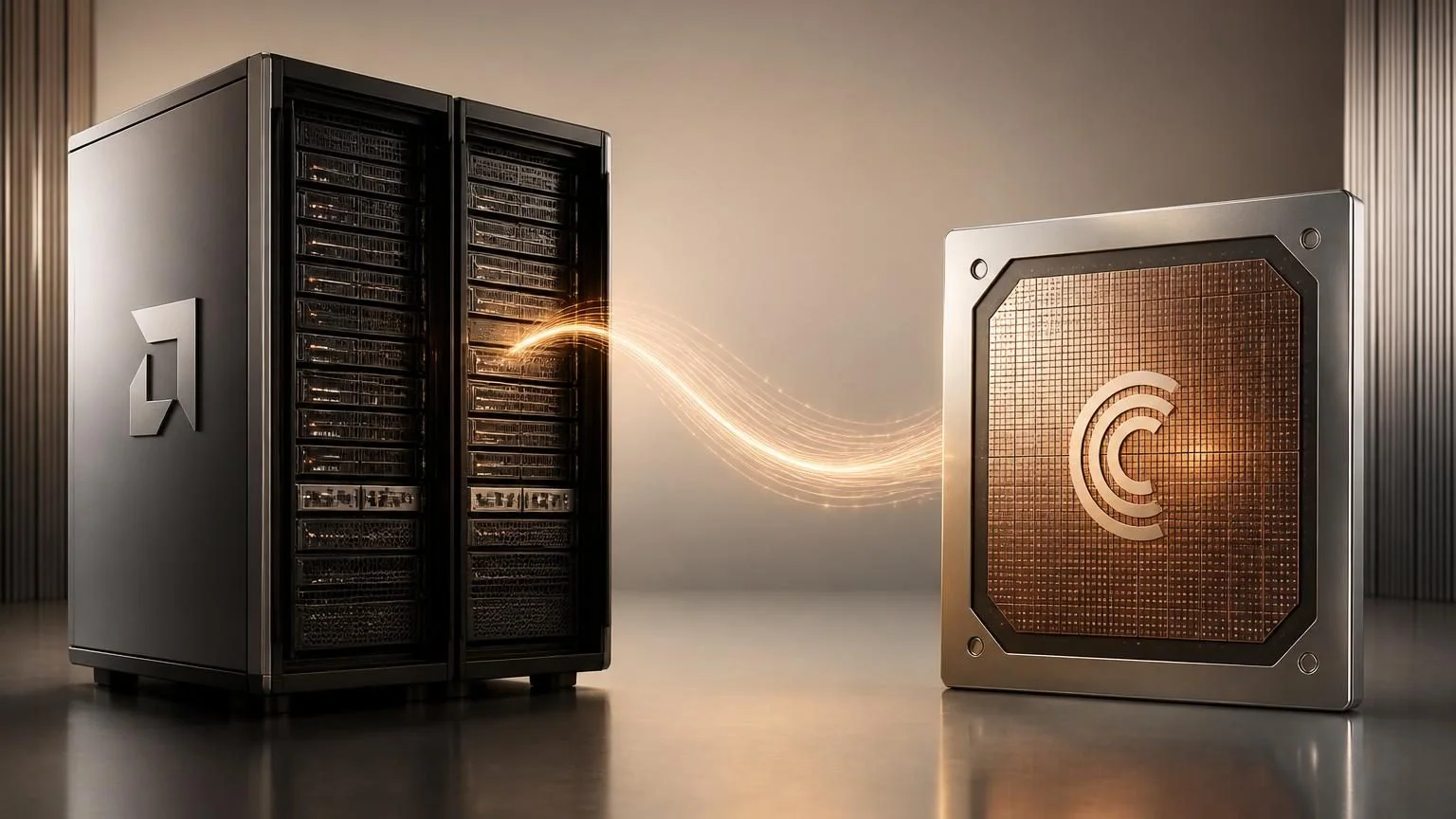
AMD and Cerebras announced a new inference partnership on July 23, 2026 that separates two expensive parts of serving an AI model: processing prompts and generating the next tokens. AMD Helios is intended to handle high-throughput prefill work, while Cerebras Wafer-Scale Engine systems are intended to accelerate low-latency decoding. That architecture matters because the infrastructure requirements for a long document analysis are not the same as those for a live coding assistant or a customer-facing agent.
The companies say the combined system will be offered first through Cerebras Cloud in the second half of 2026. Their stated performance expectations should be treated as vendor targets until independently validated, but the operational idea is the larger news: inference is becoming a workflow-design decision, not simply a model-hosting decision.
What AMD and Cerebras announced
The partnership combines AMD Helios rack-scale infrastructure with Cerebras Wafer-Scale Engine technology in one disaggregated inference workflow. According to the companies, Helios will serve as the high-throughput engine for prompts and large context windows, while Cerebras will focus on the memory-bandwidth-intensive decode phase that determines how quickly a user sees a response.
AMD and Cerebras say the design is aimed at workloads where both scale and response time matter, including coding tools, real-time copilots and agentic systems. They also say Cerebras plans to deploy Helios in its own data centers, with initial availability through Cerebras Cloud targeted for the second half of 2026.
Why split inference matters for AI agents
Many business agents do not have one consistent performance profile. An agent may need to read a long policy file, search a large knowledge base, call tools, then deliver a short response while a customer waits. Treating every stage as the same compute problem can raise cost or leave the interaction feeling slow.
The new partnership makes the alternative explicit: route prompt-heavy and context-heavy work toward throughput-oriented infrastructure, while reserving low-latency capacity for the step that affects conversational responsiveness. This is not a requirement for every deployment. Batch research, back-office classification and overnight reporting often benefit more from predictable throughput and cost controls than from instant token delivery.
The business decision is latency by workflow, not hype by model
Teams evaluating agent infrastructure should first identify which delay is actually expensive. A slow internal research summary may be acceptable; a delayed sales-assist reply, escalation triage recommendation or live support handoff may not be. The decision should measure end-to-end workflow time, including retrieval, tool execution, approvals and monitoring—not only tokens per second.
That makes the AMD-Cerebras announcement useful beyond the two vendors. It reinforces a practical deployment pattern: segment workloads by their latency sensitivity, establish approval boundaries for actions, and test the agent against the full operational path. Faster inference is valuable when it improves completion rates, handoff quality or customer experience; it is not automatically the right optimization for every task.
What to watch next
The key test will be implementation. The companies have announced a target of up to five times higher tokens per second per watt for the joint design, and availability through Cerebras Cloud is planned for the second half of 2026. Buyers should watch for production availability, supported models, routing behavior, pricing, observability tools and independent measurements across real agent workflows.
For AI leaders, the durable takeaway is clear: as agents move from experiments to live operations, infrastructure choices will increasingly be made per workload stage. The winning stack may be the one that can trade off responsiveness, throughput, governance and operating cost with the least complexity.