
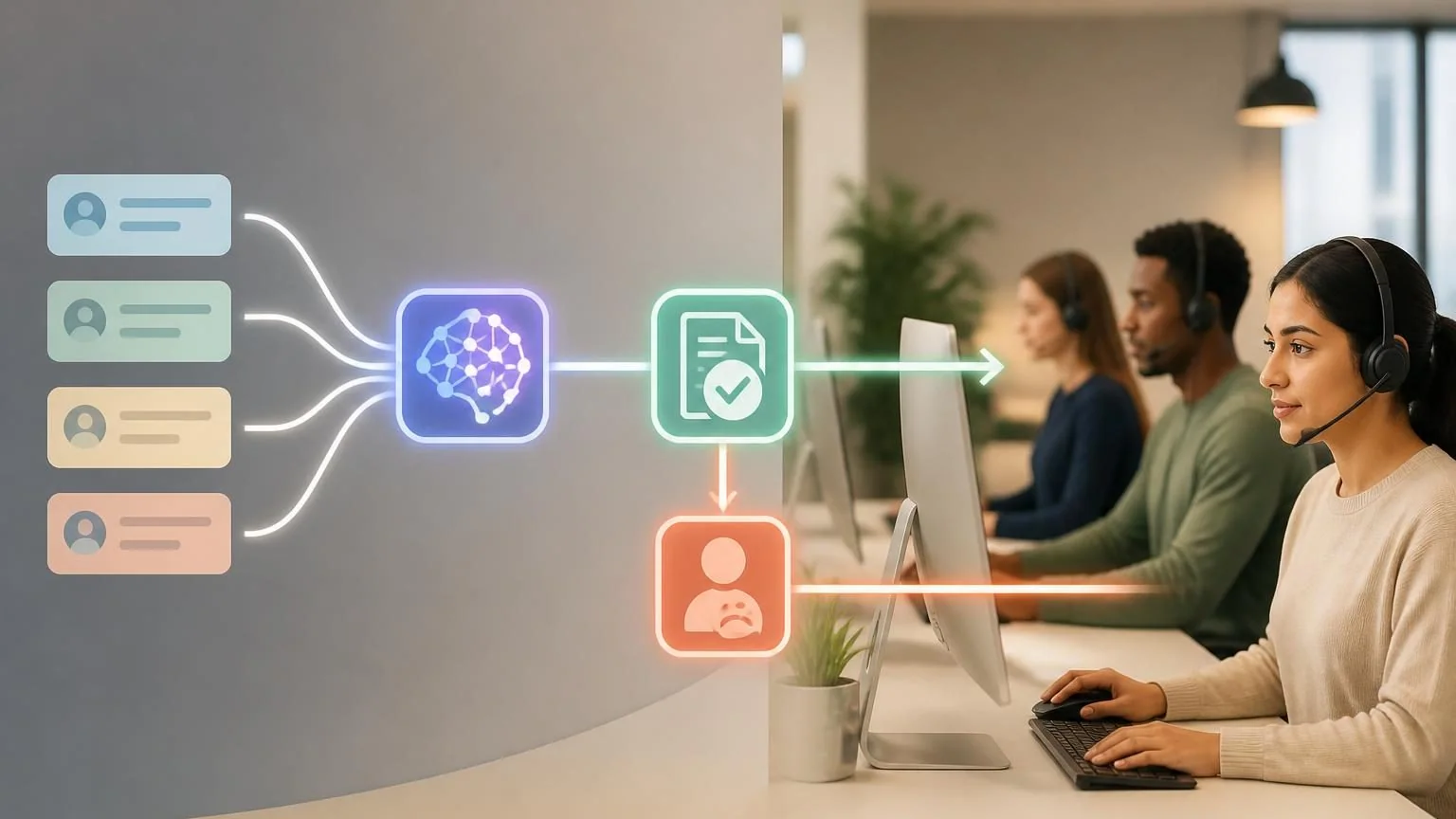
Direct answer: Yes. AI can handle a meaningful share of customer service when the work is bounded by approved knowledge, clear policies, limited actions, and reliable human escalation. It is strongest at intake, classification, answering stable questions, drafting responses, updating records, and completing low-risk requests. People should retain emotionally sensitive, ambiguous, regulated, exceptional, or financially consequential decisions.
What AI can handle in customer service
Customer service is not one task. It combines reception, identity checks, information retrieval, diagnosis, policy interpretation, system actions, communication, and relationship repair. AI is useful when those components can be separated and assigned different authority levels rather than handed to one unrestricted chatbot.
A well-designed service agent can receive requests across a website, inbox, messaging channel, or phone system; collect missing details; identify intent and urgency; retrieve an answer from approved material; draft or send an allowed response; update the support record; and route the case when its authority ends. The value comes from completing a controlled workflow, not merely producing conversational text.
Strong early use cases include order-status questions, appointment changes, account navigation, product or policy questions with stable answers, ticket classification, after-hours intake, and response drafting. Weak early use cases include disputed charges, safety complaints, legal threats, vulnerable customers, unusual exceptions, and any request whose resolution depends on undocumented judgment.
| Service activity | Suitable AI role | Human ownership |
|---|---|---|
| Intake and triage | Collect details, classify, prioritize, and route | Define urgency rules and review misroutes |
| Knowledge questions | Answer from approved, current sources with citations | Own policy and source accuracy |
| Routine account requests | Complete allowlisted, reversible actions | Approve permissions and exception rules |
| Complex troubleshooting | Gather evidence and recommend next steps | Diagnose novel or consequential failures |
| Complaints and disputes | Summarize history and prepare the handoff | Resolve the relationship and authorize remedies |
Choose automation by consequence, not message volume
A frequent question is not automatically safe to automate. Score each request type by how clearly it can be identified, whether the answer is grounded in controlled information, the consequence of a mistake, whether an action can be reversed, and whether completion can be verified. High volume improves the business case only after those controls are credible.
Use an authority ladder. At the lowest level, AI observes and summarizes. Next it drafts for review. Then it may send answers or execute low-risk actions within explicit limits. Sensitive actions require approval, and prohibited actions always move to a person. The same request can change levels: an ordinary delivery question may be autonomous, while a delivery claim involving medication or a large loss should escalate.
Avoid using confidence scores as the only gate. A model can sound confident when context is incomplete. Combine confidence with deterministic conditions such as customer type, requested action, transaction amount, policy age, complaint language, and whether the required source or system is available.
- Automate: stable questions, structured intake, classification, routine updates, and reversible actions.
- Assist: investigation, personalized drafting, troubleshooting, and recommendations that a person verifies.
- Escalate: ambiguity, repeated failure, strong emotion, unusual exceptions, identity uncertainty, or policy conflict.
- Prohibit: final regulated decisions, unrestricted refunds, policy invention, credential disclosure, and concealment of uncertainty.
Ground answers in approved service knowledge
A customer service agent should retrieve from a defined source of truth rather than answer from general model memory. Approved sources may include current help-center articles, product documentation, account records, service policies, and structured troubleshooting guides. Each source needs an owner, review date, audience, and rules for resolving conflicts.
Retrieval does not fix poor knowledge. Duplicate articles, expired policies, inaccessible account data, and contradictory instructions will produce inconsistent service. Before launch, sample real tickets and trace the correct answer back to its source. Remove or label stale material, separate public guidance from internal procedures, and prevent one customer’s data from appearing in another customer’s response.
When the required source is missing or unavailable, the agent should say what it cannot verify and route the case. It should never invent a policy, delivery state, account balance, eligibility decision, or completed action. For material claims, retain the source passages or system results used so a reviewer can reconstruct the answer.
Design a handoff customers do not have to restart
Escalation is part of the product, not an admission that automation failed. A useful handoff transfers the customer’s stated goal, verified identity status, concise conversation summary, relevant records, steps already attempted, unresolved question, detected urgency, and the exact reason human authority is required. The person should not have to ask the customer to repeat everything.
Tell the customer when the interaction is moving to a person and set a realistic expectation for the next response. Do not claim a live representative has joined until one has accepted the case. Preserve the original messages alongside any AI summary because summaries can omit details or flatten emotion.
Give service staff a clear way to correct classification, knowledge selection, and proposed actions. Those corrections should become reviewed evaluation cases, not automatically become new policy. Track transfer accuracy, time to human acceptance, repeated explanations, reopened cases, and whether the escalation reached someone with authority to resolve it.
Protect customers, accounts, and service systems
Treat every customer message and attachment as untrusted input. Requests may contain prompt injection, malicious links, false identity claims, or instructions to reveal internal information. The agent should have narrow tools whose permissions are enforced outside the model, and retrieved content must never grant itself additional authority.
Apply identity verification before exposing account information or changing a record. Minimize the personal information sent to the model, define retention rules, redact secrets from logs, and keep customer data separated by account and tenant. For outbound communication, restrict destinations and prevent a conversation from silently changing the recipient.
Sensitive actions should bind approval to an exact customer, action, amount, and payload. Log the proposed action, policy decision, approval, tool result, and final customer message. Operators need immediate controls to pause the agent or revoke one integration without shutting down the entire support operation.
- Use dedicated, least-privilege service identities instead of shared administrator credentials.
- Validate tool inputs and allowlist actions, destinations, record types, and value ranges.
- Test cross-customer data leakage, instruction injection, forged urgency, and repeated action requests.
- Fail closed when identity, policy, source data, or action confirmation is missing.
Pilot with service outcomes, not deflection alone
Begin with one or two request types that have stable policies, enough historical examples, and a clear definition of resolution. Run the agent in observation or draft mode, compare its choices with experienced staff, and build a test set containing normal cases, incomplete requests, exceptions, adversarial language, outdated knowledge, and unavailable systems.
Measure correct resolution, first-contact resolution, reopens, transfers, transfer quality, customer satisfaction, handling time, and complaints. Deflection rate by itself rewards making it difficult to reach a person. A customer who leaves without help is not a successful automated resolution. Review performance separately by request type and customer group so aggregate results do not hide harm.
Expand only when the agent meets a written quality threshold and the team can investigate failures. Re-run evaluations after changes to prompts, models, tools, policies, or knowledge. Keep a named service owner accountable for customer outcomes and a technical owner accountable for availability, access, logs, and incident response.
A practical deployment sequence
Map the current service queue before choosing a product. Identify the highest-volume intents, their correct sources, required systems, average handling time, escalation reasons, and current quality. Select a narrow workflow where the agent can complete a useful outcome without broad authority.
Define the authority ladder and handoff contract, clean the relevant knowledge, connect systems with scoped identities, and create evaluations from real cases. Launch internally or to a small segment, review transcripts and outcomes daily, and fix the underlying workflow rather than adding vague prompt warnings.
The target is dependable capacity: faster routine help, better prepared agents, longer coverage, and consistent records without trapping customers inside automation. If oversight, corrections, and escalations consume more effort than the agent removes, reduce the scope until the operating result is positive.