
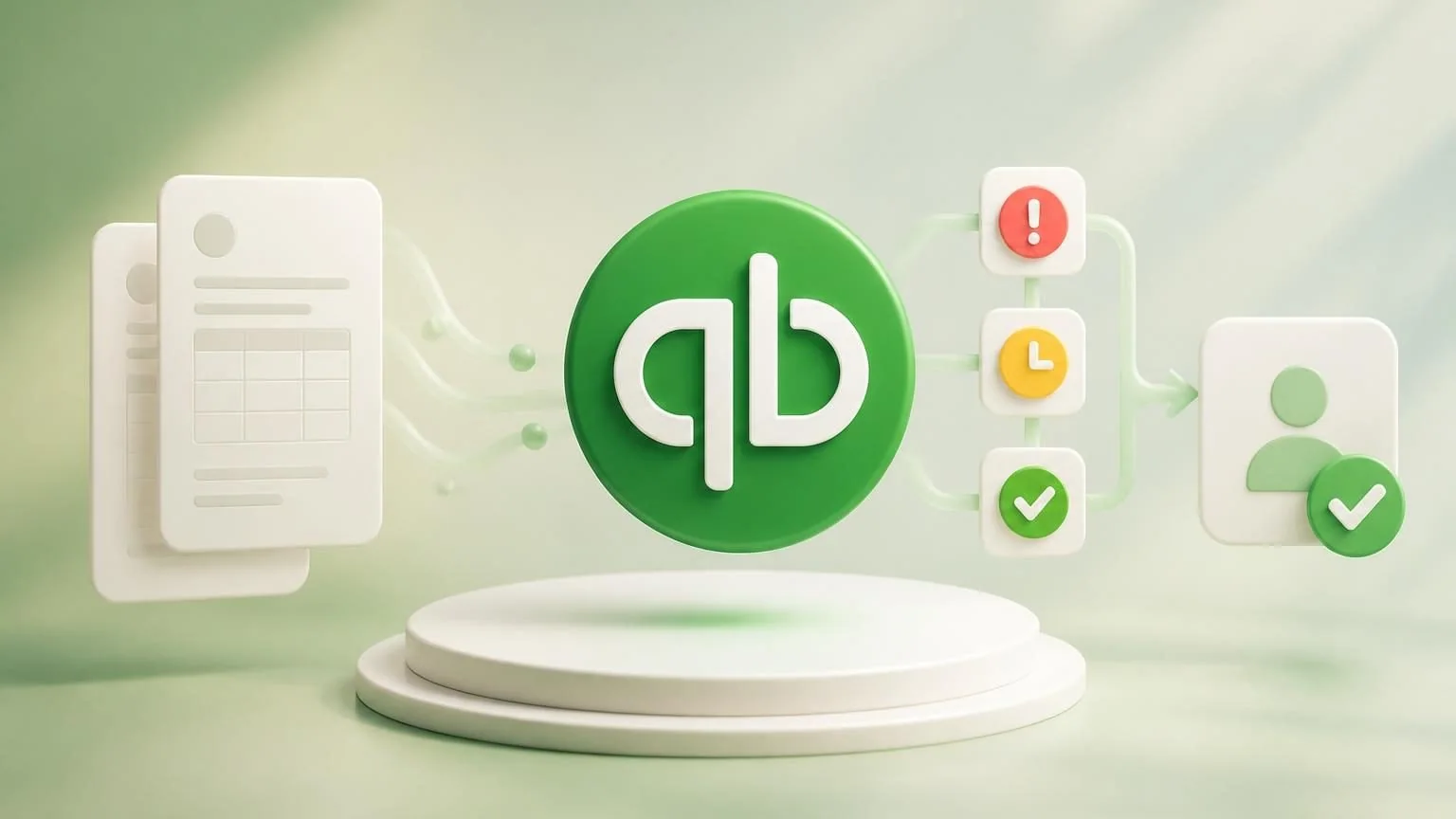
QuickBooks is the system being integrated, the workflow outcome is faster invoice follow-up and cleaner cash-flow triage, and the integration should accomplish one thing well: read the minimum accounting context needed, recommend or draft the next action, and send any meaningful financial change back to a human before it touches the books.
That design choice matters because QuickBooks already has built-in AI experiences inside the product. A custom AI integration should not try to replace every native feature. It should handle the cross-system reasoning QuickBooks does not own well on its own, such as combining overdue invoice data, customer history, inbox context, CRM notes, and approval rules into one governed workflow.
What a QuickBooks AI integration should actually own
The safest QuickBooks AI projects are narrow. Do not start with “let the agent manage accounting.” Start with a bounded finance workflow that has a clear trigger, known inputs, and a human checkpoint.
- Good first jobs: overdue invoice follow-up, estimate drafting support, exception triage, customer payment-risk summaries, and handoff preparation for finance staff.
- Bad first jobs: autonomous reconciliation, uncontrolled bill edits, direct payment actions, broad ledger changes, or open-ended access across every entity in the company file.
In practice, most teams want the agent to do three things: detect that attention is needed, assemble the right context quickly, and produce a draft recommendation or message that a finance owner can approve. That keeps QuickBooks as the ledger of record while still giving the business a meaningful time-saving workflow.
Design permissions around accounting risk, not convenience
QuickBooks integrations fail when teams authorize too much access just because the API allows it. Permission design should follow workflow risk.
Read access should be job-specific
For invoice follow-up, the agent usually needs read access only to the records that explain collection status: customer details, invoice status, due dates, balances, prior payments, and any custom fields or tags your team uses for collection rules. If the workflow also uses CRM or inbox data, that context should stay in those systems rather than being copied back into QuickBooks unnecessarily.
A good rule is simple: if a field does not help the agent decide whether to draft a reminder, escalate a dispute, or route a finance task, do not expose it by default.
Write access should be narrow, delayed, and reversible
Most finance teams should avoid giving an AI agent free write access to posted accounting records. The better pattern is draft-first execution. Let the agent create a proposed reminder, a suggested internal note, a task for a collector, or a staged status value in an approved field. Only after human review should the workflow update a live record, send a payment-related message, or create a downstream action in another system.
If you need the agent to write back into QuickBooks, use dedicated fields, clearly named statuses, or tightly controlled note surfaces. Do not let the model overwrite core accounting data just because it can.
Concrete workflow example: overdue invoice to approved follow-up
One practical starting point is overdue invoice triage for a finance or operations team.
- Trigger: an invoice moves past due, or a periodic sync finds invoices that crossed a follow-up threshold.
- Context: the workflow pulls the invoice amount, due date, aging bucket, customer payment history, open disputes, recent support activity, and any account-owner notes from the CRM.
- Action: the agent classifies the case into a small set of outcomes such as routine reminder, likely dispute, payment-plan candidate, or high-touch account escalation. It then drafts the recommended customer message and an internal summary for the finance owner.
- Human handoff: a collector, account manager, or finance lead approves the message, edits it, or rejects it. Only after approval does the workflow send the communication or update the next-step status.
This kind of workflow is valuable because the AI is doing reasoning and preparation, not unsupervised bookkeeping. The human still controls the customer-facing step and any changes that affect money, promises, or accounting records.
Implementation path: keep QuickBooks as the ledger, not the conversation layer
A durable implementation usually has four parts.
- Event detection: use a webhook-driven design where possible, and add periodic change polling as a backstop so missed events do not silently break the workflow.
- Context assembly: fetch only the QuickBooks entities relevant to the job, then join them with the external systems that actually hold communication history or approval ownership.
- Reasoning and staging: let the agent produce a classification, summary, and draft next step outside the ledger first.
- Approval and sync: once a human approves, write back only the minimum status update or note required for traceability.
This is also where teams should separate built-in QuickBooks AI from a custom external agent. Use QuickBooks’ native AI for in-product assistance where it already fits. Use an external agent when the real workflow crosses email, CRM, customer support, or internal approval systems and needs governed orchestration across them.
Risks, monitoring, and failure handling
Finance workflows need operational guardrails, not just better prompts.
- Queue work asynchronously: do not perform heavy processing inside the event listener itself.
- Protect against duplicates: finance follow-up logic should be idempotent so the same overdue invoice does not trigger multiple reminders after retries.
- Log every decision: store what triggered the workflow, what context was used, what the model recommended, who approved it, and what was finally written back.
- Define hard stops: if required context is missing, a customer has an open dispute, or the invoice exceeds a risk threshold, the workflow should escalate directly to a human instead of improvising.
- Review misses regularly: every finance AI workflow needs a weekly review of false positives, missed escalations, and drafts that humans keep rewriting.
The goal is not just speed. It is trustworthy speed. If the agent saves time but creates uncertainty around collections, customer promises, or record integrity, the workflow is not production-ready.
When to use an AI agent instead of a simple automation
Use a normal automation if the rule is deterministic: when an invoice becomes 7 days overdue, assign a task; when a field changes, notify finance; when a payment arrives, update a dashboard. Those flows do not need model judgment.
Use an AI agent when the workflow requires interpretation across messy signals. Examples include deciding whether an overdue invoice looks like a dispute or a routine delay, tailoring a follow-up message based on account history, or summarizing several systems before handing the case to a human.
If that reasoning still leads to a money-related action, keep approval in the loop. QuickBooks is too important to treat as an unrestricted playground for a model. The best integration is the one that makes finance faster while preserving trust in the books.