
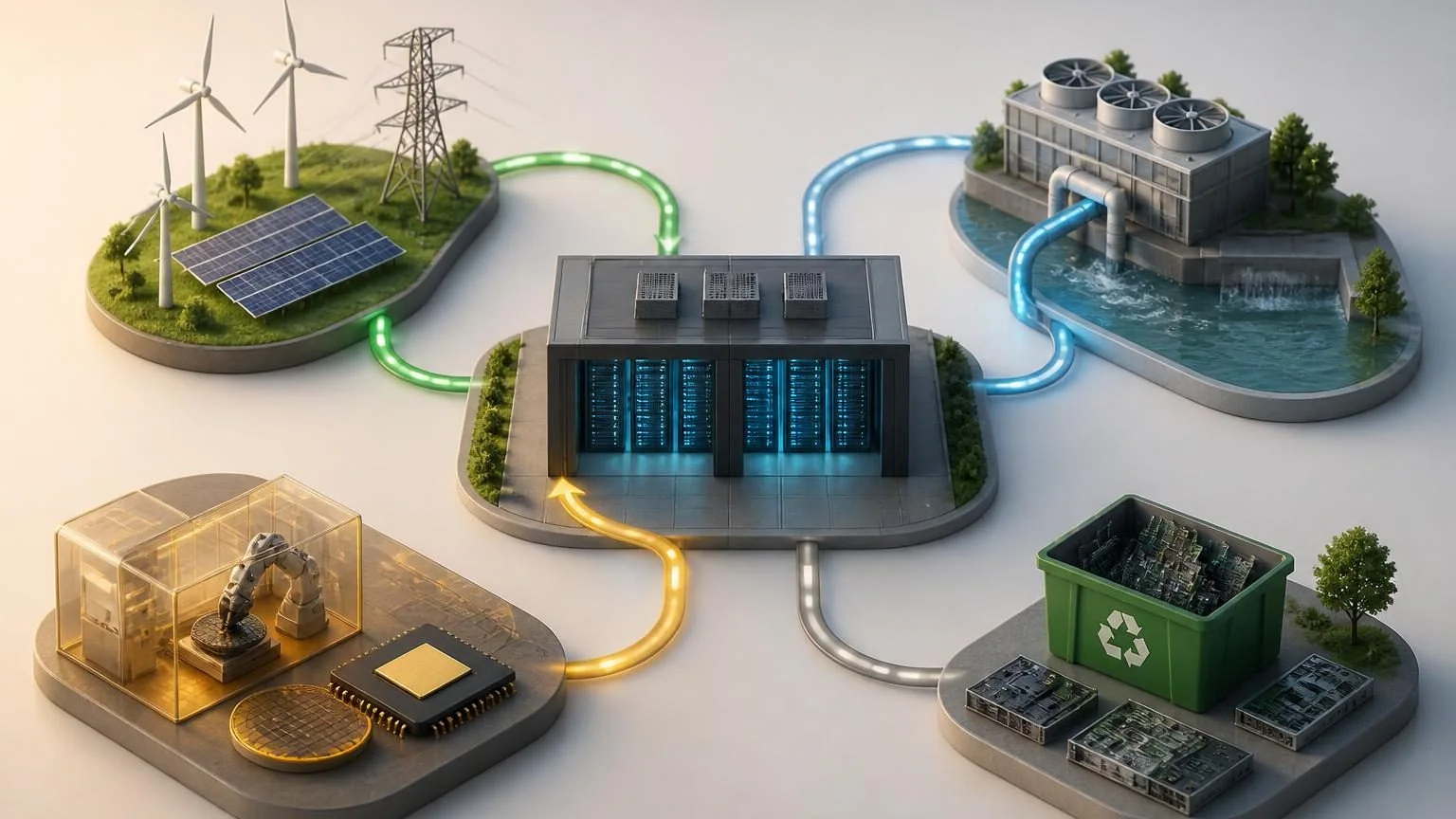
Direct answer: AI can be environmentally harmful, but there is no single footprint for “AI.” Training and serving models consume electricity; data centers and chip production use water and materials; hardware has embodied emissions and creates waste. Impact varies widely. Evaluate the complete service, regional energy mix, utilization, lifecycle, and whether the application causes more activity or displaces a higher-impact process.
The footprint starts before the first prompt
Building accelerators, servers, networking equipment, data centers, and power infrastructure requires mining, manufacturing, transport, concrete, steel, and chemicals. Those embodied impacts can be significant and are not visible in an electricity meter during use. Short replacement cycles can add electronic waste before equipment reaches its technical end of life.
Operational impact then comes from model development, training runs, evaluation, inference, storage, networking, and cooling. Consumer devices also use energy. A credible assessment states which lifecycle stages and organizational boundaries are included instead of presenting one convenient number as the whole environmental cost.
Electricity impact depends on place and time
The same amount of computation can cause different greenhouse-gas emissions depending on the power grid, contractual procurement, backup generation, and when the work runs. Annual renewable-energy matching does not necessarily mean every workload is supplied by carbon-free electricity at every hour or location.
Report energy consumption and emissions separately. Distinguish location-based emissions, which reflect the regional grid, from market-based accounting, which incorporates qualifying contractual instruments. Describe assumptions and avoid claiming a service is “green” or “carbon-free” from an offset or certificate without explaining its scope.
Water use is local, seasonal, and easy to obscure
Data centers may consume water directly for cooling, while electricity generation and semiconductor fabrication create indirect water demands. A liter used in a water-stressed basin during a hot period has a different consequence from the same volume elsewhere. Cooling designs also trade water, energy, cost, and reliability.
Organizations should identify withdrawals and consumption, source, basin stress, season, and whether water is potable or reclaimed. Company-wide annual totals cannot show the effect of one model or facility. Avoid converting a prompt into a fixed bottle-of-water analogy unless the study’s exact system boundary, workload, climate, and uncertainty apply.
Per-prompt comparisons are usually incomplete
Energy per request changes with model size and architecture, input and output length, reasoning effort, batching, caching, quantization, hardware, utilization, data-center overhead, and traffic. Image, video, and long-context generation can differ from short text. Providers often disclose too little for independent calculation.
A defensible estimate measures actual workload energy where possible and reports a range with assumptions. Compare a completed business or user outcome, not an isolated API call. A smaller model that requires ten failed attempts may consume more than a larger model that completes the task once; an AI workflow that stimulates unlimited low-value generation can erase efficiency gains.
AI can also support environmental work
Systems can help forecast power demand, optimize buildings and routes, analyze satellite imagery, discover materials, monitor equipment, and improve climate modeling. Benefits are not automatic. A pilot must compare against a baseline and include sensors, computing, operational changes, rebound effects, and the consequence of errors.
Do not subtract a speculative global benefit from a measured corporate footprint. Keep enablement claims separate and document causality: what decision changed, what resource use decreased, for how long, and what else changed. Some applications, such as accelerating fossil exploration or disposable content, can increase environmental pressure even when the model itself is efficient.
Reduce impact through architecture and procurement
Start by asking whether AI is needed. Use retrieval, rules, conventional software, or a smaller specialized model when they meet the quality requirement. Shorten context and outputs, cache stable results, batch compatible work, choose efficient hardware, schedule flexible jobs where cleaner power is available, and stop unused experiments.
Procurement should request workload-level energy, emissions, water, hardware-lifecycle, and methodology data. Set a quality-adjusted resource budget and monitor it after model changes. Extend hardware life where safe and use responsible reuse and recycling. Environmental responsibility means measuring a defined outcome, reducing absolute waste, and publishing limits—not selecting one favorable efficiency ratio while total use rises unchecked. Pair intensity targets with absolute consumption limits so a more efficient request does not justify unlimited traffic. Record which supplier figures are measured, estimated, allocated, or contractually matched.