
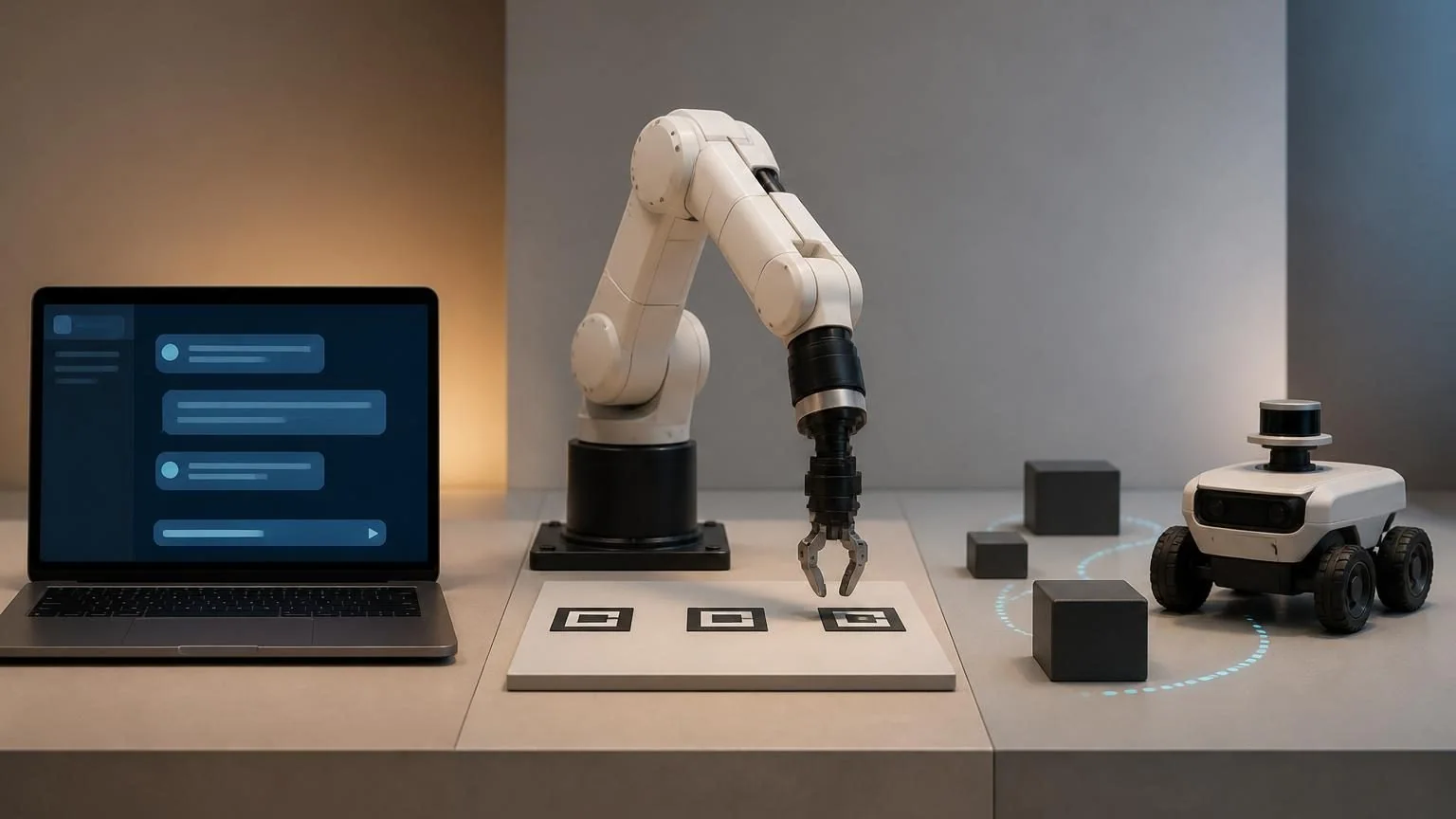
Direct answer: No. AI is software that infers predictions, content, recommendations, or decisions. A robot is a physical machine with sensors, controls, and parts that move or act. Some robots use AI for perception or planning, but many do not; most AI systems, including chatbots and recommendation engines, are not robots.
The shortest distinction: mind-like function versus machine body
The everyday words overlap because films often place an intelligent computer inside a human-shaped machine. Engineering separates them. Artificial intelligence describes information processing: recognizing an image, interpreting speech, predicting an event, generating text, or selecting an action. Robotics describes machines that sense and affect the physical world through motors, wheels, grippers, joints, tools, or other mechanisms.
Neither category requires the other. A language model running in a data center is AI with no physical body. A traditional factory arm repeating coordinates is a robot that may use no machine learning. When a warehouse robot recognizes unfamiliar objects and adjusts its route, robotics provides the body and control system while AI may provide perception or planning.
Calling software a “robot” can still be a metaphor, as in software robots for repetitive office automation. That usage describes automated work, not a machine with a physical body. Clarifying which meaning is intended prevents a great deal of confusion.
What counts as a robot
A robot generally has sensors, computation, and actuators. Sensors collect information such as distance, position, force, temperature, camera images, or sound. A controller decides what the machine should do. Actuators turn that decision into movement or another physical effect. The design may be an industrial arm, drone, underwater vehicle, surgical system, lawn mower, or planetary rover rather than a humanoid.
Autonomy exists on a spectrum. Some machines follow a preprogrammed route. Others adjust within narrow limits when a sensor changes. More advanced systems build maps, classify objects, or plan movements in changing environments. Remote-controlled machines are often discussed alongside robots, although a person supplies more of the moment-to-moment decisions.
- Sensors: measure the machine or its surroundings.
- Controller: converts instructions and sensor readings into commands.
- Actuators: move a joint, wheel, tool, valve, or other physical part.
- Task: defines the bounded job the machine is designed to perform.
- Safety system: limits speed, force, zones, or behavior around people.
Where AI enters a robotic system
Physical environments are messy. Lighting changes, objects overlap, floors become blocked, and people behave unpredictably. AI can help a robot interpret camera or sensor data, recognize speech, estimate where an object is, predict movement, plan a route, or learn a control policy from examples. These capabilities can make a machine more adaptable than fixed instructions alone.
AI is only one layer. A robot still needs mechanical design, power, real-time control, localization, networking, and safety engineering. A language model that suggests “move left” cannot guarantee a motor will stop at the right force. Trusted control software and hardware enforce physical limits even when an AI component is uncertain.
The same model may be useful without a robot. Computer vision can inspect an image without moving a machine. Planning can create a schedule instead of a path. Speech recognition can caption a meeting. The physical action is what turns an AI-enabled application into a robotic system.
Four combinations that make the boundary clear
| Example | AI? | Robot? | Why |
|---|---|---|---|
| Chat assistant on a phone | Yes | No | Generates information but has no physical actuator |
| Fixed factory arm | Not necessarily | Yes | Moves physical equipment using programmed control |
| Autonomous floor cleaner | Often | Yes | Senses, navigates, and moves in the environment |
| Spreadsheet macro | No | No | Automates explicit digital instructions |
Real systems can move between these cells as features change. Adding object recognition to a factory arm introduces an AI component; connecting a chatbot to a mobile platform introduces a robot body. Marketing names are less useful than inspecting the sensors, model, allowed actions, and safety boundary.
The distinction also explains why a conversational product can feel embodied even when it is not. A voice, avatar, name, and memory cues can create a social impression. Unless the system controls a physical mechanism, it remains software presented through an interface.
Why the difference matters for safety
A text error and a movement error have different consequences. A chatbot can produce misinformation or expose data. A robot can collide, drop, cut, burn, or enter a restricted area. An AI-enabled robot inherits both information risks and physical hazards, so its design must consider cybersecurity, model failure, mechanical limits, environmental conditions, human factors, and emergency stopping together.
Physical safety cannot rely on a generated instruction. Engineers use constrained operating zones, speed and force limits, redundant sensing where appropriate, validated controllers, access controls, and human procedures. The exact requirements depend on the application and applicable standards. A home toy, collaborative arm, delivery vehicle, and surgical device do not share one acceptable risk level.
Users should understand the operating design domain: the situations, surfaces, weather, objects, and human interactions the machine was tested to handle. “Autonomous” does not mean capable everywhere or free from supervision.
How to describe a product accurately
Start with the physical task. State what the machine senses, which actions it can take, and where it operates. Then identify any AI component and its role. “A camera model classifies packages so a conveyor robot can route them” is more informative than “an intelligent robot automates logistics.” It separates the prediction from the mechanism that acts on it.
Ask what happens when the model is uncertain, a sensor is blocked, the network fails, or an unexpected person enters the area. Find the stop control and the accountable operator. These questions expose the real capabilities without requiring advanced technical knowledge.
The useful mental model is simple: AI can help choose; robotics can make a physical change. The complete product must connect those layers through tested controls.
- What physical effect can the machine produce?
- Which sensors observe the relevant environment?
- Which decisions use learned AI rather than fixed rules?
- What hard limits remain outside the model?
- Who can pause, override, and maintain the system?