
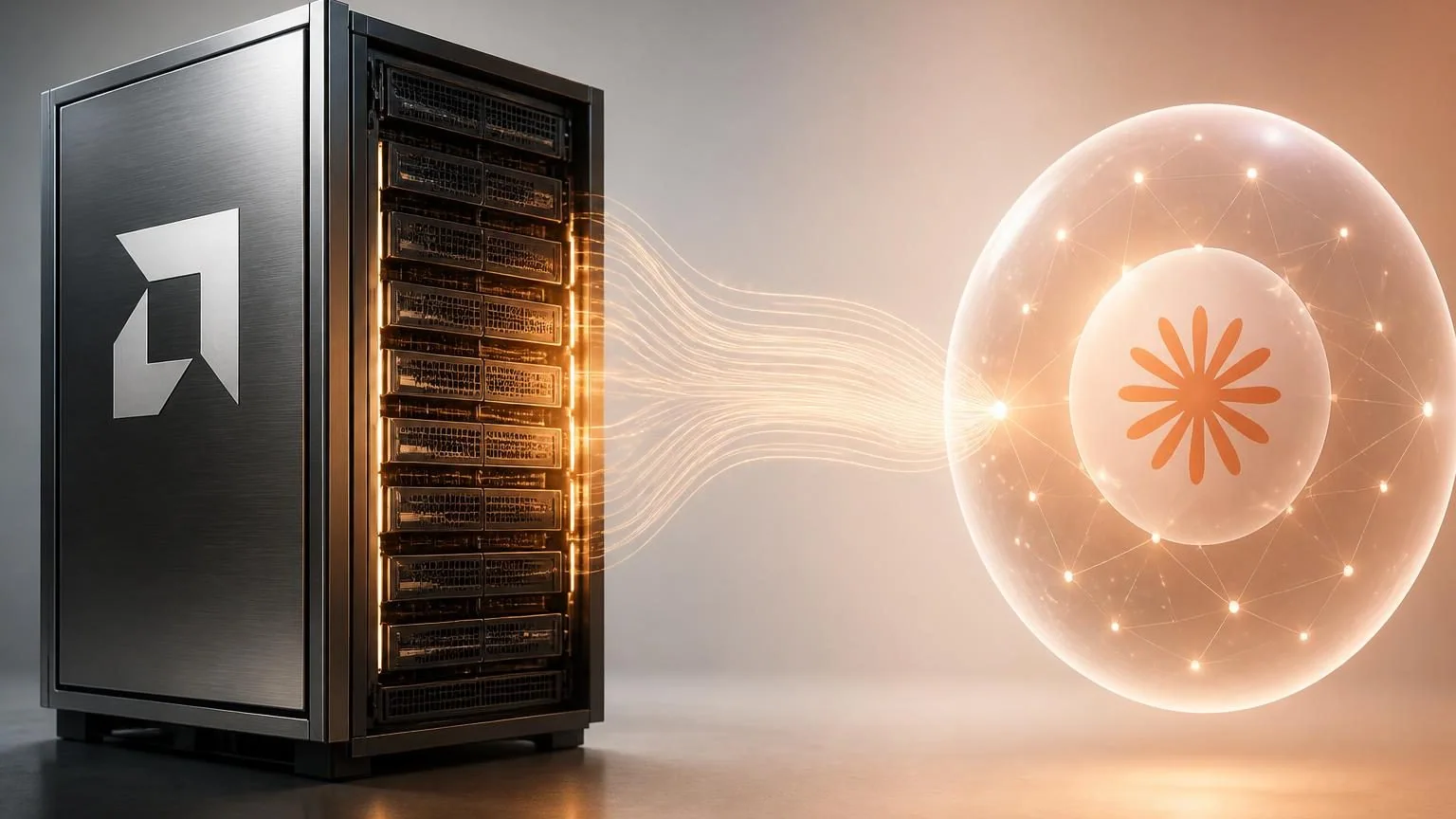
AMD and Anthropic have announced a strategic partnership to deploy up to 2 gigawatts of AMD Instinct MI450 GPU capacity in AMD Helios rack-scale systems. The first gigawatt is planned to begin deployment in the first half of 2027, alongside engineering work to optimize Claude workloads for AMD Instinct GPUs and ROCm. AMD also committed to invest up to $5 billion in Anthropic.
For business AI teams, the immediate takeaway is not that they need to procure GPUs. It is that reliable agent deployments are becoming a capacity-planning problem as much as a model-selection problem. The winning architecture will let teams route work among models and infrastructure without rebuilding the business workflow every time the underlying stack changes.
The deal turns compute diversification into a product issue
The partnership links a frontier-model provider, a chip supplier, software optimization, and rack-scale deployment. That combination matters because agentic systems do not consume compute like a single occasional chatbot query. They can search, retrieve, call tools, validate outputs, and hand off work across multiple steps. As adoption expands, predictable inference capacity and operational controls can directly affect whether those workflows are usable in production.
Anthropic said the agreement will help secure capacity for training and serving Claude while allowing workloads to be matched to appropriate hardware. AMD said the companies will collaborate on Claude-driven workload optimization for Instinct GPUs and ROCm. Those are signals that infrastructure choice is moving closer to the application layer, rather than remaining an invisible data-center concern.
Why 2027 timing still matters now
The announced capacity is not an instant change for most companies: the initial gigawatt deployment is scheduled for the first half of 2027. But large infrastructure commitments shape the availability, pricing, and deployment options that software teams will encounter well before the hardware is broadly accessible.
Microsoft’s July 20 announcement provides a nearby example of the same shift. Azure is expanding AMD-based infrastructure for data processing, chip design, and production-scale AI inference, explicitly framing agent coordination as a workload that needs specialized compute. Together, the announcements suggest that more cloud and model providers will optimize for distinct portions of the AI lifecycle rather than assume one general-purpose platform fits every task.
What enterprise agent builders should do
Do not redesign a customer-support, operations, or sales workflow around a single model benchmark. Instead, define the business job, the approved tools and data, the required human approvals, and the fallback path first. Then make the model and infrastructure layer replaceable where practical.
A practical operating checklist
- Classify workloads: Separate fast, repeatable tasks from long-running reasoning and high-risk actions.
- Measure unit economics: Track cost and latency per completed business outcome, not only per token.
- Design routing: Set rules for when a workflow uses a lower-cost model, escalates to a stronger model, or hands work to a person.
- Keep evaluation continuous: Test tool use, accuracy, and recovery behavior whenever providers, models, or prompts change.
The broader signal: agent deployment needs a portfolio mindset
The AMD–Anthropic agreement does not guarantee lower costs or better results for every organization. It does, however, strengthen the case for avoiding a brittle single-provider design. As frontier labs, chipmakers, and clouds make long-term infrastructure commitments, companies that separate agent workflows from the underlying compute vendor will be better positioned to adopt new capacity without pausing operations.
The near-term business question is simple: which workflows would benefit from a resilient routing, evaluation, and approval layer today? Answering that before capacity constraints arrive is more valuable than waiting for the next infrastructure announcement.
Primary announcements: AMD and Anthropic partnership release and Microsoft’s Azure infrastructure announcement.