
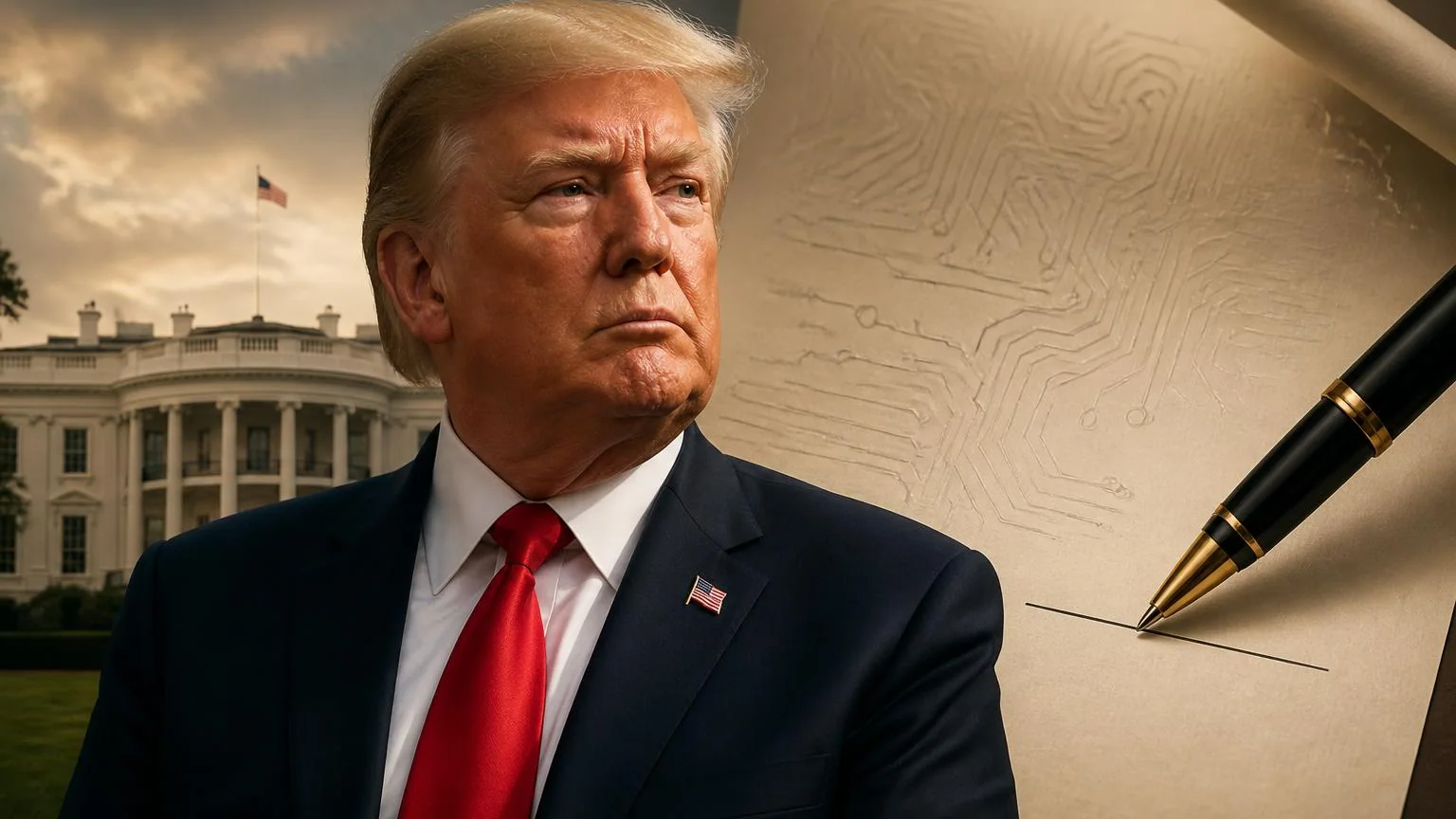
On Friday, May 22, 2026, Axios published the draft of a White House executive order on AI and cybersecurity after President Donald Trump postponed the planned signing a day earlier. The abandoned order would have created a voluntary framework for government review of certain frontier AI models before public release while directing agencies to strengthen cyber defenses. Instead, AI labs, cloud providers, and enterprise buyers are now left with policy uncertainty at the exact moment cyber-capable models are getting more powerful.
What surfaced on May 22
The clearest new development on May 22 was not a signed order but the release of the draft itself. Axios reported that the order, in its then-current form, paired a cybersecurity section with rules for what it called covered frontier models. The proposal would have asked labs to share qualifying models with the government at least 90 days before public release under a voluntary framework.
Nextgov/FCW had already reported that the White House was considering a role for the National Security Agency in that testing process, particularly for classified evaluation of advanced models. The same reporting said the order was expected to task national security and civilian agencies with using AI to improve federal cyber defenses.
Why the delay matters more than one missed signing ceremony
This is not just a Washington scheduling story. The delay exposed a real split inside the administration over whether advanced AI should face more formal pre-release review or whether any extra process risks slowing U.S. companies against China.
Axios reported that Trump said he postponed the order because he disliked parts of it and did not want anything that could interfere with the U.S. lead in AI. That matters because it turns AI oversight into a live political bargaining process rather than a settled near-term policy direction.
A signed order would not have created hard licensing, but it would have told frontier labs, federal contractors, and enterprise buyers that voluntary pre-deployment review was becoming the expected norm for the most sensitive models. The postponement leaves that norm unformed and keeps the policy signal muddy.
Why cyber-capable models are at the center of the fight
The urgency behind the draft did not appear out of nowhere. Recent reporting around the planned order tied it to the rise of more advanced cyber-focused systems, including Anthropic’s Claude Mythos Preview and OpenAI’s GPT-5.5-Cyber rollout.
Anthropic’s Mythos materials describe a model built and evaluated for cybersecurity capability, while OpenAI said on May 7 that it was rolling out GPT-5.5-Cyber in limited preview for defenders responsible for securing critical infrastructure. In other words, the policy fight is not happening in the abstract. It is happening because leading labs are now shipping models that can accelerate both defensive security work and potentially more sensitive offensive workflows.
That is why the draft focused so heavily on pre-release access and testing. Once cyber-capable models move from research novelty to commercial infrastructure, the argument over who gets to inspect them before release stops being theoretical.
Business impact for AI labs and enterprise buyers
For frontier labs, the immediate consequence is uncertainty. Companies now know the White House has considered a voluntary 90-day government review framework, but they do not know whether that approach will return in revised form, shift toward agency guidance, or disappear entirely.
For enterprises, the issue is more practical. Buyers building around advanced coding, security, and autonomous workflow models still need internal governance even if Washington delays its own. The absence of a signed order does not remove model risk, audit requirements, vendor review, or board-level questions about how powerful agent systems are evaluated before deployment.
It may even increase pressure on enterprise teams to define their own thresholds for high-risk model use. Security-sensitive deployments, especially in critical infrastructure, finance, healthcare, and government-adjacent environments, cannot wait for a cleaner federal policy picture.
What to watch next
- Whether the White House reworks the order rather than abandoning it outright.
- Whether model testing responsibilities land with the NSA, Commerce, NIST, or a mixed interagency process.
- Whether labs voluntarily adopt stronger disclosure and evaluation practices before any formal government framework appears.
- Whether enterprise procurement teams start treating frontier cyber models as a separate risk category from general-purpose enterprise AI.
The bigger takeaway is simple: on May 22, 2026, the U.S. did not get a new AI oversight framework. It got a public look at how contested that framework still is. For businesses building AI agents, automation systems, and security workflows, that means governance is becoming a deployment requirement faster than policy is becoming stable.