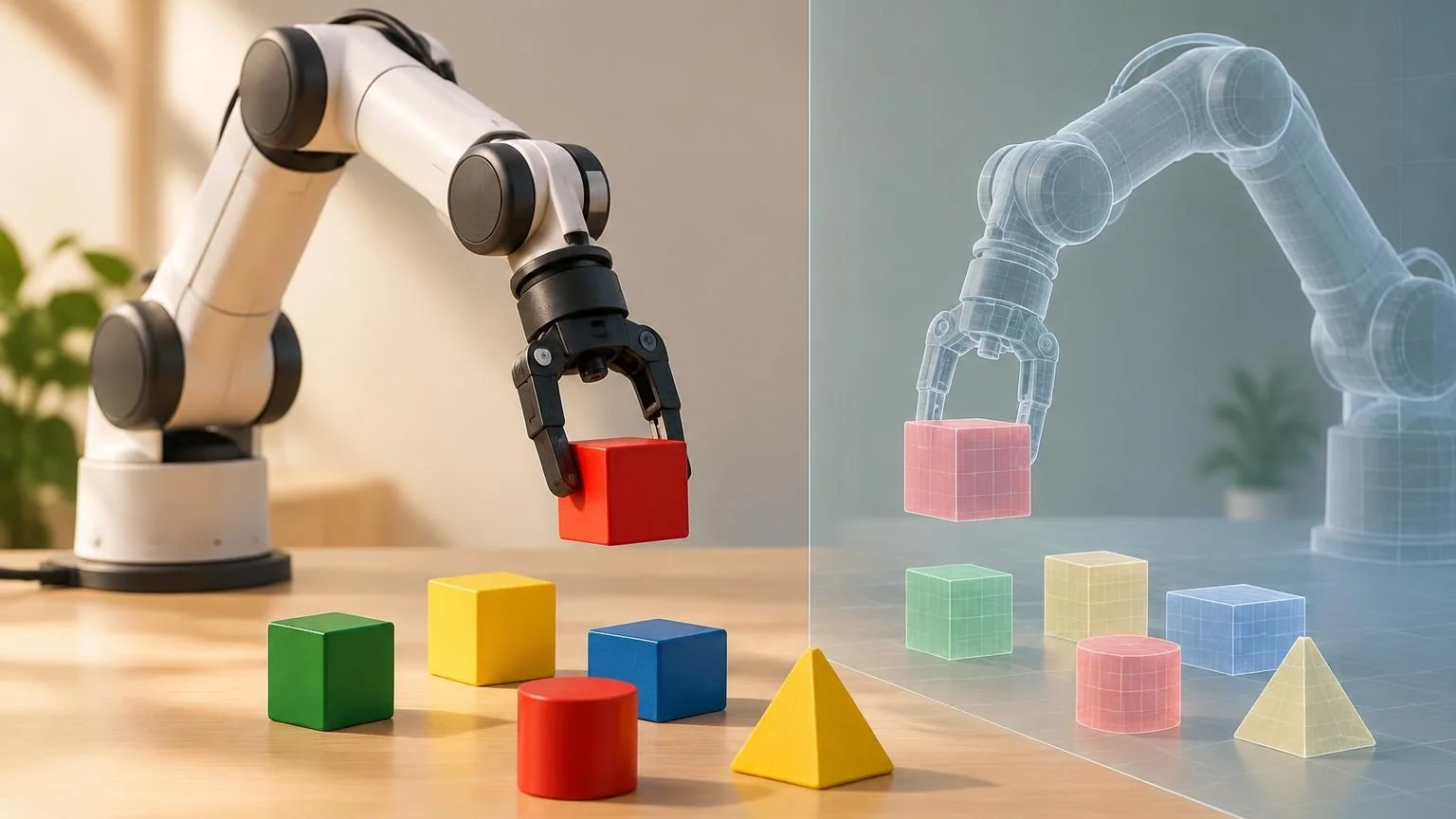
Ai2 has released ToyBlocks, an open environment for studying how robots learn, plan and recover from mistakes. Announced on November 6, it uses a simulated robot arm and tabletop blocks to make experiments repeatable and failures easier to diagnose.
The release announcement positions the project as a controlled world where researchers can vary training data and model design. Ai2 is releasing simulation assets, demonstration-generation tools, models, code and validation material. The goal is to support investigation of the learning system rather than showcase a single successful behavior.
A small world with several research uses
The project documentation describes low-level robot skills and a higher-level agent interface. Skills can be exposed as MCP tools, allowing a model to plan actions from camera observations. The project reports a first dataset containing 481,207 skill steps and roughly 1,600 hours of robot execution.
ToyBlocks uses Apache 2.0 licensing. Its demonstrations and reported throughput concern the project’s particular simulation and hardware configurations. They should not be interpreted as performance guarantees for a different robot or a less controlled physical environment.
Why controlled variation matters
Our assessment is that a simple environment can answer questions a polished real-world demonstration leaves unresolved. If a robot succeeds only when objects occupy familiar positions, moving the same blocks can reveal that limitation quickly. Repeating the experiment makes it possible to investigate whether the problem lies in perception, planning or motor control.
Separating those components also improves development decisions. A system that chooses the correct action but executes it poorly needs a different intervention from one that moves accurately toward the wrong objective. An aggregate success rate can obscure that distinction.
Researchers can use the environment to hold most variables fixed while changing one condition, such as object orientation or the distribution of training examples. They can then inspect the action sequence and recovery behavior, rather than judging only whether the final tower stands.
Transfer to physical hardware remains a separate test. Simulation can provide inexpensive repetition, but contact, sensing and actuator behavior may differ on a real machine. A strong research report should state which conditions were tested in each environment and avoid generalizing beyond them.
ToyBlocks makes that style of investigation more accessible through public artifacts and a shared task setting. Its significance lies in the ability to run comparable experiments, identify why a robot fails and measure whether a proposed improvement fixes the intended problem.