
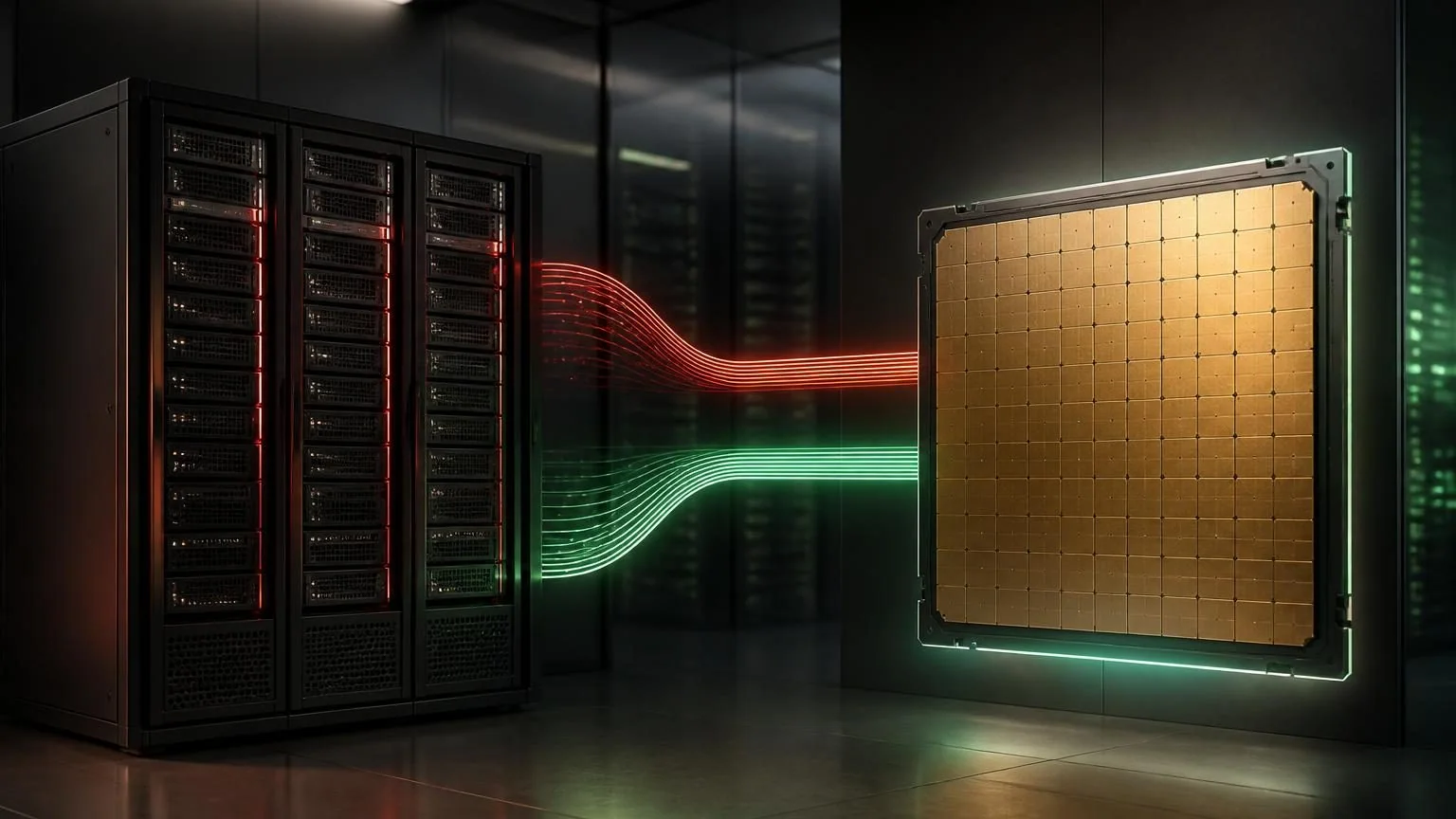
AMD and Cerebras announced on 23 July 2026 that they are developing a disaggregated AI inference solution combining AMD Helios rack-scale systems with Cerebras Wafer-Scale Engine technology. The core idea is straightforward: use different compute engines for different stages of inference rather than asking one fleet to do every part of the job.
For AI teams, the news is less about a single benchmark and more about a growing architecture choice. Production agents often need to process long prompts, retrieve large contexts, and then respond quickly. Those demands do not always reward the same infrastructure.
What the joint system is designed to do
The companies say AMD Helios will handle high-throughput prompt processing and large context windows, while Cerebras technology will accelerate the memory-bandwidth-intensive decode stage that generates tokens. They plan to operate the components as one inference workflow, with initial availability through Cerebras Cloud expected in the second half of 2026.
AMD and Cerebras describe the arrangement as workload-optimized, and cite an expected improvement of up to five times tokens per second per watt. That is a forward-looking company claim, not an independent production result, so buyers should evaluate it against their own models, context lengths, traffic patterns, and service-level objectives.
Why prefill and decode are becoming separate decisions
Prompt processing and token generation create different bottlenecks. Long-context requests can emphasize throughput and memory capacity. Interactive copilots and multi-step agents can be sensitive to the delay between tokens. A disaggregated design aims to optimize each stage independently while presenting one service to the application.
This can matter when an agent system has uneven traffic: a heavy document-analysis step followed by a conversational response, or many concurrent users waiting for fast streaming answers. In those settings, infrastructure efficiency is not just a GPU utilization metric—it affects queueing, user experience, and unit economics.
Questions to ask before pursuing a split inference stack
- Where is latency actually spent? Measure retrieval, prompt processing, first-token delay, token streaming, tool calls, and guardrails separately.
- How long are real prompts? Size the architecture around production context distributions, not a single demo workload.
- What must remain portable? Check API compatibility, routing controls, observability, and how easily workloads can move if performance or cost changes.
- Which claims are validated? Treat vendor projections as hypotheses until they are tested with your models and traffic.
The business implication: route work by constraint
The infrastructure conversation is shifting from “which accelerator wins?” to “which path serves this request best?” That mirrors application design: route simple tasks to efficient models, preserve premium capacity for demanding work, and measure outcomes at the workflow level.
Companies do not need to build custom hardware orchestration to act on that lesson. They can start by categorizing their AI workloads by context size, response-time target, concurrency, and cost ceiling. Those categories create a clearer foundation for model selection, agent design, and future infrastructure choices.