
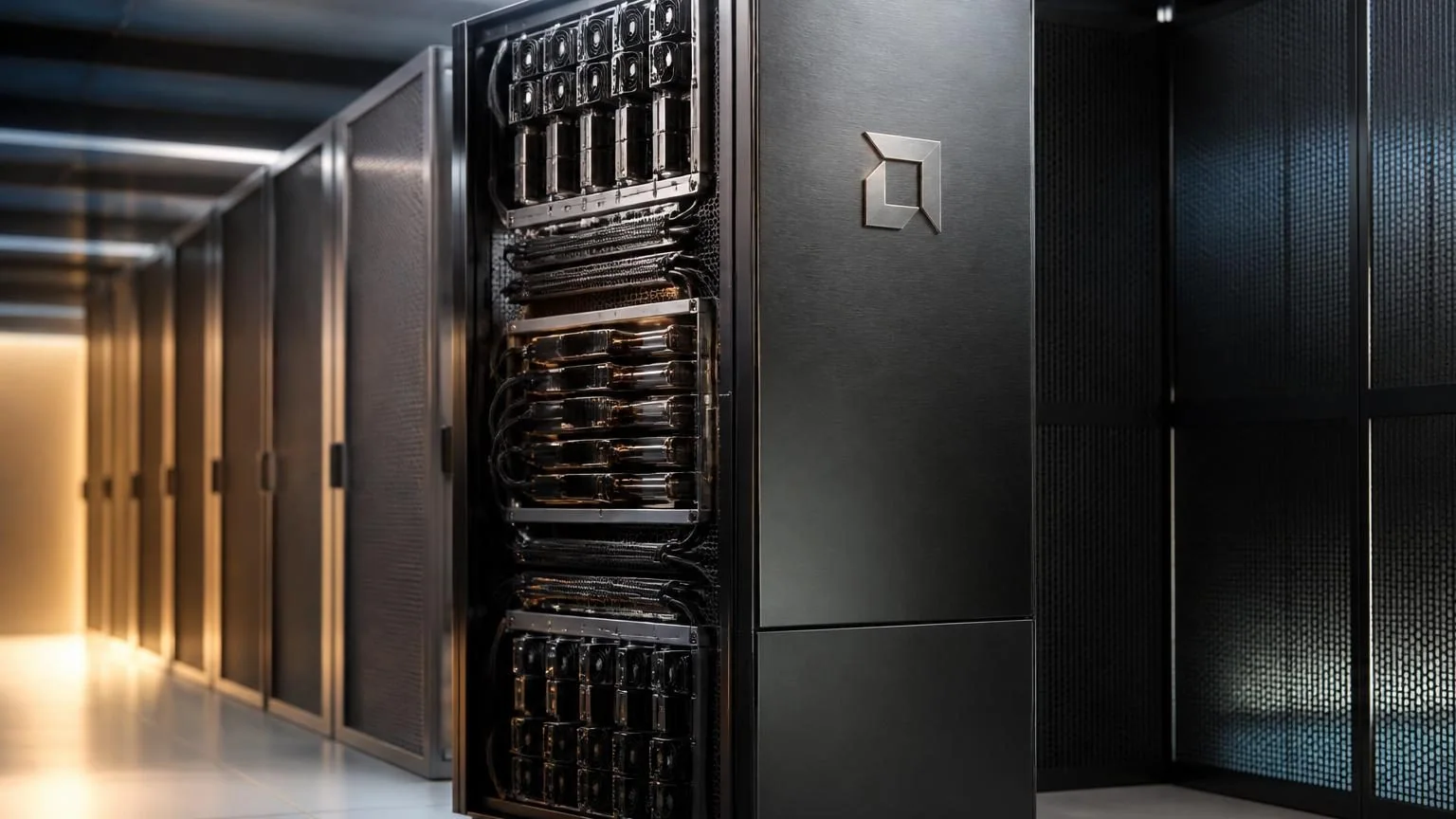
AMD’s July 23, 2026 Advancing AI event was not simply a new-chip announcement. The company launched the Instinct MI400 GPU family and Helios rackscale systems while positioning the combined hardware, networking, and ROCm software stack as the unit enterprises should evaluate for large AI workloads.
That framing matters. As agentic applications move from pilots into persistent inference, search, retrieval, and orchestration workloads, buying decisions increasingly turn on deployment speed, operational controls, and system-level performance—not a single accelerator benchmark.
What AMD announced at Advancing AI 2026
AMD said Helios is in production and described a portfolio that includes the MI400 GPUs, sixth-generation EPYC processors, networking, and software. The event also extended the company’s roadmap into physical AI and future MI500-series products.
For buyers, the notable change is that the product boundary has expanded. A rack-scale system bundles compute, memory, interconnect, host CPUs, and the software layer needed to run and monitor workloads. That is closer to how frontier-model and high-volume inference deployments are actually procured.
Why agentic AI changes the infrastructure question
Traditional model training can concentrate demand into large batch jobs. Production agents create a more varied operating profile: interactive inference, tool calls, retrieval, background execution, retries, approvals, and observability. The bottleneck may move among GPUs, CPUs, networking, memory, and the control plane.
AMD’s strategy is therefore consequential even for teams that do not buy infrastructure directly. Cloud providers and managed platforms will increasingly differentiate on the complete system they can expose, including routing choices, isolation, telemetry, and price-performance for sustained inference.
The enterprise decision is availability plus operations
The launch should not be read as proof that every workload should move to a new platform. Hardware claims require workload-specific validation, and availability schedules matter more than roadmap slides. But the announcement makes a useful procurement rule clearer: evaluate a platform as a deployable operating environment, not as a GPU line item.
Ask prospective providers for evidence on supported models, inference latency at your target context lengths, capacity commitments, observability, security boundaries, migration tooling, and failure handling. A system that wins a benchmark but complicates agent operations can be the more expensive choice in production.
What to do next
Organizations building multi-step AI workflows should separate their application architecture from a single infrastructure assumption. Keep model routing, tool interfaces, evaluation suites, and audit logging portable where practical. Then test the complete workflow against the infrastructure options that will actually be available when deployment begins.
AMD’s Helios launch is another sign that AI infrastructure competition is moving up the stack. For business teams, the winning platform will be the one that turns reliable agent operations into a repeatable capability—not merely the one with the boldest silicon claim.