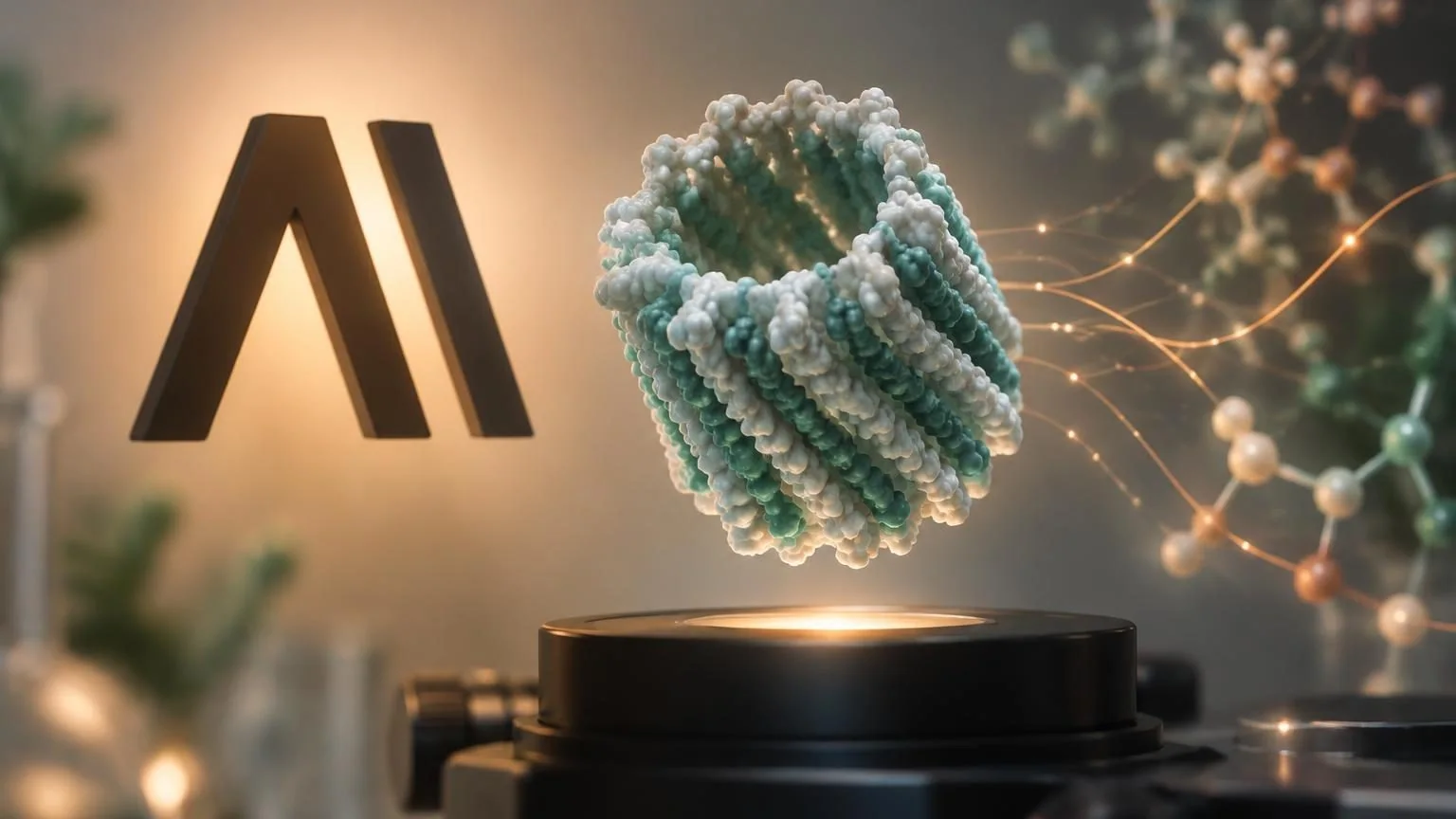
Anthropic’s biology team has reported a three-dimensional structure of a vault-like particle formed from a bacteriophage protein inside a prokaryotic cell. The November 4 account describes how Claude contributed to database research, experimental preparation and structural analysis.
The research post says the particle contains 96 copies of a protein, compared with 78 in a human vault. The team also reports engineering a larger version. It has not established the particle’s biological function. The findings are being shared through an early preprint rather than presented as a completed account of what vaults do.
AI assistance and physical experiments
Anthropic describes Claude searching protein databases, helping design constructs, optimizing isolation and processing microscopy data. Reported reductions in purification and modeling time are the team’s own estimates from this workflow, rather than a controlled comparison across laboratories.
The work follows the biology laboratory introduced in September. That earlier account explains the team’s combination of computational searches and experimental testing, and states that human scientists perform its physical laboratory work.
What the example demonstrates
Our analysis is that the interesting development is the continuity between computational suggestions and experimental evidence. An assistant can search a large space of candidates quickly, but the scientific claim becomes meaningful only when the proposed structure or behavior is supported by measurements.
That distinction helps avoid a common misunderstanding about AI-assisted discovery. A predicted protein relationship, a proposed protocol and an experimentally observed structure are different kinds of results. A good research account should make clear which step produced each claim and which uncertainties remain.
For laboratories considering similar tools, the practical lesson is to preserve that chain of evidence. Record the candidate-selection criteria, the proposed changes, the observations and the reasons a hypothesis was retained or rejected. This makes later review possible even when many computational suggestions are discarded.
Speed estimates also need context. A faster purification method can be valuable, but its generality depends on whether another team can reproduce it with comparable materials and equipment. Replication of the biological result and replication of the workflow improvement are related but separate questions.
The report adds a concrete case study to the discussion of AI in basic science. It describes an observed structure and a human-directed research process, while leaving the larger biological question open for further investigation.