
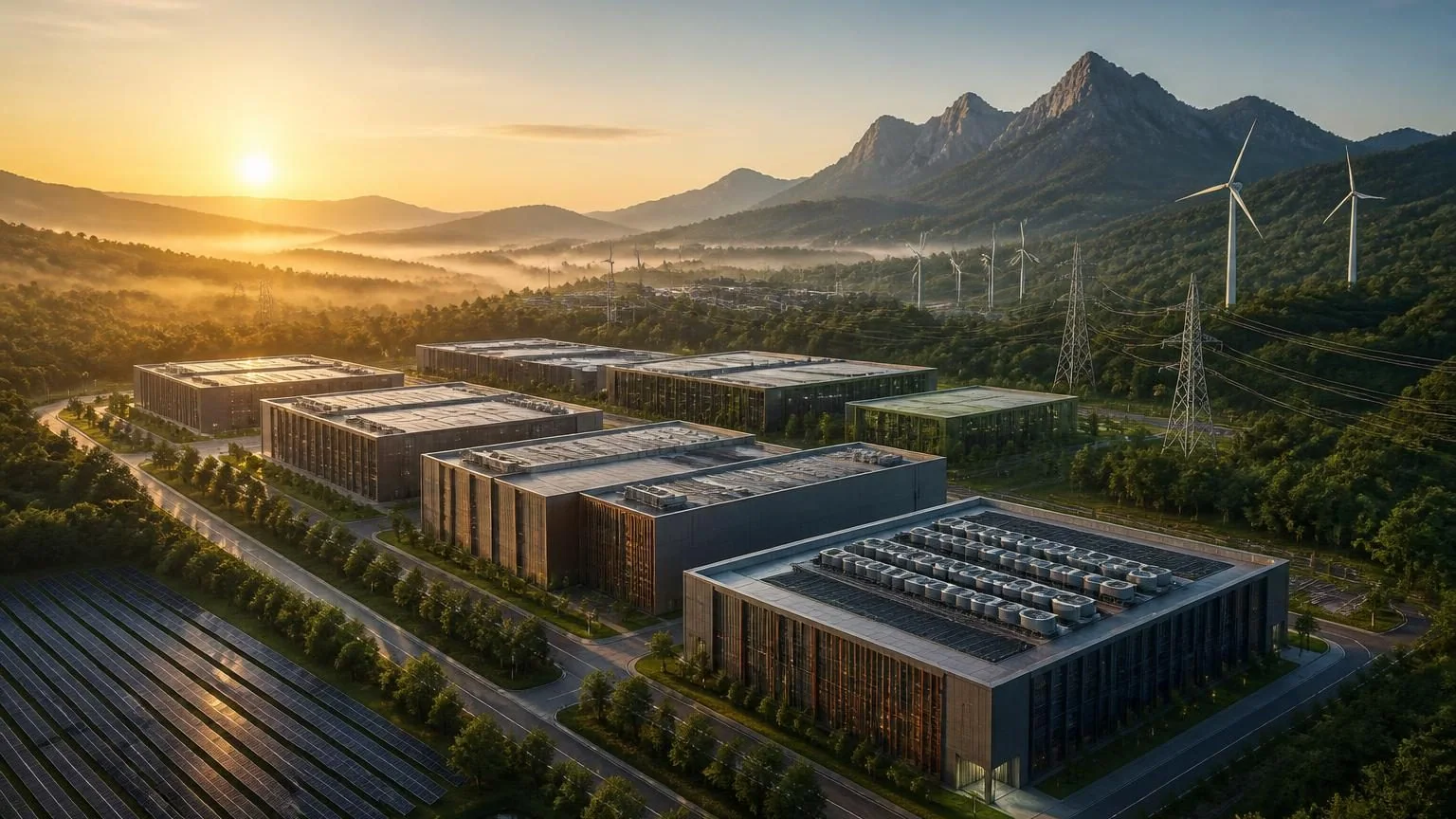
The European Union has opened a call to establish up to seven AI Gigafactories, a new layer of computing infrastructure intended for training, inference, and fine-tuning advanced AI models. The European Commission says the initiative can receive up to €10 billion in EU and national support and is designed to unlock at least €20 billion in private investment.
That makes this a €30 billion investment target, not a guarantee that seven facilities will be built tomorrow. It is a procurement and investment process. But it is a material shift in the EU’s approach: rather than treating compute as background infrastructure, Brussels is treating access to large-scale AI capacity as a strategic capability.
What is an AI Gigafactory?
EuroHPC describes AI Gigafactories as large-scale facilities for developing and training next-generation models with trillions of parameters. The Commission’s plan combines advanced AI processors, software and cloud stacks, high-speed connectivity, and energy-efficient data centres.
The proposed facilities are expected to operate at a scale of at least 100,000 advanced AI chips each. That is why the announcement matters beyond the data-centre sector. Frontier-model development increasingly depends on the ability to secure compute, power, networking, operations, and capital as one coordinated system.
Why Europe is making the move now
The EU already has an AI Factory network linked to supercomputing infrastructure. Gigafactories are the attempted next step: bigger capacity, a stronger role for private operators, and access for startups, scale-ups, small and medium-sized businesses, industry, researchers, and public authorities.
The policy goal is often described as technological sovereignty. In operational terms, that means reducing the risk that European AI builders must depend entirely on foreign cloud and model providers for their most compute-intensive work.
What the announcement does not solve
Compute capacity is necessary, but it is not a complete AI strategy. A facility still needs reliable power, hardware supply, skilled operators, viable economics, security controls, and customers with workloads worth running. It also does not automatically create leading models, proprietary data, or strong product distribution.
For businesses, the near-term value is less about waiting for a new campus to open and more about preparing to use AI infrastructure well. Teams that know which workloads need scale, which can run on smaller models, and how to govern data and agent access will be better positioned as capacity options expand.
The practical takeaway
The EU is trying to make frontier AI compute less concentrated and more available to its own ecosystem. Whether that ambition succeeds will depend on execution, energy, procurement speed, and whether the resulting capacity is accessible to companies beyond the largest incumbents.
For operators, the signal is clear: AI strategy is becoming infrastructure strategy. The best next step is to identify the workflows that genuinely need more capable models, then build the controls and operating design to deploy them responsibly.