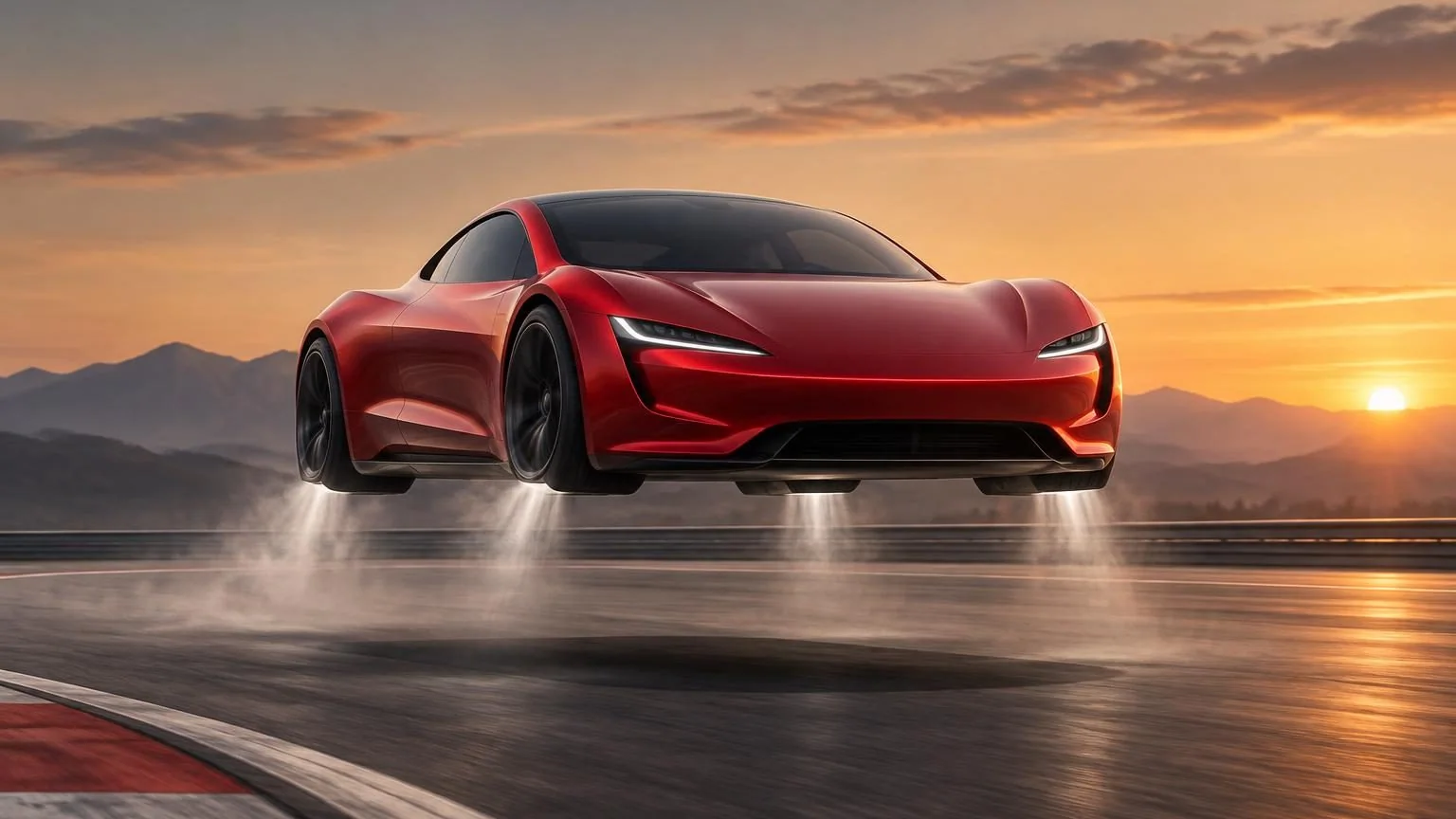
The flying Tesla is now a demonstration story, rather than just a promise. At its October 15, 2026 unveiling, Tesla showed a redesigned Roadster performing airborne maneuvers using a system developed with SpaceX. That is a striking engineering milestone. It does not establish that customers can buy a vehicle ready to fly through everyday traffic.
The useful question is what the demonstration proves, which features Tesla is offering, and which practical questions remain unanswered.
What happened at the Roadster demonstration?
Reuters’ video report describes a driverless Roadster climbing a steep ramp, becoming inverted, flipping through the air and landing. A later demonstration showed it jumping over a line of Tesla vehicles. Reuters also reports that Tesla is targeting production in 2028. That is an announced schedule, not a delivery already achieved.
Those details matter because a short airborne maneuver and sustained flight solve different problems. The footage establishes what was shown in a controlled setting. It does not, by itself, establish flight duration, usable airborne range, repeatability across conditions, or the capabilities of a final customer vehicle.
How does the flying Tesla work?
Associated Press reports that the demonstration combined cold-gas thrusters with a suction system. In basic engineering terms, a thruster generates force by expelling gas. A suction system can increase the force holding a car against a surface. These mechanisms serve different purposes, even when they appear in the same demonstration.
The distinction helps explain the spectacle without turning it into an aircraft specification. Strong grip, a brief jump and controlled movement in the air are separate capabilities. A successful demonstration of one sequence does not supply a complete operating envelope for the vehicle.
Which version can fly, and when can customers get it?
Tesla’s Roadster page includes a qualification that a feature is available only with the Rocket trim and that this trim is not available in all regions. The page also distinguishes its optional Thrust augment. Buyers should check the exact configuration rather than assume every Roadster includes the capabilities shown onstage.
Axios reports that Tesla lists three models and acknowledges that its flying version is not approved for public roads. The same report gives 2028 as Musk’s production target. Neither a reservation nor a production target settles the final specifications, delivery date or permitted uses.
What still needs to be demonstrated?
A meaningful customer evaluation would need answers to several practical questions:
- Repeatability: How many maneuvers can the vehicle perform, and what replenishment or maintenance is required between attempts?
- Operating conditions: What limits apply to wind, surface geometry, vehicle load and the space surrounding a maneuver?
- Failure behavior: How does the system respond when available thrust or sensor information is insufficient?
- Customer access: Which functions ship in each trim, where can owners use them, and what training is required?
These are evaluation questions, not claims that Tesla has failed particular tests. Public demonstration footage cannot answer them all. The next useful evidence would be detailed customer documentation, repeatable testing and delivered vehicles matching their advertised capabilities.
Why the flying Tesla matters
The Roadster puts an unusually ambitious combination of automotive and aerospace engineering in public view. Its significance today is the demonstration itself and the questions it opens about what a performance car can do.
Our editorial assessment: enjoy the engineering, then evaluate the product against its documented limits. A remarkable maneuver deserves attention. Everyday usefulness depends on repeatability, availability and clearly defined operating conditions. Until those are established, the flying Tesla is best understood as a demonstrated capability with a customer product still to prove.