
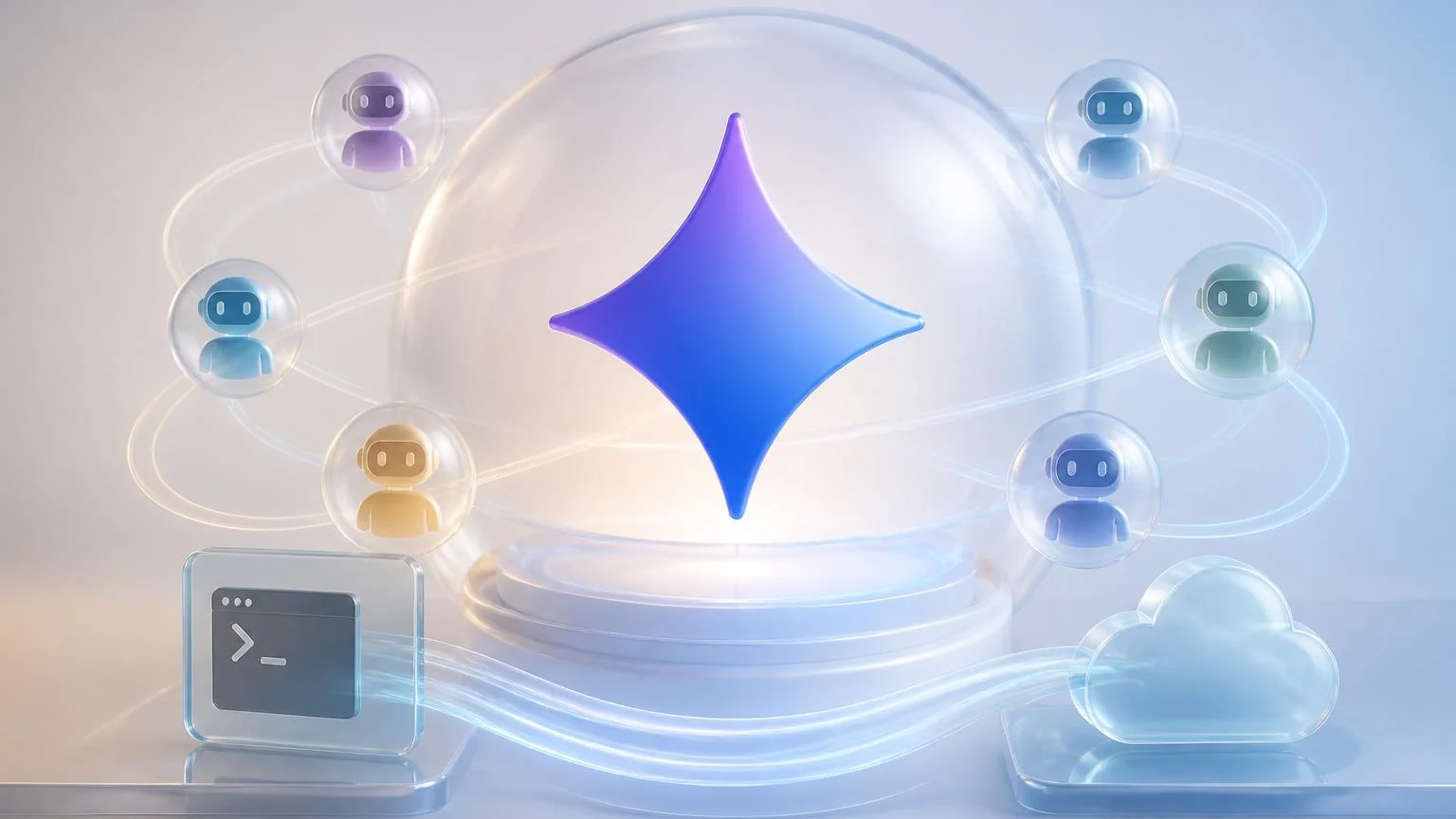
Google introduced Gemini 3.5 and released Gemini 3.5 Flash on May 19, 2026 at Google I/O 2026, positioning it as its strongest model yet for agentic and coding work. The release was not limited to one developer surface: Google made 3.5 Flash available across the Gemini app, AI Mode in Search, Google Antigravity, the Gemini API in Google AI Studio and Android Studio, Gemini Enterprise Agent Platform, and Gemini Enterprise.
The bigger story is that Google paired the model launch with new managed-agent infrastructure. On the same day, Google launched Managed Agents in the Gemini API in preview, built on the Antigravity agent harness, and began pushing Gemini CLI users toward Antigravity CLI. That combination makes May 19 look less like a normal model-refresh day and more like a platform-consolidation move around agent execution.
What Google actually shipped on May 19
At the model level, Google said Gemini 3.5 Flash is the first release in its new Gemini 3.5 family and that Gemini 3.5 Pro is planned for next month. Google also made 3.5 Flash the default model for the Gemini app and AI Mode in Search globally, which immediately gives the launch distribution far beyond a developer-only release.
For builders, Google tied the model to a larger Antigravity rollout. Managed Agents in the Gemini API now let developers spin up an agent with a single call that can reason, use tools, and execute code in an isolated Linux environment. Google said developers can define custom behavior with files such as AGENTS.md and SKILL.md, while enterprise support for managed agents on Gemini Enterprise Agent Platform is entering private preview.
Google also used I/O 2026 to make Antigravity a more explicit umbrella for its agent stack. In its migration notice, the company said Antigravity CLI is available starting May 19 and that Gemini CLI and Gemini Code Assist extensions will stop serving requests for free, Pro, and Ultra consumer access on June 18, 2026. Enterprise customers using Gemini Code Assist licenses or Gemini Enterprise Agent Platform API keys are not being cut off under that timeline.
Why this is bigger than a faster Flash model
Google’s own pitch was unusually specific about agent execution. The company said Gemini 3.5 Flash outperforms Gemini 3.1 Pro on Terminal-Bench 2.1, GDPval-AA, MCP Atlas, and CharXiv Reasoning, and that it runs four times faster than other frontier models on output-token speed. Google also argued that 3.5 Flash can help complete long-horizon work at less than half the cost of other frontier systems in many cases.
Those claims matter because agent platforms fail less often on headline intelligence than on latency, orchestration overhead, and cost. A model that is good enough to reason across multi-step work but still fast enough for tool-calling loops changes what can be deployed in practice. Google is clearly trying to position 3.5 Flash as that execution model rather than as a pure chatbot upgrade.
The model examples reinforce that message. Google highlighted workflows like transforming legacy codebases, building interactive UIs, running multiple subagents in parallel, and maintaining context across longer sessions. In other words, Google is marketing Gemini 3.5 Flash as the model for sustained work loops, not just one-shot answers.
The platform story is Antigravity
The most important product signal may be the unification happening around Antigravity. Google’s developer materials now frame Antigravity as the agent-first platform spanning the desktop app, CLI, SDK, Google AI Studio, and enterprise agent surfaces. Managed Agents in the Gemini API are powered by the same Antigravity harness, and Google is explicitly steering terminal users away from Gemini CLI toward Antigravity CLI.
That matters because developers and enterprises have spent the last year juggling disconnected agent pieces: one model surface for prompting, another for code execution, another for workflow state, and another for enterprise controls. Google is trying to collapse those layers into one operating model. If that works, the value is not only benchmark performance. It is a cleaner path from experiment to production.
The migration timeline also shows Google is willing to break from earlier branding to push that consolidation faster. June 18, 2026 is now the practical deadline consumer Gemini CLI users need to remember, while enterprise users are being given a more gradual path. That split suggests Google sees Antigravity as the growth surface and older Gemini CLI access as a transitional layer, not the long-term interface.
Where businesses may feel the impact first
The release is most relevant for teams building coding agents, document-heavy workflows, and multi-step operational automations. Google cited examples including Macquarie Bank piloting customer-onboarding work across long documents, Salesforce using 3.5 Flash in Agentforce for multi-turn enterprise tasks, Ramp applying it to invoice understanding, and Xero using agents for multi-week back-office processes.
That mix is notable. Google is not only talking about software development. It is trying to show that one model and harness combination can cover engineering, finance operations, OCR-heavy document work, and customer-facing enterprise systems. That is the kind of breadth a real agent platform needs if it wants to move beyond demos and into enterprise budgets.
For Nerova’s audience, the practical implication is straightforward: faster agent models only matter if they reduce operational friction in real workflows. Google’s May 19 move suggests the market is shifting from model shopping toward integrated execution stacks that combine model quality, sandboxing, orchestration, and enterprise deployment paths in one place.
What to watch next
The next checkpoint is not the May 19 keynote hype. It is whether Google can turn today’s launch into stable production adoption. Gemini 3.5 Pro is scheduled for next month, managed agents on Gemini Enterprise Agent Platform are still only in private preview, and Antigravity’s migration path still has to prove that developers will accept a unified platform instead of a loose collection of tools.
Still, the strategic direction is clear. Google is using Gemini 3.5 Flash to reset how it wants the market to think about its AI stack: one fast model for action, one harness for execution, and one platform story from consumer surfaces to enterprise agent deployment. For AI agents and automation teams, that is the real May 19 signal to pay attention to.