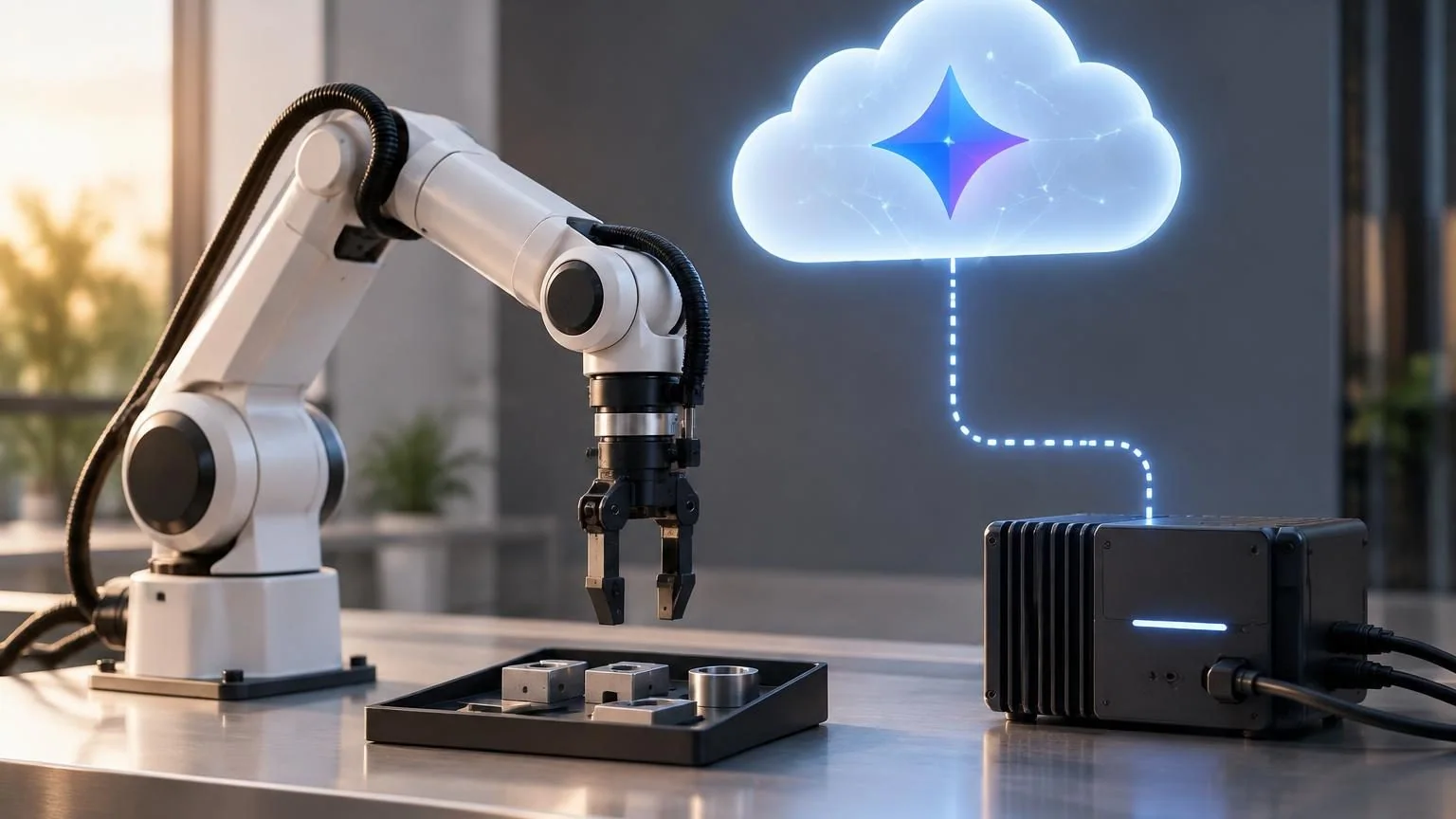
Gemini Robotics Embodied Reasoning 2 entered public preview on Google Cloud on October 27, 2026. This expands the enterprise access path for an existing robotics reasoning model through Model Garden and Google’s cloud platform. It is an availability milestone following the July announcement, with a Cloud API contract that differs from earlier demonstrations.
July introduced the model; October widened enterprise access
Google first announced Gemini Robotics ER 2 on July 30, 2026, making it publicly available through the Gemini API and Google AI Studio while describing Gemini Enterprise Agent Platform access as private preview. The October 27 announcement moves the Cloud offering into public preview. Older July references to private preview therefore describe an earlier access stage, not the latest Cloud status.
The model is a high-level reasoning layer: it interprets observations, plans tasks, and delegates movement to lower-level vision-language-action models or robot APIs. Neither the July announcement nor the October Cloud announcement presents this as a downloadable ER 2 weights release. Teams should not interpret Model Garden access as permission or a package for offline self-hosting.
The Cloud API contract is narrower than the broader demos
Google’s Cloud model reference identifies the preview as gemini-robotics-er-2-preview, built on Gemini 3.5 Flash. It accepts text, image, audio, and video inputs and returns text, with structured output and function calling supported. GenerateContent and Count Tokens are supported; Gemini Live, Interactions, and Chat Completions APIs are not. The documented endpoint is global.
That distinction is consequential. July’s announcement described bidirectional streaming through Gemini Live, but that does not establish Live API support for this Cloud preview. A developer prototype using that streaming route needs an explicit compatibility review before migration. Video input support and a supported bidirectional conversation API are different capabilities.
The Cloud reference also lists tuning, batch inference, and Provisioned Throughput as unsupported. Preview terms permit commercial or production use subject to the applicable agreement, but the feature remains pre-GA, provided as is, with potentially limited support. Permission to operate commercially is not a general-availability commitment.
What changes for a robotics pilot
The enterprise path uses Google Cloud credentials rather than a Gemini API key. Google’s guide specifies an enabled Cloud API, Application Default Credentials, and the Agent Platform backend. Operationally, this creates a route for evaluating robot reasoning within an existing Cloud project rather than treating a developer-key demo as the deployment architecture.
Google names inspection and training-data applications: Boston Dynamics discusses video inspection, while DeepReach describes understanding recordings to identify useful training data. These are company-reported applications, not evidence that every workcell is ready for autonomous operation. Google also describes keeping latency-sensitive workloads such as SLAM and path planning local using Google Distributed Cloud. That architecture should not be confused with downloading ER 2 itself.
The next gate is controlled evidence, not more autonomy
Google’s documentation warns about hallucinations, slower processing for complex or high-resolution requests, and sensitivity to visual conditions. It places responsibility for a safe robot environment on the operator. Its privacy notice also requires notification and consent before identifiable people interact with or are present around deployments collecting their personal data.
Our practical recommendation is to make the first Cloud evaluation observational: replay approved inspection footage, compare completion judgments with human labels, and record uncertain outputs. Only then test a narrowly permitted robot tool in simulation. Before hardware execution, define who can approve actions, how stale observations are rejected, and what happens when the Cloud call fails. These are proposed acceptance gates, not results from firsthand testing.
The October 27 milestone opens an enterprise evaluation route. It does not remove the separate engineering work of proving that a cloud-generated decision is timely, authorized, and safe enough for a particular machine.