
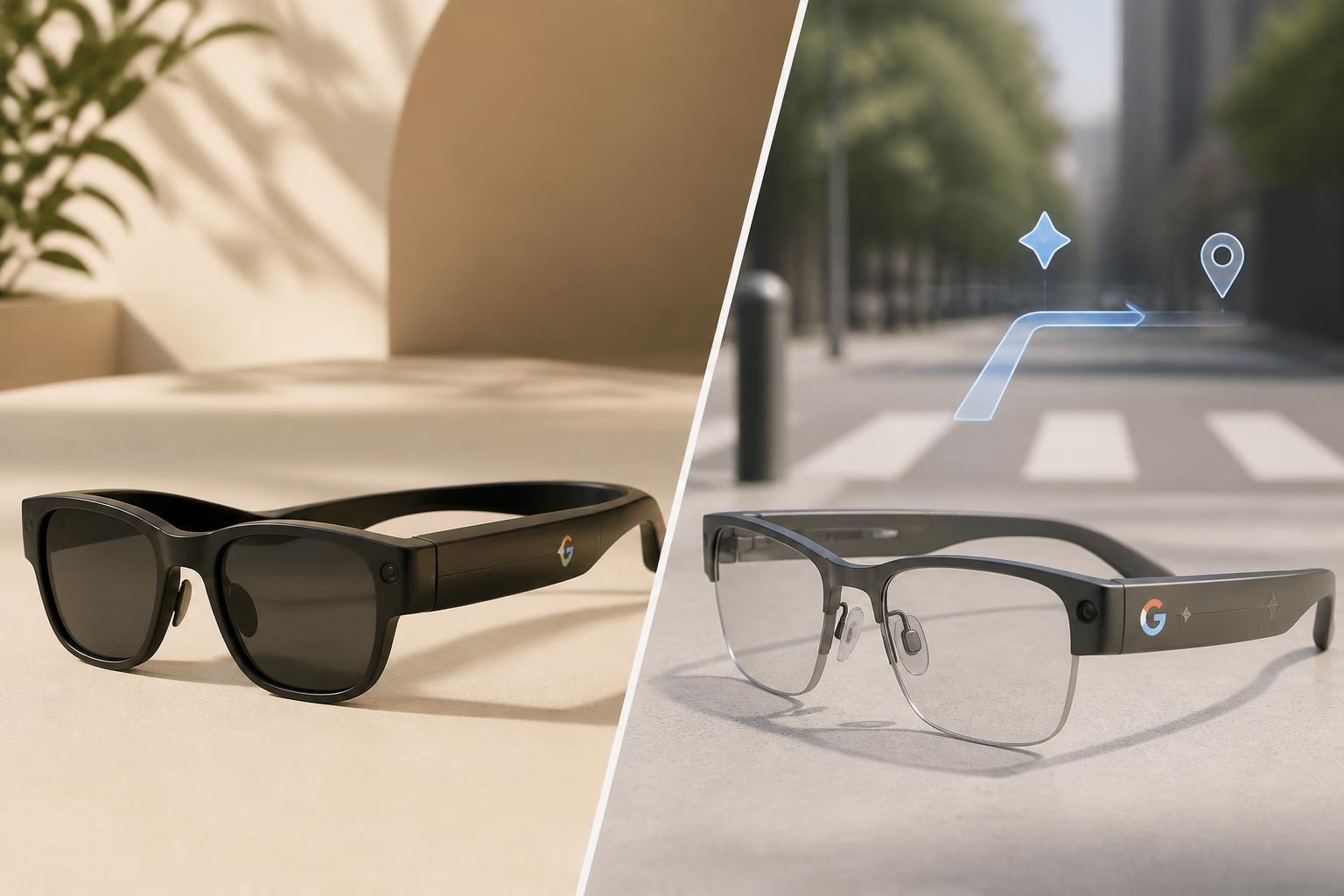
On May 19, 2026, at Google I/O 2026, Google unveiled its latest Android XR intelligent eyewear push and made the product strategy much clearer: two kinds of glasses are coming, audio glasses that deliver spoken help in your ear and display glasses that show information in your field of view. Google said audio glasses will launch first later this fall, with Gemini handling directions, messaging, translation, photo capture and multi-step tasks without requiring you to pull out your phone.
The announcement matters because it turns wearable AI from a long-running demo category into a more practical interface story. Google is not just putting Gemini on another device. It is testing whether the best assistant surface for many everyday tasks is one that stays heads-up, hands-free and aware of what you are seeing in the moment.
What Google actually launched
Google framed the new products as intelligent eyewear built on Android XR, the platform it says it developed with Samsung and Qualcomm. At I/O, the company showed two product types. Audio glasses are the near-term product, while display glasses are the more ambitious version that can place information directly in front of you when needed.
Google also used the announcement to show that style is part of the product strategy. The first designs shown at I/O came through partnerships with Gentle Monster and Warby Parker, and Google said the initial eyewear will launch as part of those brands’ collections later in 2026. That is a notable shift from treating smart glasses as a hardware experiment first and a wearable product second.
Functionally, the glasses are being positioned as an always-available Gemini interface. Users can say Hey Google or tap the frame, then ask about what they see, get natural turn-by-turn navigation, send texts, summarize missed messages, take photos and videos, hear or view translations, and trigger app-based tasks such as ride ordering or language learning. Google also said the glasses will pair with both Android and iOS phones, which broadens the addressable market well beyond Google’s own hardware base.
Why Google is leading with audio glasses first
The most interesting product choice may be the rollout order. Google talked about both audio and display glasses, but it is sending audio glasses to market first. That suggests the company sees voice-first wearable AI as the lower-friction entry point: easier to style, easier to power and easier to introduce into daily life than a full-time visual overlay.
That decision also matches the kinds of tasks Google highlighted on stage and in its announcement. Navigation, message handling, spoken translation, quick photo capture and background task execution all benefit from an assistant that can hear, speak and stay context-aware without demanding constant visual attention. In other words, Google appears to be prioritizing utility over spectacle.
Display glasses still matter, but for now they look like the second phase of the interface shift. Google’s Android XR developer updates on May 19 also showed the company is preparing software tools specifically for both audio and display glasses, including new terminology, testing tools and UI work aimed at optical see-through experiences. That makes the hardware story look less like a one-off demo and more like an ecosystem buildout.
The bigger shift is from chat windows to real-world workflows
The deeper business takeaway is that AI interfaces are moving out of the app window and into the environment around the user. A phone assistant still requires a screen check, an app switch or an explicit prompt moment. Glasses change that interaction model. They let the assistant stay available while a person keeps walking, driving, translating, inspecting, navigating or talking.
That matters because the most valuable AI experiences often break when they interrupt the task they are supposed to help with. If Gemini can guide a route, summarize messages, prepare an order, recognize a sign or translate speech while the user stays focused on the real-world task, the interface becomes much more compatible with everyday work. The assistant is no longer a destination. It becomes part of the operating layer.
This is also why Google’s eyewear story connects to its broader Gemini Intelligence push across Android. Google has already been positioning Gemini as a system that can act across apps, use context and work in the background with visible progress and user confirmation. Intelligent eyewear gives that model a more natural surface than a chat box for many situations.
Where businesses may feel the impact first
Google did not pitch these glasses as an enterprise device on May 19, but the practical workflow implications are easy to see. The strongest early fits are places where workers need information in motion: field service, logistics, hospitality, inspections, retail assistance, navigation-heavy work and multilingual frontline interactions. That is an inference from the product direction, but it is a plausible one given the features Google chose to emphasize.
Audio glasses are especially important here because they reduce the adoption barrier. Many businesses do not need a heavy visual overlay to benefit from wearable AI. They need faster message triage, better route guidance, hands-free translation, contextual lookup and a simpler way to trigger tasks while work is already happening. Display glasses could expand those use cases later, but audio glasses may be the product that proves the category is useful first.
For AI agent builders, this is a reminder that the next interface battle is not just about model quality. It is about where the model shows up, how little friction it adds and whether it can fit into real work without forcing people back into a keyboard-and-screen loop every few minutes.
What to watch after I/O 2026
The next questions are less about the concept and more about execution. Google has now committed to audio glasses arriving later in fall 2026, but it still has to prove battery life, comfort, privacy signaling, app reliability and clear day-to-day value. It also needs to show that third-party developers will build experiences that make Android XR glasses more than a Google-first showcase.
The software signals are at least encouraging. On the same day, Google shipped Android XR Developer Preview 4 with updated support for audio glasses and display glasses, plus a new Catalyst program offering selected developers access to pre-release hardware. That suggests Google wants real apps ready as these devices move closer to launch.
The broader implication for AI teams is straightforward: assistants are becoming more ambient, more wearable and more action-oriented. If phones made the assistant mobile, glasses could make it continuous. For businesses thinking about AI agents, automation and human-in-the-loop workflows, Google’s intelligent eyewear announcement is an early sign that real-world interfaces may become just as important as the model behind them.