
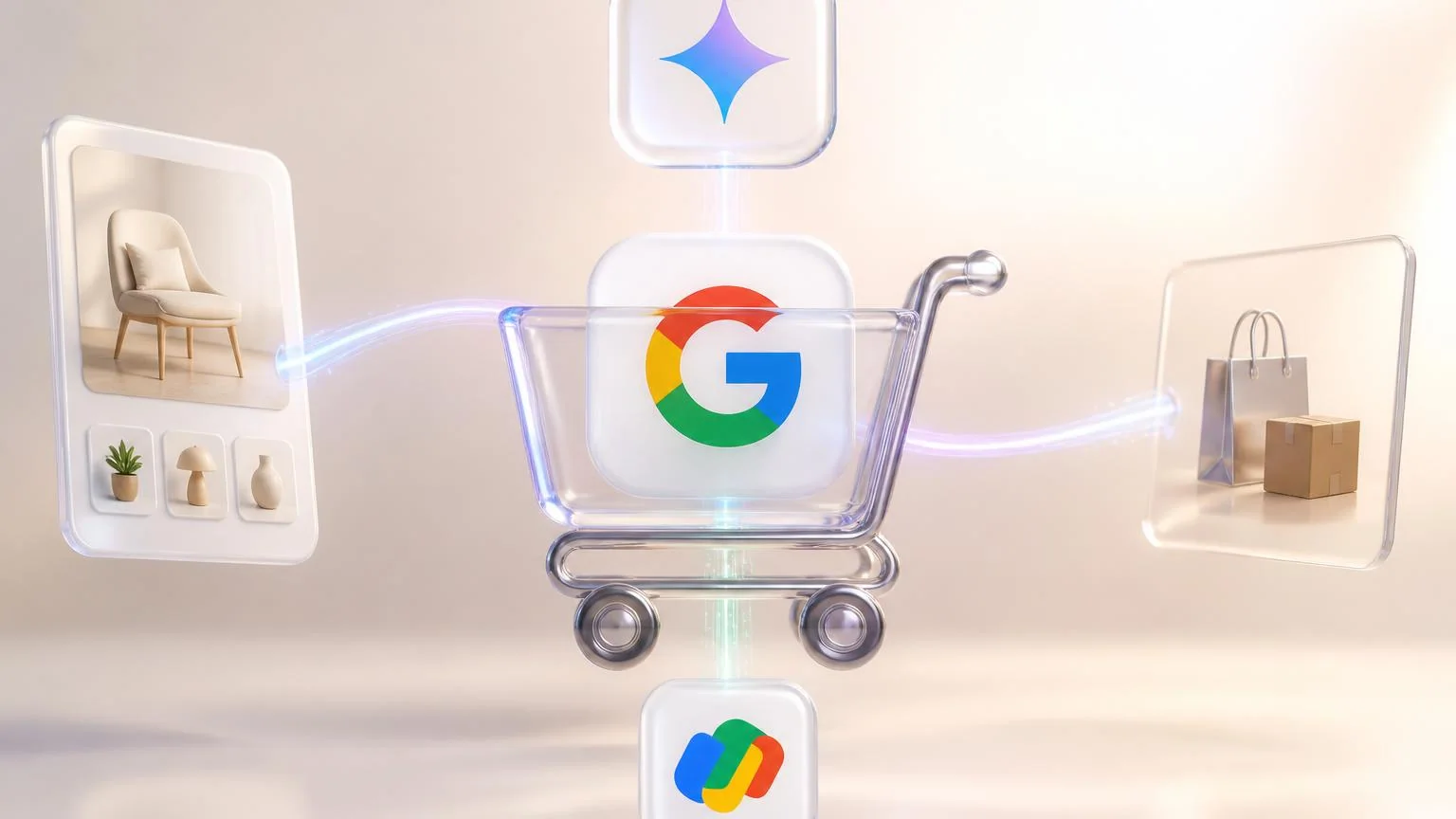
On May 19, 2026, at Google I/O 2026, Google introduced Universal Cart as the next step in its agentic commerce push, tying together Search, the Gemini app, Google Wallet, the Universal Commerce Protocol and agentic checkout. The announcement matters because Google is no longer treating shopping AI as a discovery feature alone. It is building a cross-surface transaction layer that can follow a shopper from product research to purchase.
For ecommerce operators, that changes the story from “Google sends traffic” to “Google increasingly shapes the shopping workflow itself.” Universal Cart is meant to work across merchants and across Google surfaces, while the underlying protocol and payments work are designed to make agent-driven checkout more standardized, portable and secure.
What Google actually launched on May 19
Universal Cart is Google’s new intelligent shopping hub. Shoppers can add products while browsing Search, chatting with Gemini, and eventually while using YouTube or Gmail, and Google keeps the cart working in the background.
- It watches for price drops, deal opportunities and back-in-stock updates.
- It adds price-history context and other decision support inside the cart.
- It uses Gemini models for reasoning-based shopping assistance.
- It can proactively flag issues such as product incompatibility in multi-item purchases.
Google also tied the cart directly to Google Wallet data, which means the system can factor in payment-method perks, loyalty benefits and merchant offers when helping a shopper decide. That is a meaningful shift from a passive cart to a decision-making surface.
On checkout, Google says shoppers will be able either to complete a purchase with Google Pay in a few taps or transfer the items to the merchant site to finish the order. Google also said the brand remains the merchant of record, an important detail for retailers worried that agentic commerce platforms will try to sit between merchants and the final transaction relationship.
Select checkout features are expected across merchants including Nike, Sephora, Target, Ulta Beauty, Walmart, Wayfair and Shopify merchants such as Fenty and Steve Madden. Google said Universal Cart will roll out across Search and the Gemini app in the U.S. this summer, with YouTube and Gmail to follow.
Why this is bigger than a smarter shopping cart
The important part of the announcement is the infrastructure underneath it. Universal Cart is built on top of Google’s broader commerce stack, especially the Universal Commerce Protocol, or UCP, and the Agent Payments Protocol, or AP2.
Google introduced UCP earlier in 2026 as an open standard for agentic commerce across discovery, buying and post-purchase flows. In March, Google added capabilities that let agents save multiple items to a cart, retrieve real-time catalog data such as variants, inventory and pricing, and support identity linking so shoppers can receive retailer-specific loyalty or membership benefits on integrated platforms.
That means Universal Cart is not just a front-end feature. It is a consumer-facing expression of a larger protocol strategy. If UCP adoption grows, Google gets a more normalized way to move product data, cart actions, loyalty context and checkout intent across merchants and AI surfaces.
AP2 matters for the same reason. Google has been positioning it as the security and accountability layer for agentic payments, with strict transaction guardrails and a verifiable record of what an agent was allowed to buy. In practice, that is one of the key blockers for real agentic checkout. Recommendation flows are easy to demo. Trusted payment execution is much harder.
The combined effect is that Google is trying to turn shopping from a search-and-click behavior into an agent-assisted workflow with shared standards, payment controls and persistent context.
Business impact for ecommerce operators
The biggest implication is that product discovery, cart building and checkout optimization may increasingly happen inside Google-controlled surfaces rather than only on a merchant’s own storefront. That does not eliminate the merchant relationship, but it does raise the stakes on structured product data, real-time inventory quality, loyalty integration and protocol readiness.
Merchants that treat Google Shopping as just another traffic channel may be late to the next shift. If agentic carts and agentic checkout gain usage, operators will need to think about Google as a transaction orchestration layer, not only an acquisition channel.
Three business effects stand out.
Discovery and conversion get closer together
Google is compressing the distance between product research and purchase. If a shopper can compare, monitor, save and buy across Search and Gemini without starting over each time, the handoff friction that used to happen between discovery and checkout starts to shrink.
Merchant data quality becomes even more strategic
UCP’s catalog, cart and identity-linking capabilities all depend on cleaner merchant-side data and better systems exposure. Operators with weak catalog hygiene, patchy inventory accuracy or disconnected loyalty data may become less legible to agentic shopping systems.
AI agents gain a clearer commerce execution layer
For AI agent builders, Google’s move is a signal that shopping is becoming a protocol problem, not only an interface problem. Once carts, product data, payment permissions and checkout handoffs are standardized, external agents and internal commerce automations become more realistic.
That matters well beyond retail media. It affects concierge buying flows, replenishment agents, travel and booking assistants, comparison agents, post-purchase service agents and any commerce workflow where AI is expected to take action instead of only answering questions.
What to watch next
The near-term questions are adoption, rollout depth and platform control.
First, watch whether UCP onboarding through Merchant Center becomes materially easier for merchants and commerce platforms. Google has already said it is simplifying onboarding and that partners such as Commerce Inc, Salesforce and Stripe will implement UCP. If that turns into broad ecosystem support, Google’s protocol layer gets stronger.
Second, watch how much shopping volume actually moves into Search and Gemini-native flows once Universal Cart rolls out in the U.S. this summer. If consumers start treating Google as the place where carts persist across services, it could meaningfully change conversion paths for ecommerce brands.
Third, watch expansion beyond retail products. Google said its UCP-powered checkout experience is expanding to Canada and Australia in the coming months and later to the U.K., and that UCP is also coming to YouTube in the U.S. and later to verticals including hotel booking and local food delivery. That suggests Google sees agentic commerce as a horizontal transaction layer, not a shopping-only feature.
The broader takeaway is simple: Google is trying to make agentic commerce operational. Universal Cart is the visible product announcement, but the more important shift is the stack behind it. For ecommerce operators, the question is no longer whether AI will influence shopping. It is whether your catalog, checkout, loyalty and post-click systems are ready for AI agents to become active participants in the purchase journey.