
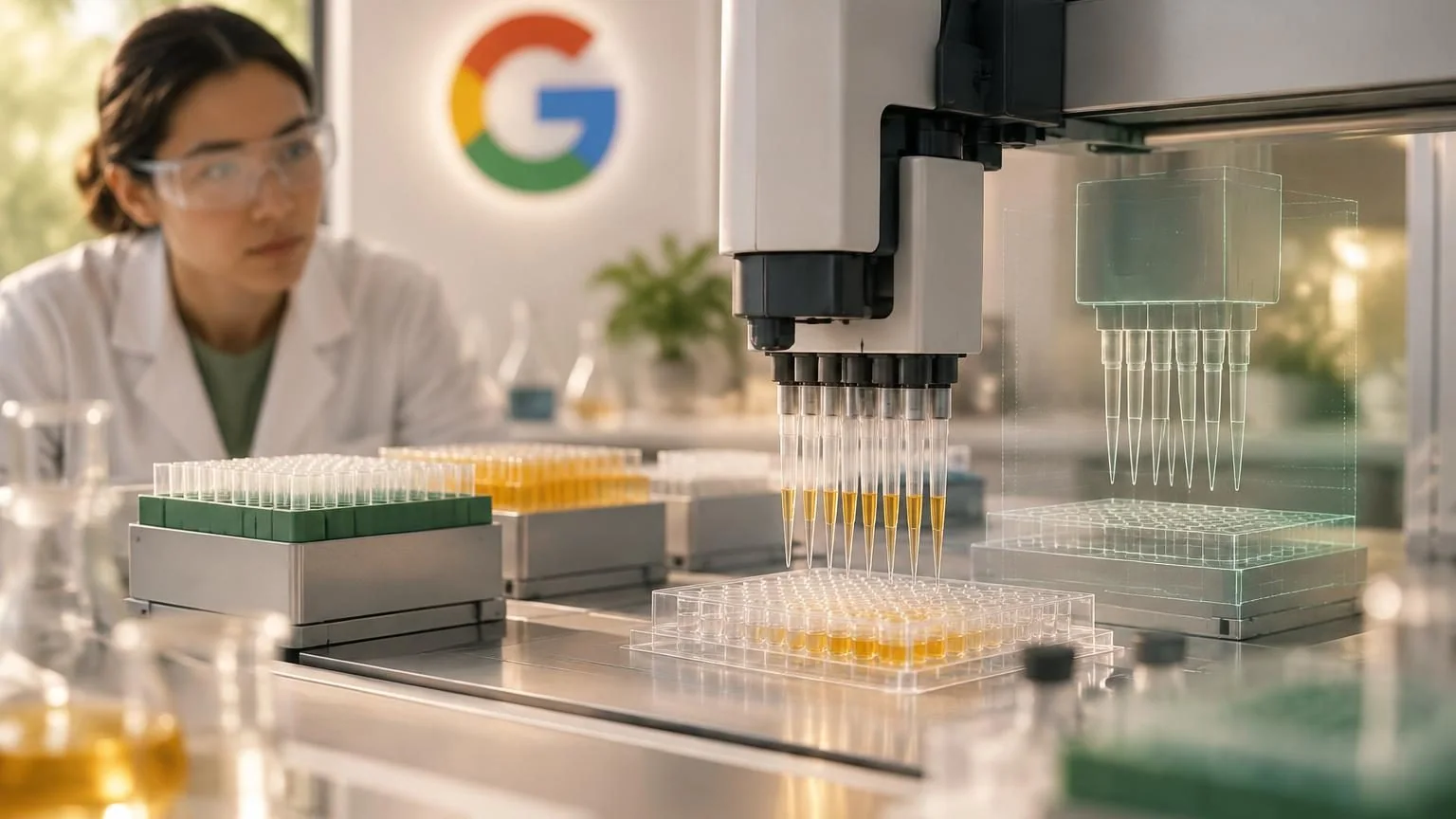
Google Research presented three connected research projects on October 16, 2026, covering laboratory robotics, iterative molecular discovery and protein design. The important distinction: these are building blocks for human-directed discovery, not a completed autonomous laboratory. Google says integrating the strands is a next step. Read Google's announcement.
VERID checks the lab, not just the code
VERID, short for VERified Infrastructure for Discovery Laboratories, maintains a persistent digital representation of a robotic workcell. It tracks geometry, liquid volumes and equipment state across command blocks. Proposed actions pass through simulation before hardware execution, while synchronized records support debugging. The VERID paper describes three case studies using dye and water, rather than biological discovery experiments.
That scope matters. A successful software instruction can still be an impossible physical action. The researchers demonstrate error detection and recovery, including continuation after an instrument failure. This is evidence about execution infrastructure, not proof that arbitrary laboratory tasks are safe to delegate.
Experimental feedback changed molecular designs
A separate aptamer study tested whether agents could improve protein-binding DNA candidates across three rounds. Reported bead-corrected hit rates reached 42.1% for alpha-thrombin and 33.5% for myoglobin among newly designed candidates.
Progress was not uniformly upward. Myoglobin hit rates fell from 10.2% to 3.7% before recovering. Experimental feedback exposed nonspecific binding that had made some candidates look promising. The useful lesson is not simply that agents generated molecules. It is that measured failures helped redirect the search.
Human-agent collaboration had a measurable advantage
The protein-design paper explores reducing computation by modeling a local binding region rather than an entire target. In its FAP comparison, a human-in-the-loop workflow increased the computational hit rate from 5.06% to 9.33% under a fixed compute budget. Those are computational screening results, not clinical success rates.
The researchers also report laboratory evidence of nanomolar binders. That does not establish a treatment. Compute savings were conditional: seven of 15 benchmark targets showed no speedup because their full complexes already fitted the smallest processing bucket.
What deployment teams should take from this
Google says humans authorize and review designed sequences, verify protocols and supervise robot runs. Its announcement also identifies further integration and reliability work. These safeguards remain part of the research workflow.
Our deployment takeaway is broader than biology: evaluate the environment around an agent, not only its answers. Before expanding permissions, ask what state it can inspect, what blocks an invalid action, how a failed run resumes and who authorizes consequential steps. Treat those as acceptance criteria, not optional documentation.