
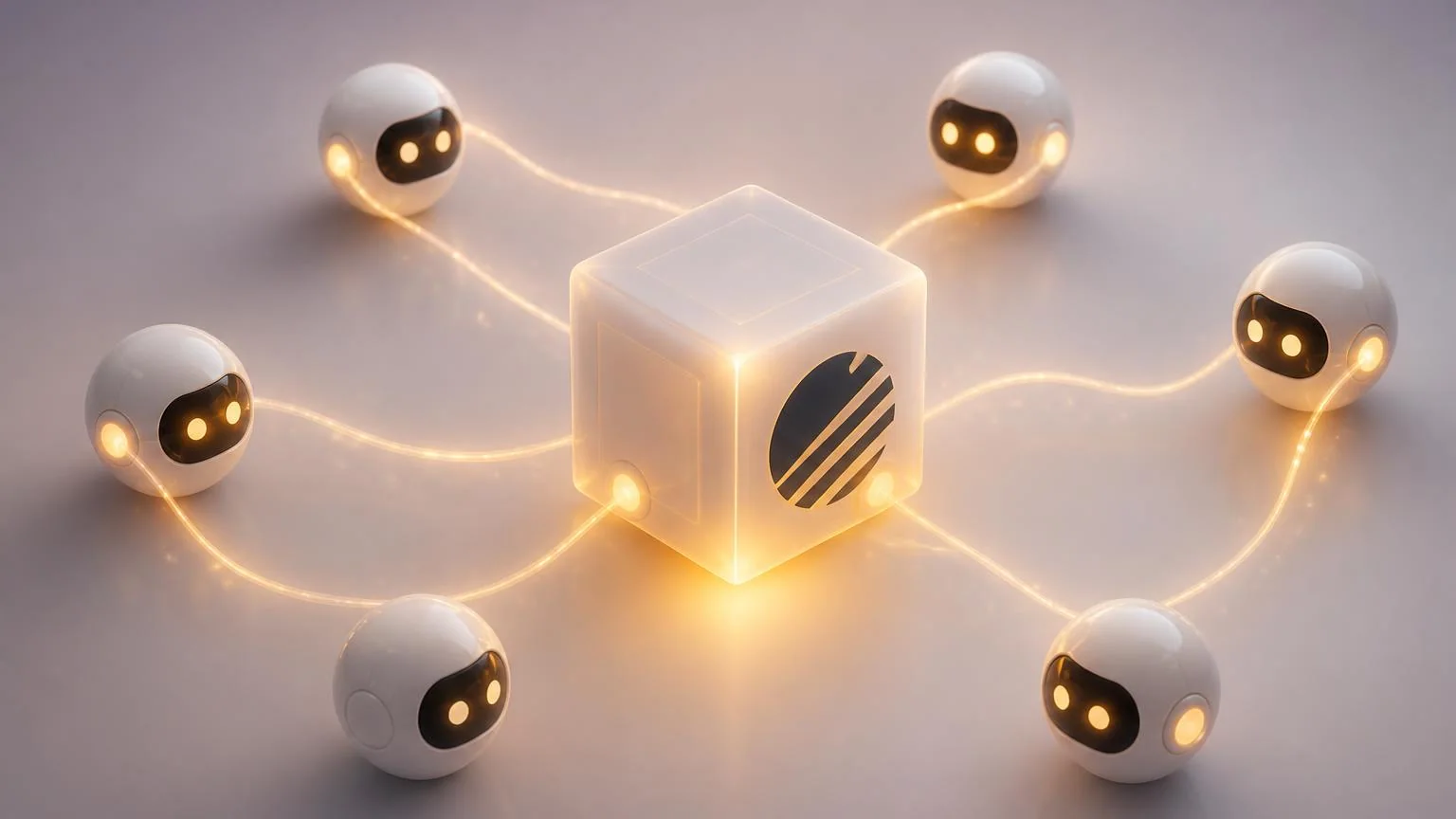
Moonshot AI’s April 20, 2026 Kimi K2.6 release is easy to summarize the wrong way. Many people see it as another strong open model for coding. That is true, but it undersells the bigger shift.
Kimi K2.6 is really a bet on a different operating model for AI work: not one overloaded assistant, but a coordinated swarm of specialized agents that can search, analyze, write, build, and package outputs together. That matters because the industry’s next bottleneck is no longer just model quality. It is workflow coordination, long-running reliability, and how teams turn one capable model into repeatable output across real tasks.
This guide explains what Kimi K2.6 Agent Swarm actually is, how it differs from ordinary coding-agent products, and why businesses should pay attention.
What Kimi K2.6 added beyond a model upgrade
Moonshot describes Kimi K2.6 as an open-source model built for state-of-the-art coding, long-horizon execution, and agent swarm capabilities. On its product page, the company frames the release around a clear shift: “from code to creation, from one to many.”
That phrasing matters. Kimi K2.6 is not only trying to answer better than earlier models. It is trying to coordinate more work across multiple agents and output types.
Moonshot highlights several additions around that idea:
- Upgraded Agent Swarm for stronger parallel coordination across specialized agents
- Long-horizon execution for sustained multi-step work
- Document-to-skills workflows that turn high-quality documents into reusable skills
- Claw Groups support for more open collaboration across humans and multiple agents
- Broader deliverable generation across websites, documents, slides, spreadsheets, and multimodal tasks
That makes Kimi K2.6 feel less like a single-model release and more like an open multi-agent work system.
What Agent Swarm actually does
The most important product claim is that Kimi K2.6 improves how agents coordinate in parallel. Moonshot says the swarm can combine strengths such as broad search, deep research, large-scale analysis, long-form writing, and multi-format content generation in a single run.
The practical implication is straightforward: the agent does not have to solve everything serially. It can split work into parallel branches, then recombine the results into a polished output.
That matters because many real tasks are naturally multi-threaded:
- Research requires search, filtering, summarization, and synthesis
- Software tasks require planning, coding, debugging, and validation
- Business deliverables require writing, slide generation, spreadsheet work, and formatting
Single-threaded agents can do these tasks, but they often become slow, brittle, or hard to supervise. Swarm-style execution is one path toward making longer workflows feel more operational and less like prompt theater.
Why this is different from a standard coding agent
Most coding-agent products still revolve around one main loop: inspect code, propose changes, run tools, retry, and report back. Kimi K2.6 pushes further than that.
Moonshot positions the model as capable of building not only code, but complete deliverables. Its product materials emphasize website generation, multimodal understanding, slide creation, and document workflows alongside software tasks.
That matters because the market is shifting from “AI that helps write code” toward “AI that helps complete work.”
For engineering and operations teams, that can mean a system that handles repository work, produces artifacts, and packages outputs for stakeholders. For non-engineering teams, it can mean one agentic system that moves across research, structured content, and presentation-ready assets.
The point is not that every team needs a swarm. The point is that the unit of value is changing from single response quality to coordinated task completion.
Reusable skills may be the sleeper feature
One of the more commercially interesting pieces of Kimi K2.6 is its document-to-skills workflow. Moonshot says high-quality documents can become reusable skills that capture how strong work is structured and written, then be applied to future tasks.
That is more important than it sounds.
Most teams already have valuable process knowledge, but it lives in decks, reports, templates, SOPs, and examples. Converting those into reusable skills is a way to turn static knowledge into operational behavior.
If this approach works well, it could lower one of the biggest barriers in enterprise AI adoption: the gap between “we know how to do this task well” and “the agent can now do it consistently.”
In other words, Kimi is not just selling model capability. It is selling a way to package institutional know-how so agents can reuse it.
Claw Groups points toward a more open multi-agent environment
Moonshot’s technical materials also describe Claw Groups as a research preview that extends the Agent Swarm concept into a more heterogeneous environment where humans and agents can collaborate together.
The significance here is architectural. Many multi-agent systems assume one vendor-controlled runtime. Claw Groups points toward a looser model where different agents, devices, skills, and memory contexts can collaborate in a shared operating space.
That is still early, but it aligns with a broader market direction: businesses do not want one monolithic agent. They want a governed system where multiple agents can contribute specialized work across tools and environments.
How strong is the underlying model?
Kimi K2.6 is getting attention partly because the base model is competitive enough to make the Agent Swarm story credible. Moonshot reports strong results across coding, tool-augmented tasks, reasoning, and vision, and says tests were run with a 262,144-token context length.
Its technical materials report results across benchmarks such as Terminal-Bench 2.0, SWE-Bench Pro, SWE-Bench Verified, BrowseComp, DeepSearchQA, and OSWorld-Verified. As with any vendor-reported benchmarks, teams should treat them as directional rather than final truth. But the important point is that Kimi K2.6 appears strong enough across coding and agentic tasks that the workflow layer is worth taking seriously.
That combination matters. A swarm interface without a capable base model is mostly orchestration theater. A strong base model without a good coordination layer can still struggle on long, messy tasks. Kimi K2.6 is interesting because it is trying to improve both at once.
What businesses should take away
Kimi K2.6 Agent Swarm will not replace every agent stack. Enterprises that need tight security controls, compliance layers, and deep system integration may still prefer more governed platform paths. But the release is important for at least three reasons.
- Open models are becoming more operational. The conversation is moving beyond “cheap alternative to closed models” toward “credible foundation for real multi-agent work.”
- Multi-agent coordination is becoming a product feature. Teams no longer need to assume all orchestration must be hand-built from scratch.
- Reusable skills are becoming a competitive layer. The best agent systems may not only have strong reasoning. They may also package a team’s best workflows into repeatable behavior.
The bottom line
Kimi K2.6 Agent Swarm matters because it makes the open-model market feel more workflow-native. Moonshot is not only trying to win on raw model quality. It is trying to make open AI systems better at coordinating long-running, multi-format, multi-agent work.
That is exactly where many teams are headed. The next generation of business AI is not one assistant answering one question. It is groups of agents handling research, creation, execution, and packaging together. Kimi K2.6 is one of the clearest open-model signals that this shift is moving from concept to product reality.
Want AI agents that do more than answer prompts?
Nerova helps businesses build AI agents and AI teams that can coordinate work across tools, workflows, and governed production environments.