
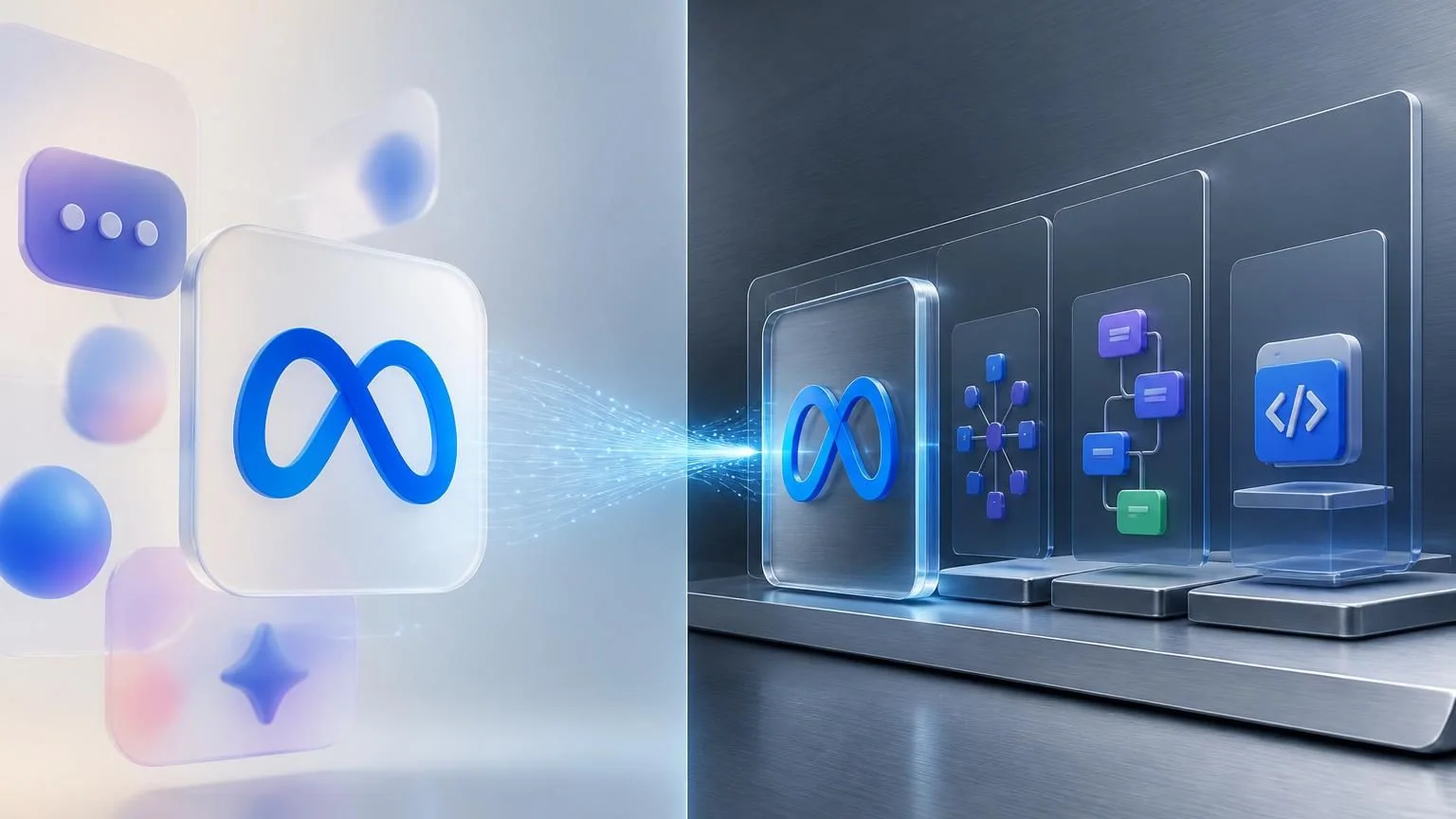
Meta’s July 9, 2026 AI release matters for a simple reason: it was not just another benchmark-heavy model announcement. With Muse Spark 1.1 and the new Meta Model API, Meta took a clear step from shipping consumer-facing AI experiences to courting developers who want to build paid, production-facing agent systems on top of Meta’s own stack.
That is the real story for business teams. Meta can now compete more directly not only for AI attention, but for the workflow layer that sits underneath coding assistants, multimodal agents, and enterprise automation. If you build AI agents for internal operations, software delivery, support, or multimodal workflows, Meta just became harder to ignore.
What Meta actually launched on July 9
Meta introduced Muse Spark 1.1 as a multimodal reasoning model with stronger tool use, computer use, coding, and multimodal understanding than the earlier Muse Spark release. In the company’s launch post, Meta positioned the model around agentic tasks rather than plain chat, highlighting use cases such as debugging large codebases, operating software, using tools, and handling long, multi-step workflows.
The launch came with a more important infrastructure move: Meta opened the new Meta Model API in public preview, giving outside developers access to Muse Spark 1.1 for the first time. Reuters reported that the preview is currently available to U.S. developers, includes $20 in free credits for testing, and then moves to pay-as-you-go pricing.
That combination changes the commercial picture. A strong in-house model is interesting. A metered API with developer onboarding, preview credits, and an explicit pricing model is a platform play.
Why the API matters more than another benchmark chart
Most frontier model launches now arrive with the usual claims about coding, reasoning, and tool use. What makes this launch different is that Meta is no longer asking the market to judge it only as a research lab or chatbot maker. It is asking developers to trust Meta as an AI runtime vendor.
That raises the stakes. Once a company offers public API access for agent workloads, buyers stop asking whether the model looks impressive in a demo and start asking harder questions: Can it slot into production workflows? Can it support multi-step automation? Is pricing predictable enough for repeated use? Does it broaden model optionality for teams that do not want to rely on a single vendor?
Meta’s own positioning suggests it understands that shift. The company emphasized tool and computer use, enterprise-grade coding tasks, and multimodal workflows where perception and action happen together. In practical terms, that points toward a model meant to sit inside agent systems, not just answer prompts in a consumer app.
For Nerova’s audience, that is the useful takeaway. Muse Spark 1.1 is not important because every business suddenly needs to migrate to Meta. It is important because the frontier model market just gained another serious supplier for agent orchestration, coding-heavy automation, and multimodal execution flows.
The safety report is part of the story too
Meta also published a detailed Muse Spark 1.1 evaluation report alongside the launch. That matters because it shows Meta trying to operate more like the leading frontier labs it is chasing. The report says Meta could not rule out a “high risk” capability threshold in chemical and biological and cybersecurity domains before mitigations, but that with its deployment safeguards in place, residual risk was reduced to “moderate or lower” under its framework.
That does not make the launch risk-free. It does show that Meta is treating external API access for agentic systems as a deployment problem that needs governance, red-teaming, and mitigation layers, not just marketing language.
The performance details are also notable. In Meta’s report, Muse Spark 1.1 posts a Cybench pass@1 score of 92.9%, up from 65.4% for Muse Spark 1.0, and a curated CTF pass@1 score of 89.9%, up from 72.0%. Those numbers matter less as scoreboard theater and more as evidence that Meta is optimizing for hard technical workflows where autonomous or semi-autonomous agents need to reason across many steps.
What business teams should do with this news
The wrong reaction is to treat Muse Spark 1.1 as an instant default. The better reaction is to expand your model evaluation shortlist.
If your team is building coding agents, desktop or browser automation, multimodal intake workflows, or long-running internal assistants, Meta now looks more relevant than it did a week ago. The right question is not “Is Meta best overall?” It is “Which parts of our stack benefit from another frontier model option?”
For many companies, the biggest value will be strategic rather than immediate. A broader vendor field can improve pricing leverage, reduce concentration risk, and create more room for task-level routing across models. Some workflows may still fit OpenAI or Anthropic better. Others may benefit from testing Muse Spark 1.1 where coding, multimodal context, or agent scaffolding matter most.
That is why this launch deserves attention. Meta did not just update a model. It crossed into a more operational category: paid developer infrastructure for AI agents. In the next phase of enterprise AI, that category will matter more than who wins a single benchmark cycle.
The bottom line
Muse Spark 1.1 may or may not become the default choice for serious agent builders. But the Meta Model API launch means Meta is finally competing where real production decisions get made: API access, workflow integration, agent reliability, and commercial usability.
For businesses, this is a stack decision signal. If you are planning AI agents that write code, use tools, process multimodal inputs, or run multi-step workflows, Meta now belongs in the conversation.