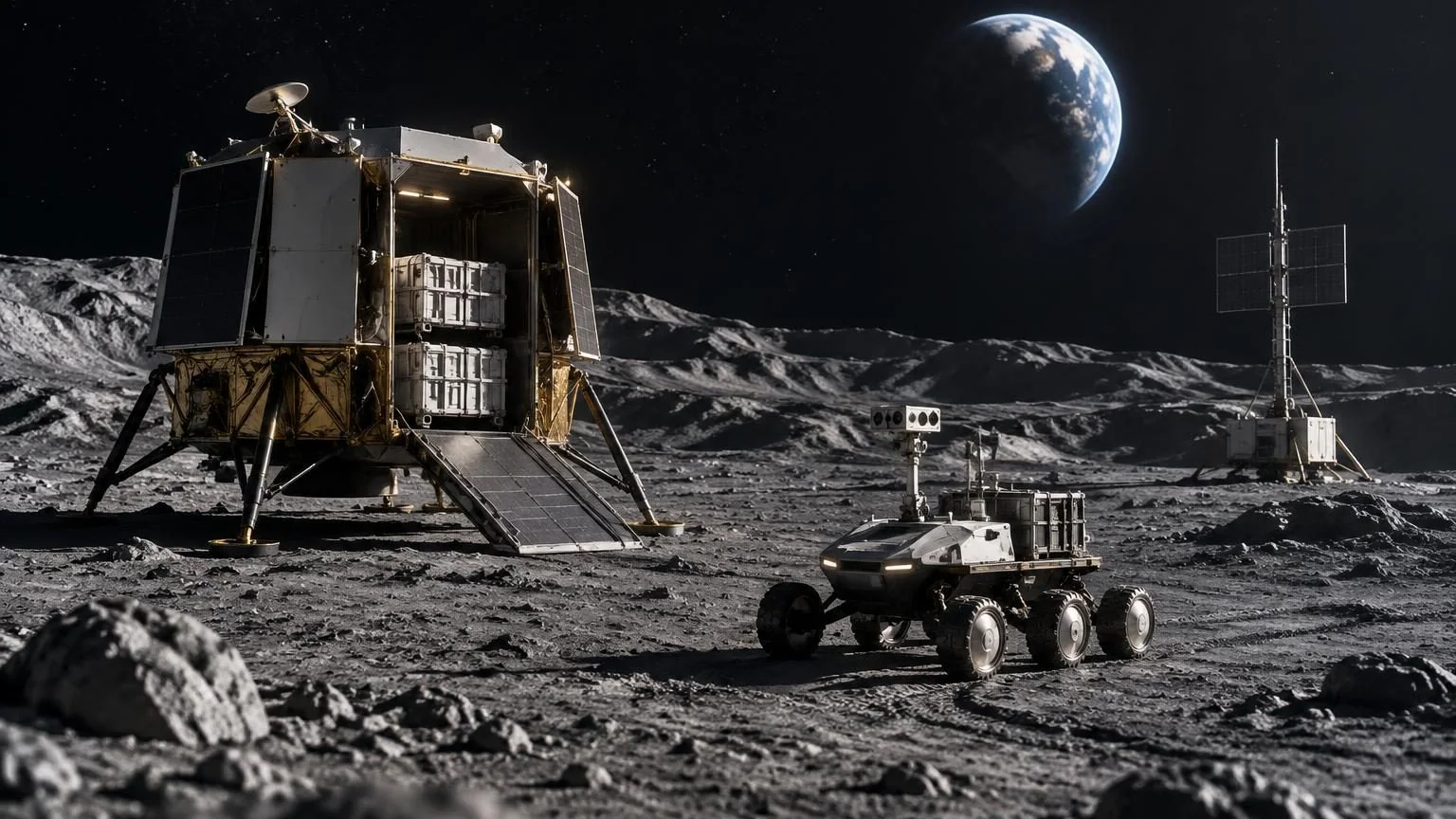
NASA announced a broad set of Moon Base transportation, technology, and science awards on November 7, 2026. The package spans commercial cargo delivery, development of a nuclear-powered rover, orbital transport demonstrations, and surface power and communications components. It connects several kinds of infrastructure needed for sustained lunar operations.
A delivery framework and a rover development program
NASA selected eight companies for the CLPS 2 delivery framework. The ten-year, multiple-award contract has a combined maximum value of $10 billion. That figure is a ceiling for the framework, rather than an announcement that every participant has received a share of a fully spent budget.
The agency also advanced PROMISE, the Polar Rover for Observation, Mapping, and In-Situ Exploration. NASA’s mission page describes a six-wheeled rover intended to investigate the lunar south pole, including locations difficult to explore because of darkness and extreme conditions. A late-2028 launch target and an 18-month mission remain plans, with development and delivery work still ahead.
Power and communications are mission capabilities
The November announcement also identifies commercial components for miniCAST, a small communications and solar tower concept. NASA names Honeybee Robotics for energy storage, Redwire for power generation, and Yank Technologies for wireless power transfer. Initial work involves components, with assembly and testing at Marshall Space Flight Center.
Our interpretation is that this infrastructure deserves attention alongside lander announcements. A payload reaching the surface needs a dependable way to operate and communicate afterward. Breaking those needs into explicit systems makes the development work more visible and helps explain why one launch cannot represent completion of a lunar infrastructure program.
How to read a package of space contracts
Separate selection, task award, development, launch, and successful operation when evaluating progress. Each stage resolves a different uncertainty. A company joining a procurement framework has crossed a meaningful threshold, but its future mission still needs a specific requirement, schedule, and delivery outcome.
For suppliers and researchers, the practical next step is to follow the particular program relevant to their work. Rover instruments, energy storage, surface communications, and transport services have different interfaces and qualification needs. A general exploration announcement can reveal an opportunity, but detailed program documentation determines whether a contribution fits.
The milestones worth following
Useful follow-up will include named delivery task orders, completed hardware tests, updated mission schedules, and evidence that separately developed systems can operate together. Changes to launch targets should be tracked as program updates rather than hidden behind the original announcement date.
NASA’s November package broadens the industrial work supporting its Moon Base plans. The strongest reading is a connected set of development and procurement steps, with future flight and surface operations providing the tests of whether the planned capabilities work together.