
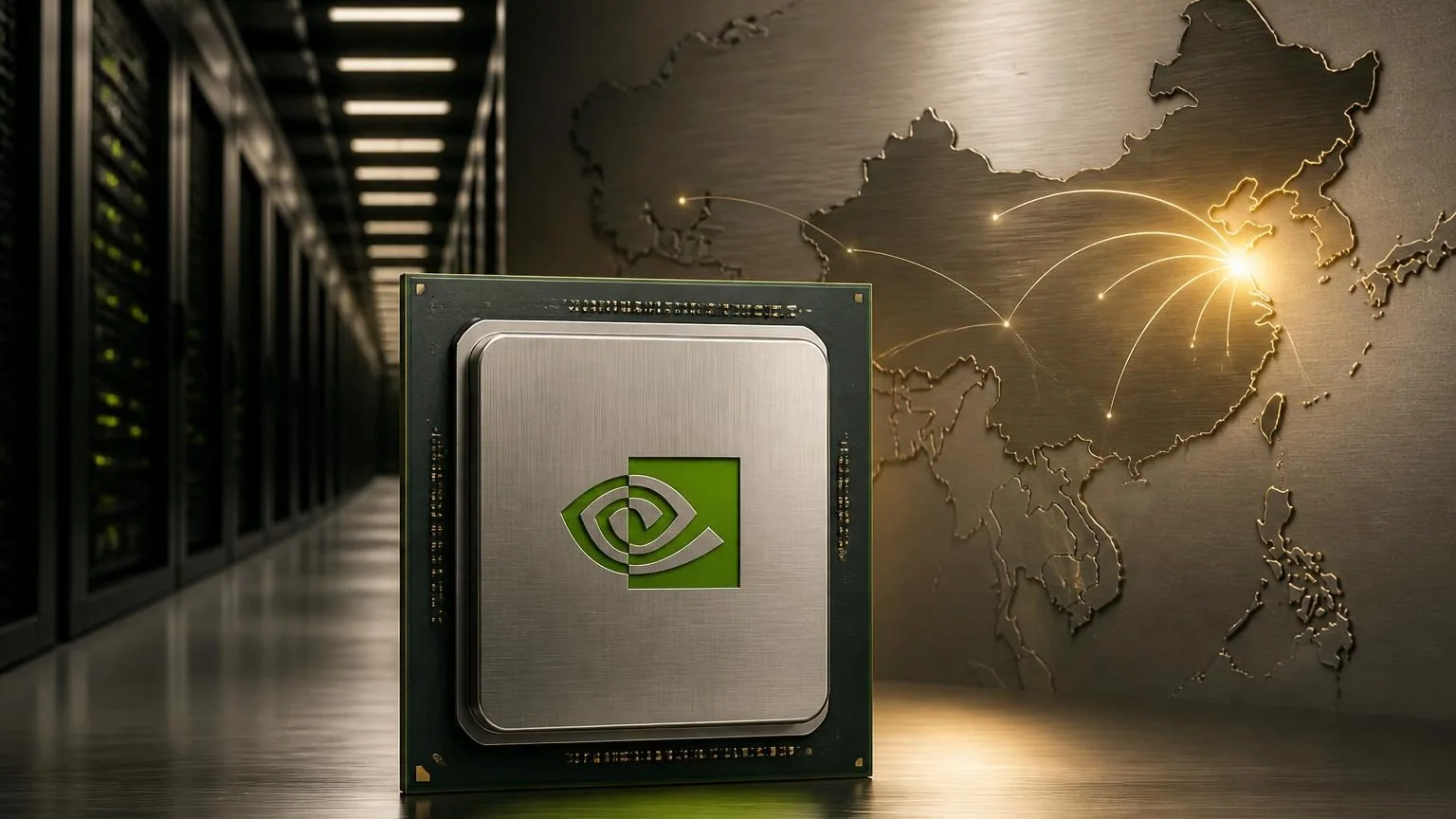
On June 12, 2026, Reuters reported that Nvidia has started telling Chinese customers they can place orders for its new Vera central processors for AI data centers, with availability potentially starting in August. The outreach matters because Nvidia’s H200 GPU deliveries to China have reportedly stalled for months, leaving the company looking for a new route back into one of the world’s most strategically important AI infrastructure markets.
That makes this more than a regional chip-sales update. Vera is Nvidia’s first standalone CPU built specifically for agentic AI workloads, and its China push lands as the market shifts from pure model-training capacity toward the CPU, memory, networking, and orchestration layers that long-running AI agents depend on.
What Nvidia told Chinese customers on June 12
According to Reuters, Nvidia has told Chinese clients that Vera CPUs could be available as soon as August and that ordering can begin now. One major Chinese cloud company is reportedly planning to test more than 300 servers, each with two Vera CPUs, before deciding on a larger deployment.
Reuters also reported that Chinese customers plan to test Vera first in overseas data centers. That detail matters because it suggests the near-term opportunity is not a simple domestic China rebound for Nvidia. It is a more cautious route shaped by export controls, local approval dynamics, and the practical difficulty of shifting workloads across different infrastructure stacks.
- Possible August availability for Vera CPUs in China
- Initial customer outreach focused on AI data center buyers
- At least one reported test plan involving more than 300 servers
- Early deployments expected to start in overseas data centers rather than inside mainland China
Why a CPU matters more than it used to
When Nvidia unveiled the Vera Rubin platform on March 16, it positioned Vera as a core part of agentic AI infrastructure rather than a side product. Nvidia said reinforcement-learning and agentic AI systems rely on large numbers of CPU-based environments to test, validate, and coordinate the work happening around GPU systems.
In Nvidia’s official description, a Vera CPU rack integrates 256 Vera CPUs, and the company says the system can deliver twice the efficiency and 50% faster results than traditional CPUs for those workloads. The broader point is the important one for buyers: the bottleneck in AI infrastructure is no longer only the accelerator. Long-running agents need more behind-the-scenes compute for orchestration, environment simulation, retrieval, and execution support.
Nvidia also said Vera Rubin-based products are expected to be available from major cloud and hardware partners in the second half of 2026. That makes Vera more than a niche experiment. It is being framed as a mainstream component in the next rack-scale AI factory buildout.
Why this is a China and export-controls story, not just a product story
Reuters said Nvidia’s market share in China has effectively fallen to zero, reflecting the combined effect of U.S. export controls on advanced chips and Beijing’s push for domestic self-reliance. Reuters also reported that about 10 Chinese firms have been licensed to buy H200 GPUs, but that no deliveries have yet been made.
That is why Vera matters. Selling CPUs into China may prove less politically and regulatorily fraught than selling top-end GPUs, even if it does not fully replace Nvidia’s lost accelerator business there. Based on Arm technology, Vera also puts Nvidia into a more direct fight with Intel and AMD in AI data center CPUs, at a moment when inference demand is putting more pressure on the server processor layer.
This is not a full reset
Early interest does not guarantee fast adoption. Reuters said customers still face software ecosystem and compatibility questions, especially when workloads were designed around domestic chips or different server architectures. A test order is a signal of demand, but it is not the same thing as a production-standard rollout.
What to watch before August
The first question is whether pilot systems turn into committed production orders. A second is whether Chinese cloud providers can integrate Vera into inference-heavy and agentic workloads without creating new operational friction elsewhere in the stack. A third is geopolitical: if CPUs become a more important workaround for serving AI markets under GPU restrictions, Washington may face pressure to look harder at the broader AI server bill of materials, not only accelerators.
For enterprise AI teams, the practical takeaway is straightforward. Infrastructure planning for AI agents is becoming less about picking one frontier model and more about understanding the full execution stack around it: CPUs, GPUs, networking, memory, approvals, and regional supply constraints. Nvidia’s June 12 Vera move is one more sign that the next AI rollout fights will be won in deployment architecture, not just model headlines.