
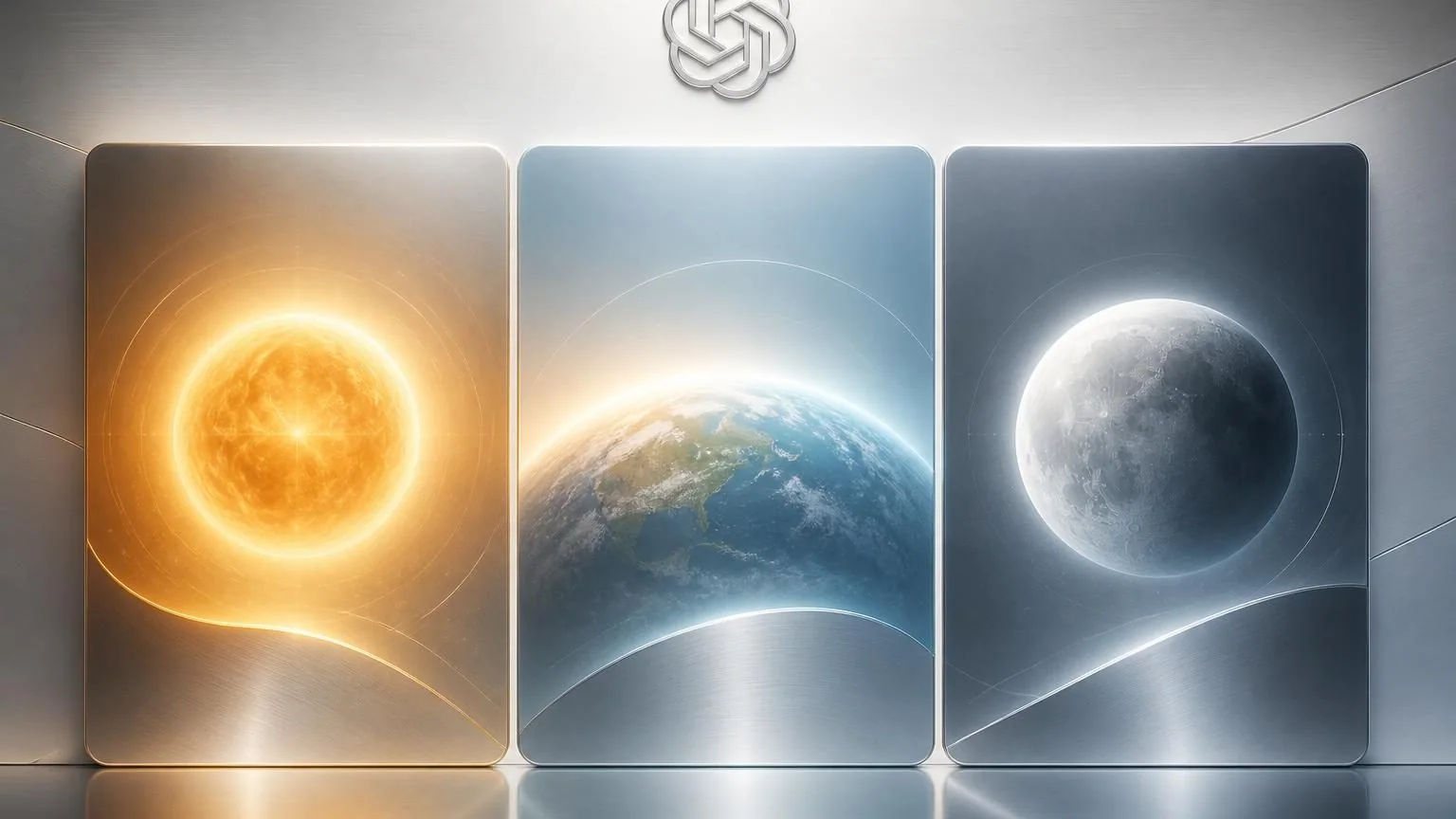
OpenAI turned GPT-5.6 from a limited June 26 preview into a July 9, 2026 rollout across ChatGPT, Codex, and the OpenAI API. The important part for buyers is not just the launch date. GPT-5.6 now ships as three durable tiers: Sol for maximum capability, Terra for the best everyday balance, and Luna for speed and cost efficiency.
If you only want the short answer, use Sol when quality failures are expensive, Terra for most serious business workflows, and Luna for high-volume tasks where latency and unit cost matter more than frontier reasoning.
What changed on July 9
On July 9, 2026, OpenAI began rolling GPT-5.6 out across ChatGPT, Codex, and the OpenAI API, after first previewing the family on June 26. That matters because Sol, Terra, and Luna are no longer just a preview naming experiment. OpenAI now describes them as durable capability tiers that can advance on their own cadence.
That is a meaningful change from earlier model naming. Instead of one default model plus a few hidden variants, OpenAI is making the tradeoff explicit: highest capability, balanced capability, or lowest-cost throughput.
Access also reflects that split. In the current rollout, Free and Go users get GPT-5.6 Terra in ChatGPT Work and Codex, while paid users can choose among Sol, Terra, and Luna. Pro and Enterprise users can also select Sol Pro in chat for the highest-quality results on complex work.
GPT-5.6 Sol vs Terra vs Luna at a glance
GPT-5.6 model differences that matter most
| Model | What it is best for | Main tradeoff |
|---|---|---|
| GPT-5.6 Sol | Hard coding, long-horizon research, complex agents, and high-stakes knowledge work | Highest cost and more safety friction on sensitive work |
| GPT-5.6 Terra | Most everyday business workflows that still need strong reasoning | Less headroom than Sol on the hardest tasks |
| GPT-5.6 Luna | Fast, high-volume automation, triage, lightweight copilots, and cost-sensitive workloads | Biggest drop in depth, long-context strength, and frontier-task performance |
OpenAI’s pricing reinforces that positioning. Sol is priced at $5 input and $30 output per million tokens. Terra is half that at $2.50 and $15. Luna drops to $1 and $6, making it the clear budget tier.
Why Sol is the premium tier
Sol is OpenAI’s flagship and strongest GPT-5.6 model. It is the tier to pick when you want the model to plan, use tools, revise, and stay on task across harder workflows. OpenAI also reserves its newest heavy-compute modes here: max reasoning and ultra, which coordinates multiple agents in parallel for demanding work.
The benchmark pattern is clear. Sol leads the family on professional work, coding, computer use, and cybersecurity. On OpenAI’s July 9 release page, Sol scores 52.7% on Agents' Last Exam, 80 on the Artificial Analysis Coding Agent Index, 88.8% on Terminal-Bench 2.1, and 62.6% on OSWorld 2.0. In plain English, Sol is the tier for jobs where the model needs to think longer, recover from mistakes, and produce work that is closer to ready to use.
Businesses should think of Sol as the model for expensive errors: production code changes, multi-step financial research, serious document generation, or agent workflows that need stronger judgment instead of just fast output.
Why Terra will probably be the default business pick
Terra is the middle tier, but it is not a throwaway midrange model. OpenAI describes it as a balanced model for everyday work and says it delivers performance competitive with GPT-5.5 at a lower cost. In the earlier preview announcement, OpenAI was even more explicit: Terra had competitive GPT-5.5-level performance while being 2x cheaper.
That makes Terra the practical center of the lineup. It is materially cheaper than Sol, but it stays surprisingly close on many business-relevant evaluations. On July 9 figures, Terra scores 50.4% on Agents' Last Exam, 77.4 on the Coding Agent Index, 87.4% on Terminal-Bench 2.1, and 87.5% on BrowseComp. Those are not flagship numbers, but they are high enough to make Terra a serious option for internal assistants, coding copilots, research helpers, and document-heavy workflows.
If Sol is what you buy for the hardest cases, Terra is what you deploy when you need strong quality at sustainable scale.
Why Luna is about throughput, not prestige
Luna is the fastest and most affordable tier in the family. OpenAI positions it as the model for high-volume work where cost and latency matter most. That makes Luna the best fit for first-pass classification, triage, monitoring, lightweight automation, or large volumes of routine user requests.
The tradeoff is real. Luna is still capable, but it falls further behind Sol and Terra on long-context recall, difficult cyber tasks, and the hardest reasoning-heavy benchmarks. On July 9 data, Luna scores 50.3% on Agents' Last Exam, 74.6 on the Coding Agent Index, 84.7% on Terminal-Bench 2.1, and only 41.3% on OpenAI’s MRCR long-context test where Sol reaches 91.5% and Terra 89.6%.
So Luna is not bad GPT-5.6. It is the tier for teams that care more about cost per successful task than best possible performance on every request.
The biggest non-obvious difference: safety behavior
The Sol-Terra-Luna split is not only about price. OpenAI’s system card says the safeguard stack is calibrated to each model’s capability profile, and it specifically notes new activation classifiers for Sol and Terra in sensitive domains. OpenAI’s help center also says some cybersecurity and biology requests may trigger extra automated checks, and users may be offered a retry on GPT-5.6 Luna as the faster, lower-intelligence fallback.
That matters operationally. If your workflow touches security research, defensive testing, or other dual-use areas, the model choice can affect not only quality and cost but also how often requests slow down, escalate to extra checks, or need a lower-capability retry.
Which GPT-5.6 tier should a business actually choose?
The easiest way to think about the family is by failure cost.
- Choose Sol when bad answers are expensive, tasks are long-horizon, or the agent must reason, browse, code, and self-correct with minimal supervision.
- Choose Terra when you want the best operating point for everyday business use: strong quality, lower token cost, and broad applicability.
- Choose Luna when speed, concurrency, and budget matter more than squeezing out the last 10 to 20 percent of capability.
The news here is that OpenAI has turned those tradeoffs into a product structure users can actually target. Sol, Terra, and Luna are not cosmetic labels. They are now the practical menu for matching model economics to workflow difficulty.
For most companies, the likely rollout pattern is straightforward: start with Terra, upgrade the hardest workflows to Sol, and push repetitive high-volume work down to Luna.