
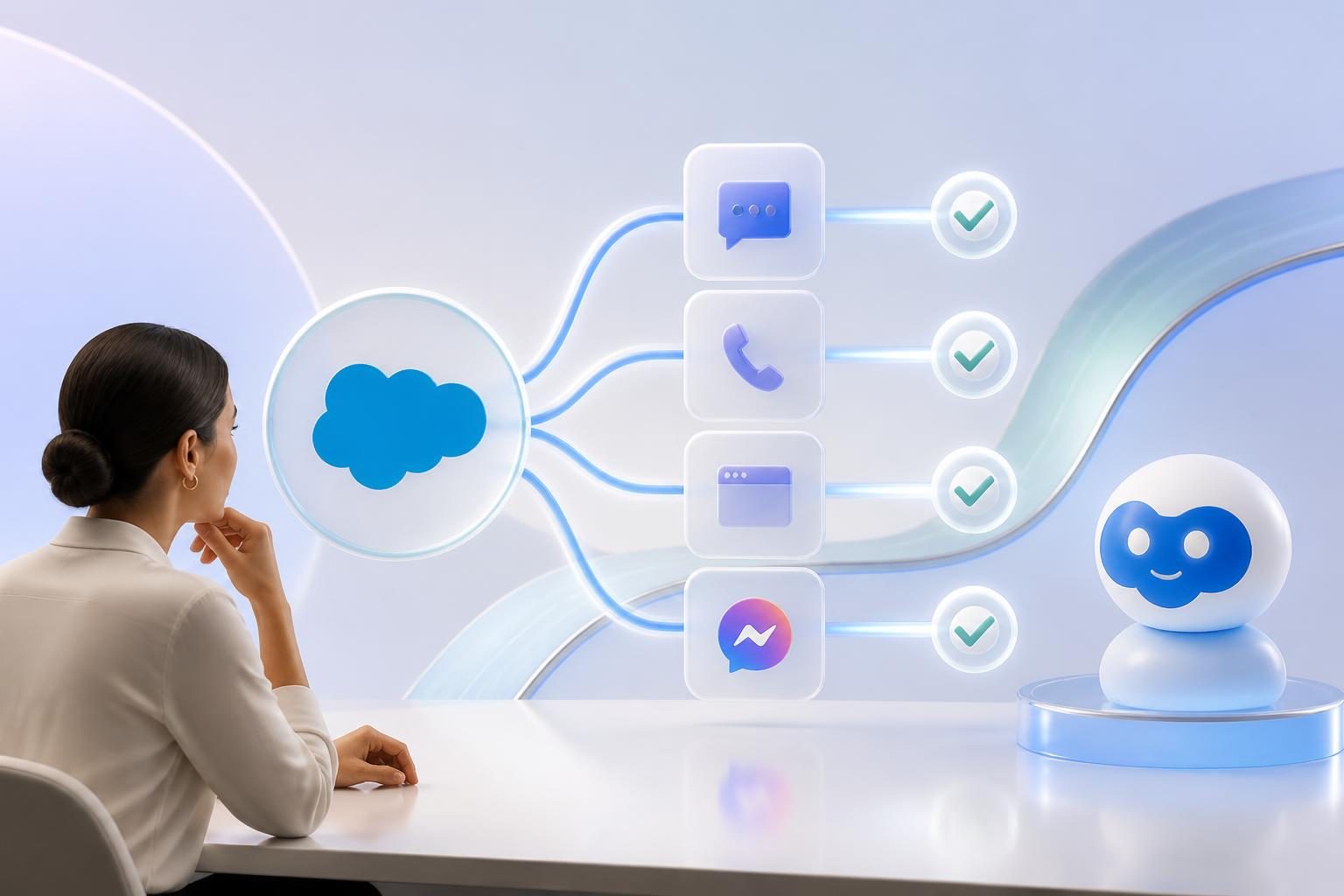
Salesforce used June 25, 2026 to make a sharper claim about where customer-service AI is heading. Its new Agentforce Help Agent is not just another support bot. It is a prepackaged autonomous service agent that Salesforce says can be deployed in minutes, grounded on Salesforce Knowledge, extended with real actions, and switched on across voice, web, portal, and messaging from a single setup flow.
The most important part is not the interface. It is the pricing model. Salesforce says customers will pay only when the Help Agent autonomously resolves an issue from start to finish. If the conversation escalates to a human or ends without a successful resolution, there is no charge. That shifts the AI support conversation from seats, tokens, and experimental usage toward a more outcome-based buying model.
For enterprises evaluating AI agents, that makes this launch more consequential than a standard feature release. It is a sign that large vendors now think the competitive edge in service AI is not just model quality. It is time-to-value, operational trust, and commercial alignment.
What Salesforce announced on June 25
According to Salesforce, Agentforce Help Agent is built for one specific job: resolving customer issues from start to finish on day one. The company is packaging several of the hardest deployment steps into the initial product:
- Knowledge grounding: the agent can ground itself on Salesforce Knowledge, with added files or crawled web content.
- Prebuilt actions: the system can answer questions, manage cases, and extend into workflows like appointment scheduling, order management, and account tasks.
- Omnichannel rollout: teams can enable voice, web, portal, and messaging from one screen instead of stitching together separate deployments.
- Guided setup and preview: Salesforce is positioning the product as deployable in minutes, with a testing layer before launch.
Salesforce also shared an internal proof point meant to reduce skepticism: on help.salesforce.com, Agentforce has handled 4.3 million inquiries and resolved 70% of them, with those operational lessons now baked into the packaged product. General availability for Agentforce Help Agent, the reworked customer-service portal, and pay-per-resolution pricing is scheduled for July 2026.
Why pay-per-resolution is the real story
Most enterprise AI buying still gets stuck on usage math. Teams may like a demo, but budgeting becomes harder once leaders have to estimate prompt volume, overage risk, support complexity, and the cost of human fallbacks. Salesforce is trying to simplify that conversation by tying spend to an outcome executives already understand: resolved customer issues.
That matters for three reasons.
First, it lowers procurement friction. A support leader can compare autonomous resolutions against cost-to-serve more directly than they can compare token curves or model throughput numbers.
Second, it puts pressure on vendors to care about end-to-end performance, not just partial automation. A flashy bot that deflects simple questions but fails on real tasks becomes less attractive if the pricing only triggers when the job is actually completed.
Third, it raises the bar for implementation quality. If revenue depends on successful resolutions, then data quality, action safety, escalation logic, and workflow reliability become central product features rather than deployment afterthoughts.
In other words, Salesforce is selling service AI less like a model access layer and more like a business result. That will likely resonate with buyers who are tired of AI pilots that look promising but remain hard to operationalize.
This launch also fits a broader Salesforce service-agent push
Viewed on its own, Help Agent is a meaningful product announcement. Viewed in context, it looks like part of a larger acceleration strategy. Just ten days earlier, on June 15, Salesforce announced a definitive agreement to acquire Fin, a customer-agent platform whose packaged service offerings are meant to expand Salesforce’s fast time-to-value options.
That pairing matters because it suggests Salesforce sees two parallel needs in the market. Some organizations want a deeply customizable agent platform tied into enterprise governance and workflow systems. Others want a faster path to a working support agent that can launch quickly and prove measurable value. Help Agent pushes Salesforce toward the second group without abandoning the first.
The company’s own recent service research also points in the same direction. In May, Salesforce said adoption of AI agents in customer-service organizations rose from 39% in 2025 to 66% in 2026, and that 70% of adopting organizations reported measurable value within 60 days. If those numbers hold up broadly, the next competitive fight is no longer about whether service agents are real. It is about who can package them with the least deployment drag and the clearest ROI story.
What enterprise teams should do next
Even if your company is not a Salesforce shop, this release is worth paying attention to because it changes the benchmark. AI support tools will now be judged more aggressively on how quickly they can launch, how safely they can act, and how directly their pricing maps to business outcomes.
That means support and operations teams should pressure-test four areas before choosing any service agent platform:
- Knowledge readiness: Is your support content accurate, current, and structured enough to ground an agent well?
- Action depth: Can the agent actually complete tasks, or does it mostly answer questions and hand off?
- Escalation design: When the agent fails, does the human handoff preserve full context and keep customer friction low?
- Success metrics: Are you measuring containment, resolution quality, CSAT, and cost-to-serve, rather than just interaction volume?
Those questions matter more than the launch-day branding. Salesforce’s move is important because it packages a clearer answer to them than many AI support offerings have managed so far.
The bigger takeaway
Agentforce Help Agent is a useful reminder that the enterprise AI market is maturing. The winning products are starting to look less like general-purpose assistants and more like opinionated systems designed around one measurable workflow. In this case, the workflow is customer support resolution.
If Salesforce executes well in July, this launch could push the rest of the market toward a similar standard: packaged deployment, real workflow actions, strong governance, and pricing that tracks completed work instead of abstract consumption. For enterprises, that would be a healthy shift. It makes service-agent buying easier to justify, easier to compare, and harder to fake.