
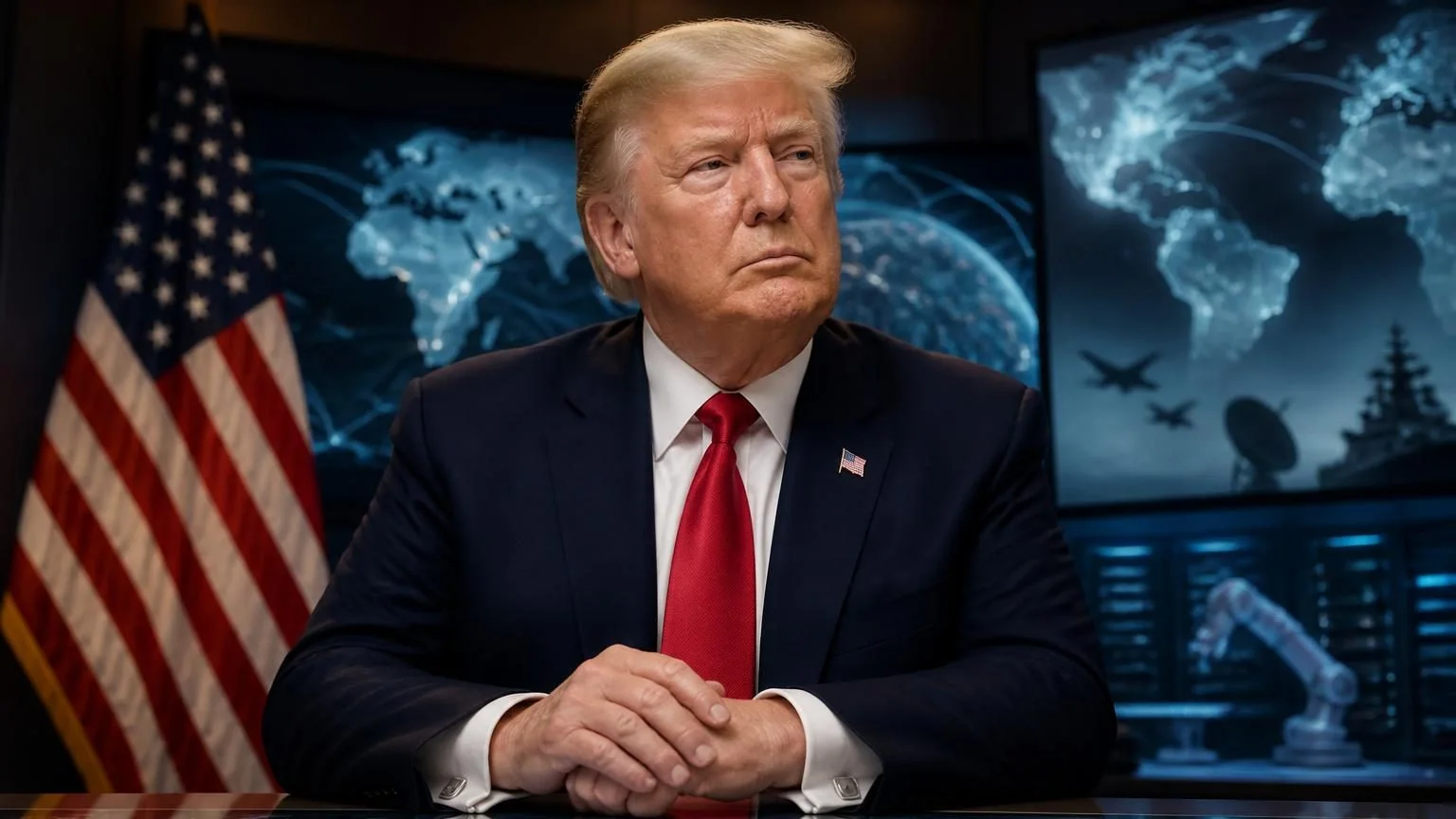
On June 5, 2026, President Donald Trump signed National Security Presidential Memorandum 11, or NSPM-11, directing the U.S. national security enterprise to accelerate artificial intelligence adoption across defense and intelligence functions while tightening expectations around controllability, accountability, and civil-liberties protections. The memo does more than signal political support for military AI. It sets deadlines for updated autonomy rules, new governance policy, multi-vendor procurement, secure compute planning, and an outside talent reserve for national-security AI work.
That makes this a real deployment story, not just a Washington headline. The administration is pushing agencies to close the gap between the best AI available commercially and the AI available inside high-security government systems. For frontier model vendors, defense contractors, and enterprise AI operators watching how the U.S. government buys and governs advanced systems, that is the bigger signal.
What Trump signed on June 5
The memorandum says the national security enterprise should accelerate AI adoption across intelligence and warfighting domains under four pillars: adoption, adaptation, assurance, and accountability. It explicitly argues that earlier policy created too much bureaucracy, increased dependence on single vendors, and slowed access to leading systems.
Several deadlines inside the memo matter immediately:
- Within 90 days, the Secretary of War must update Directive 3000.09 on autonomy in weapon systems.
- Within 90 days, the government must issue policy for AI governance in national security systems.
- Within 90 days, officials must produce a roadmap for advanced computing access, including high-security AI facilities and a national-security AI test range.
- Within 120 days, defense and intelligence agencies must review procurement so they can onboard advanced AI models from multiple vendors faster.
- Within 120 days, the government must initiate an AI National Security Strategic Reserve of non-governmental talent.
The memo also rescinds and replaces National Security Memorandum 25, the Biden-era framework it says had slowed adoption and increased dependence on narrower supplier choices.
Why the multi-vendor language matters more than the headline
The most commercially important part of NSPM-11 may be its push to avoid single-vendor dependence. The memorandum tells defense and intelligence agencies to update procurement so the most advanced models from multiple vendors can be brought in quickly. That is a meaningful shift in how the government is framing frontier AI access: less like a limited research relationship and more like an operational procurement problem.
It also goes beyond model access. The memo says agencies should ensure no commercial entity or adversary can disable, degrade, or materially modify an AI system used in critical missions without federal approval. In practice, that raises the importance of steerability, controllability, uptime, supply assurance, and secure deployment architecture alongside model quality.
The same logic shows up in the compute section. The administration wants a roadmap for secure advanced AI computing capacity and an AI test range for national-security use cases. That means the next defense-AI race is not only about who has the strongest model. It is also about who can operate inside high-security environments with reliable infrastructure, evaluation, and governance.
The Anthropic backdrop makes this more than a generic policy memo
This directive arrives after a public clash between Anthropic and the Pentagon over military use, surveillance, and autonomous weapons. Reuters reported on June 5 that the new memorandum came as the administration tried to accelerate AI use for national security while the Anthropic dispute was still shaping policy attention. AP also reported that the memo calls for faster military AI adoption while keeping civil-liberties protections and human oversight in view.
That context matters because NSPM-11 is not written as an abstract AI-governance document. It is written as an operating framework for a market where leading AI companies may want tighter usage limits than national-security officials will accept. The memorandum’s emphasis on chain of command, lawful use, and protection against vendor disruption suggests the White House wants fewer ambiguities once AI systems are embedded in mission-critical environments.
In other words, this is partly a policy statement, but it also reads like procurement pressure. Vendors that want a bigger role in national-security AI may now face stronger expectations around mission continuity, supportability, and willingness to work inside government-defined operating boundaries.
Business impact for AI vendors and enterprise buyers
The direct impact lands first on frontier model vendors, defense contractors, secure-cloud providers, and infrastructure companies that can support classified or tightly governed workloads. The White House is signaling demand for three things at once: better model access, more secure compute, and more operational control.
But the memo also matters outside defense. Enterprise buyers have been moving in the same direction, even if their stakes are lower. They increasingly care about whether an AI system can be governed, audited, evaluated, updated safely, and kept available during vendor disputes or policy changes. NSPM-11 makes those requirements more explicit in the highest-stakes part of the market.
That is why this story should matter to AI agents and automation teams. The procurement center of gravity is shifting away from pure benchmark competition and toward deployability under constraints. If the U.S. government now wants multi-vendor optionality, secure compute capacity, resilience against service degradation, and clearer accountability, enterprise buyers are unlikely to move in the opposite direction.
What to watch next
The next checkpoints are concrete. The 90-day deadlines will show whether the administration can turn this into governance rules, weapons-autonomy updates, and real secure-compute planning rather than broad intent language. The 120-day procurement and talent deadlines will show whether the government is serious about shortening the gap between frontier commercial AI and what national-security teams can actually use.
There is also a political and market question hanging over the story. Reuters reported that Trump said he plans to host AI executives as soon as next week. If that meeting happens, it could clarify which companies are positioned as core national-security AI partners and which ones are still negotiating the terms of participation.
The practical takeaway is straightforward: the national-security AI race is being reorganized around controllable deployment, not just model access. For companies building AI agents, secure automation, or high-trust enterprise systems, that is the real read-through from June 5.