
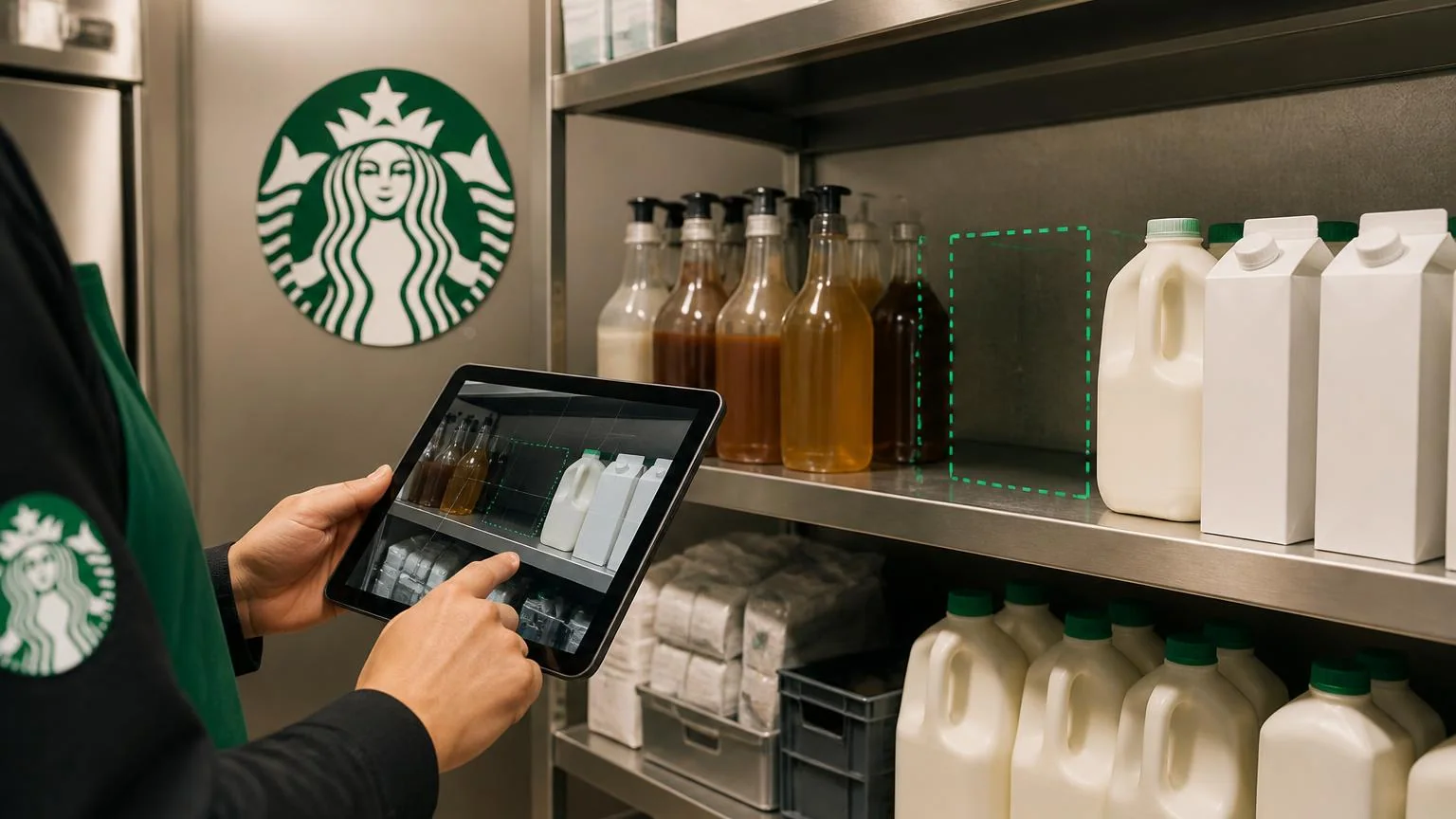
Starbucks retired its worker-facing Automated Counting inventory tool this week, according to a Reuters report published on May 21, 2026, ending a North America rollout that had started in September 2025. The system was built to help coffeehouses scan beverage inventory faster, but Reuters reported that the tool frequently miscounted and mislabeled items, including similar milk types, and sometimes missed stocked items altogether.
The rollback matters beyond one coffee chain. Starbucks had framed the system as a practical AI operations upgrade, not a moonshot experiment. Its retirement turns the story into a sharper test of where AI still struggles when it leaves the screen and enters messy, fast-moving physical workflows.
What Starbucks ended this week
According to Reuters, Starbucks told employees in an internal newsletter that “starting today, Automated Counting will be retired,” and that beverage components and milk would go back to being counted the same way as other inventory categories in the store. Reuters also reported that Starbucks confirmed the change and said the move was meant to standardize counting across coffeehouses while the company continues to focus on consistency and execution at scale.
That is a notable reversal from the way Starbucks introduced the technology on September 3, 2025. In its original announcement, Starbucks said the system would roll out across North America, letting employees use a handheld tablet to scan shelves and instantly see what was in stock. The company said the tool, developed with NomadGo, used computer vision, 3D spatial intelligence, and augmented reality to make counts faster and more frequent.
At launch, Starbucks said the tool would help inventory get counted eight times more frequently and improve replenishment by giving the company better visibility into low-stock items. NomadGo separately said the deployment would reach more than 11,000 Starbucks locations across North America and described the product as a replacement for manual counting.
Why the bigger story is not one bad retail AI demo
It would be easy to reduce this to a funny failure story about an AI tool that could not reliably tell products apart. But the more important signal is operational. Starbucks did not deploy this system in a lab or a showcase pilot. It pushed the technology into a core store workflow tied to product availability, replenishment, and labor time.
That matters because inventory counting looks like a narrow task, but it sits inside a larger execution loop:
- store staff need the scan to be fast enough to use during real shifts,
- the model needs to recognize similar-looking items under inconsistent shelf conditions,
- the counts need to be accurate enough to affect replenishment decisions, and
- operators need enough trust in the system to stop double-checking it manually.
When one part of that chain breaks, the labor savings often disappear. Inference from the launch and retirement details suggests Starbucks did not just hit a model-quality problem. It hit a workflow-trust problem. If frontline staff cannot rely on the count, the automation layer becomes extra process overhead instead of operational leverage.
Reuters underscored that point by noting the tool was part of CEO Brian Niccol’s effort to reduce persistent product shortages. In other words, Starbucks was trying to use AI to improve a real business metric, not just to make store technology feel more modern.
What this means for enterprise automation teams
For AI and automation buyers, the Starbucks reversal is a useful counterweight to the current wave of agent and workflow announcements. Digital tasks such as summarization, routing, drafting, and software-side orchestration are getting better quickly. Physical-world operations are harder because perception, environment variability, and exception handling all become part of the system design.
Three business lessons stand out.
1. Narrow workflow scope is not the same as deployment safety
Inventory counting sounds constrained. In practice, shelves change, packaging shifts, lighting varies, products get blocked, and employees use tools under time pressure. That means “simple” physical automation can be more brittle than broader-looking software automation.
2. Frequency gains do not matter if trust drops
Starbucks said the system enabled much more frequent counting. But higher measurement frequency only helps if operators believe the output is reliable enough to act on. Otherwise, the organization just creates more low-confidence data.
3. The real moat is the correction loop
The strongest operational AI systems are usually not the ones with the flashiest first-pass demo. They are the ones with better escalation, validation, exception handling, and recovery when the model is wrong. That is especially true in stores, warehouses, service operations, and field workflows.
This is where the story connects back to AI agents and enterprise automation more broadly. Agents that touch real operations need governed handoffs, clear confidence thresholds, and fallback paths. A system that works on most shelves but fails on the wrong ones can still be a bad production system.
What to watch next
Starbucks said it is still working toward more frequent replenishment and continued supply-chain improvements, so the retirement of Automated Counting does not mean the company is stepping away from operational technology. The more likely next move is a reset: standardize the process first, improve replenishment mechanics, and only then reintroduce automation where the error boundaries are tighter.
More broadly, expect this episode to sharpen how businesses evaluate AI in physical operations. The next competitive line will not just be Can the model recognize the item? It will be Can the workflow stay reliable when recognition is imperfect?
That is an important distinction for anyone building AI agents, automation systems, or retail operations tooling. The enterprise AI market is full of launch headlines right now. Starbucks just provided a reminder that production value comes from controlled execution loops, not from adding AI to a frontline task and hoping the edge cases behave.