
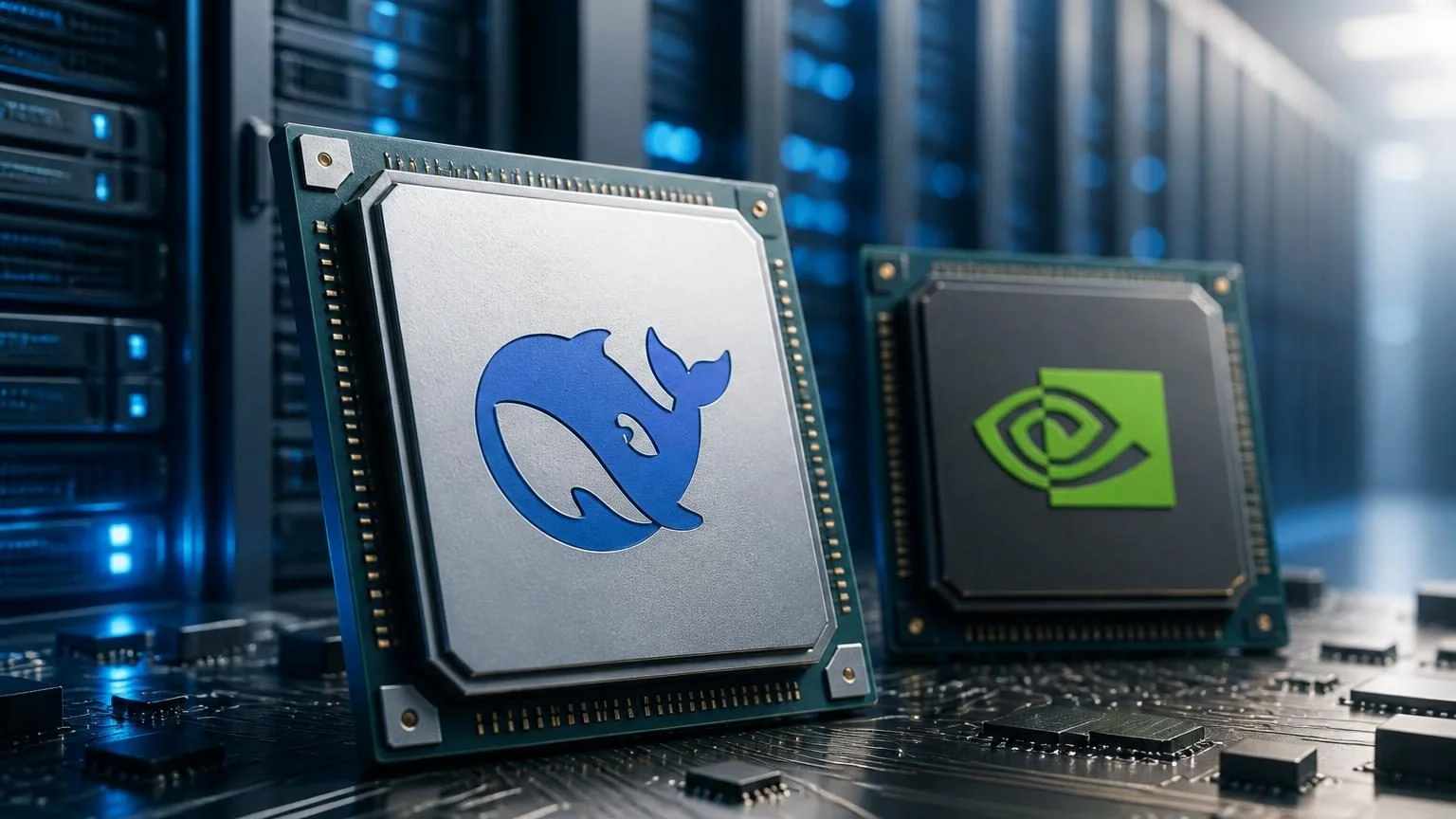
DeepSeek is reportedly developing its own AI chip, and that may be the clearest sign yet that the AI race is moving deeper into infrastructure. Reuters reported the plan on July 7, 2026, and markets reacted immediately: the Nasdaq opened lower after the news hit sentiment. Read the Reuters report and the market reaction story here.
Why DeepSeek’s chip move matters now
According to Reuters, DeepSeek’s chip is designed for inference, not training. That matters because inference is the stage where a finished model answers users, powers agents, and serves real workloads at scale. It is also where latency, reliability, and cost become business-critical.
Reuters said the effort is still early and will face serious hurdles, including chip design, foundry access, and high-bandwidth memory constraints. In other words: this is not just a model story. It is a supply-chain story.
This is part of a broader shift in AI
DeepSeek is not alone in trying to control more of the stack. OpenAI and Broadcom announced Jalapeño on June 24, 2026, a custom inference chip built to make advanced AI faster, more reliable, and more affordable. OpenAI’s announcement and Broadcom’s release both describe a multi-generation platform aimed at large-scale deployment.
The signal is clear: frontier AI companies are increasingly treating hardware as a strategic advantage, not a commodity input.
What enterprise AI teams should learn
- Inference is where AI value is delivered, so it deserves its own infrastructure plan.
- Cost, latency, and vendor concentration now matter as much as model quality.
- Private cloud and sovereign deployment pressures are rising as AI scales.
- AI strategy now includes compute strategy.
That last point is not just theory. Broadcom’s Private Cloud Outlook 2026 said 56% of enterprises are running or planning production inferencing on private cloud, while 83% are considering moving workloads back from public to private cloud. Read the report.
What to watch next
The key questions are whether DeepSeek can secure manufacturing, whether its chip performs well enough to reduce reliance on Nvidia and Huawei, and how quickly it can turn design into real deployments. Reuters said the effort began about a year ago and is still at an early stage.
For businesses building AI products, the practical takeaway is simple: audit where your inference costs, control points, and rollout bottlenecks will be over the next 12 months. The chip race is now an AI operations issue.