
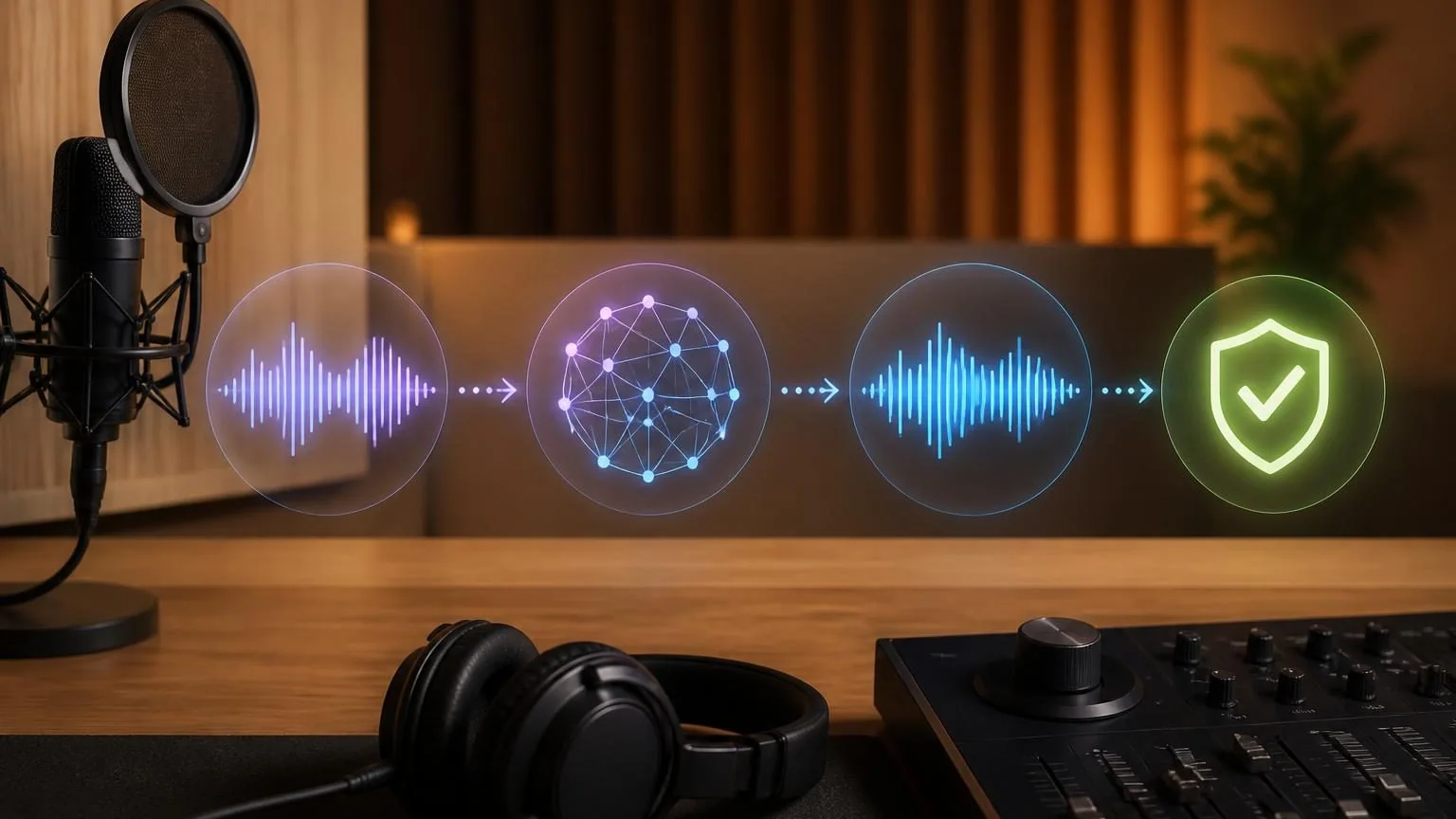
Direct answer: Yes. Current systems can generate speech that resembles a real person from recordings, sometimes convincingly. Creating or using a clone requires the person’s informed permission and clear disclosure; hearing a familiar voice is not proof of identity, especially when a caller requests money, credentials, secrecy, or urgent action.
What voice cloning does
A voice-cloning system learns patterns associated with a speaker—such as timbre, cadence, accent, pronunciation, and pitch—and uses them to synthesize new speech. It does not place the person inside the model or prove what that person would say. Output quality depends on the service, recording length and cleanliness, language, emotional range, and the new script. A clone may sound excellent in one sentence and fail on names, laughter, shouting, or another language.
Voice conversion can also make one live speaker sound like another, while text-to-speech generates audio from a script. Editing, impersonation, and splicing can create similar deception without a learned clone. These distinctions matter for investigation, but not for authentication: a voice alone is replayable and synthesizable.
- Treat a clone as generated media, not as the represented person speaking.
- Do not infer consent from the fact that recordings are publicly available.
- Keep original and synthetic files clearly separated and labeled.
Recording quantity is not a reliable safety barrier
Some products can create a resemblance from a short sample; higher fidelity or expressive coverage may need more and better audio. Public videos, podcasts, voicemail greetings, livestreams, and social posts can provide material. There is no universal number of seconds that guarantees cloning will or will not work, and publishing less audio cannot eliminate the risk for people whose voices are already widely available.
Protecting yourself therefore depends more on verification habits than on silence. Avoid using a spoken name, favorite phrase, or voiceprint as the only approval for a payment or account recovery. Organizations should authenticate callers through controlled account factors and known contact routes, not “the employee sounded right.”
- Limit unnecessary public recordings, especially clean isolated speech.
- Review old voicemail greetings and public media when threat exposure is high.
- Assume a determined impersonator may obtain some usable sample.
Consent must cover purpose, audience, and duration
Permission to record a meeting is not automatically permission to build a reusable synthetic voice. A meaningful agreement identifies who operates the system, why the clone is needed, where it may appear, which scripts are allowed, whether vendors retain samples, how long permission lasts, and how the person can revoke future use. Employment and performer relationships deserve particular care because unequal bargaining power can weaken nominal consent.
Do not clone a deceased relative, public figure, customer, child, coworker, or performer merely because audio exists. Laws differ by jurisdiction and use, including publicity, fraud, biometric, contract, labor, copyright, and communications rules. Obtain qualified legal review for commercial or public distribution rather than treating a tool’s upload button as authorization.
- Record consent separately from the source audio.
- Prohibit scripts that imply unapproved endorsements or commitments.
- Define deletion, revocation, and incident-notification duties.
Disclose synthetic speech where people could be misled
A listener should understand when speech is generated and whom it represents. Disclosure is especially important in calls, advertising, political communication, news-like media, customer service, education, and emotionally sensitive uses. A label hidden in a description may not reach someone who hears an extracted clip, so consider an audible disclosure and durable metadata appropriate to the distribution channel.
Disclosure does not cure an unauthorized clone or make a harmful script acceptable. Nor should a synthetic voice be used to bypass accessibility preferences, union terms, platform rules, or a person’s right to withdraw. Keep a publication record connecting each output to consent, script approval, model version, editor, and destination.
- Make the disclosure understandable before it affects a decision.
- Prevent downstream users from removing required identification.
- Offer a human or non-cloned alternative where appropriate.
Verify suspicious voice messages out of band
Scammers exploit emotion and urgency. If a familiar voice reports an emergency, requests a transfer, asks for a code, or insists on secrecy, end the interaction and call the person using a number already in your contacts. Ask a family or workplace question that is not publicly available, but do not rely on one static “safe word” forever if it has been typed or shared broadly.
Listen for odd pacing or pronunciation only as a warning; high-quality clones may lack obvious artifacts, and real calls can sound strange because of stress or network processing. Verify the underlying story with the relevant hospital, school, employer, bank, or family member through independently located contact information. Never send money using instructions supplied solely by the suspicious caller.
- Slow down and resist a caller’s deadline.
- Use a second known person or channel for high-value requests.
- Do not reveal the correct answer while challenging the caller.
Respond to unauthorized cloning
Preserve the original message, call details, account name, URL, timestamps, payment instructions, and any related texts without repeatedly forwarding the audio. Report impersonation to the platform and, for fraud, contact the financial institution promptly and file with the relevant authority. Tell likely targets through a trusted channel so they know which requests are false and how to verify future contact.
A detector may assist, but it cannot reliably establish identity across every codec and generator. Focus on source, behavior, transaction trail, and independent confirmation. Publicly posting the clone to warn people can unintentionally distribute better training material or harm the impersonated person, so share the minimum evidence needed with responders.
- Change compromised account credentials and review sessions.
- Document where the authentic recordings may have originated.
- Seek legal advice when reputation, employment, intimate abuse, or commercial rights are involved.