
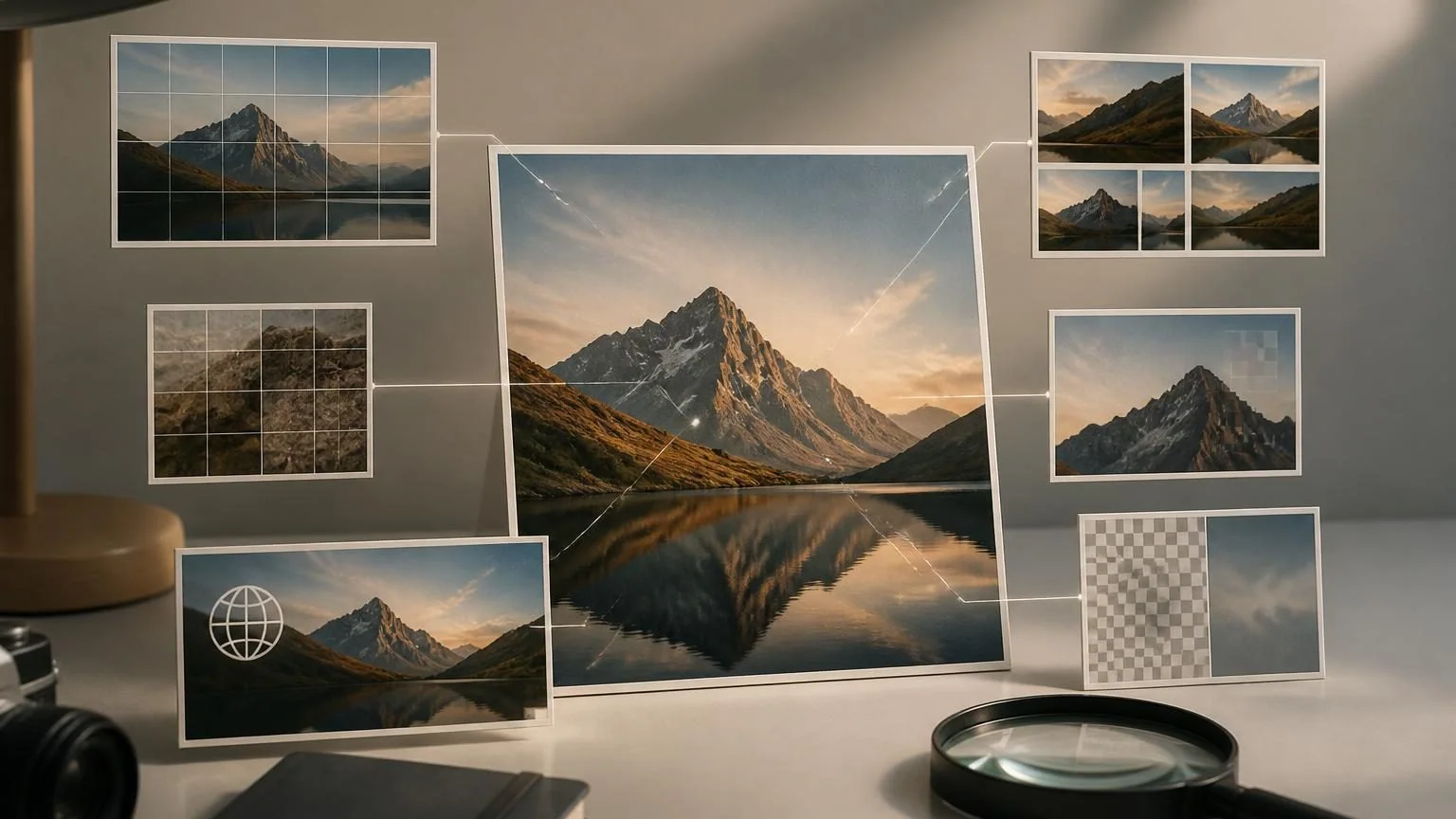
Direct answer: You usually cannot tell from appearance alone. Start with where the picture came from, seek its earliest available version, inspect Content Credentials or other provenance when present, reverse-search the image, compare the claimed event with reliable reporting, and treat visual oddities as clues rather than proof.
Begin with the claim, not the pixels
An image becomes misleading through the story attached to it. A genuine photograph can be reposted with the wrong date, place, or identity; an edited photograph can contain one synthetic element; and a fully generated scene can be labeled as documentary evidence. Before searching for artifacts, write the exact claim you are evaluating: who or what appears, where and when it supposedly happened, who published it, and what conclusion the post asks you to draw.
Separate observation from caption. “A flooded street is visible” is an observation. “This shows today’s storm in Miami” is a claim requiring outside evidence. Search the event, location, weather, landmarks, clothing, and credited photographer independently. Reliable reporting, an agency release, or the original photographer’s sequence can settle context more effectively than staring at fingers or shadows.
- Save the post URL and capture its caption before it changes.
- Note whether the account supplies a photographer, date, location, or original file.
- Do not amplify a sensational image while asking others whether it is fake.
Trace the image to its earliest available source
Reposts strip away useful context. Follow credits, watermarks, linked articles, and quoted usernames toward the first known publication. Reverse-image search can reveal older copies, different captions, a stock-photo listing, or a high-resolution version that predates the alleged event. Try the full picture and meaningful crops because borders, captions, mirrors, and screenshots can prevent a match.
Chronology matters. If the same picture appeared years earlier, it cannot document a new event as claimed, even if nobody used generative AI. If the earliest source is an anonymous account created recently and every later post points back to it, provenance remains weak. Absence from a reverse search is not proof of generation: new, private, heavily cropped, or rarely indexed photographs may have no match.
- Run more than one search engine when the consequence matters.
- Compare upload dates, image dimensions, crops, and compression.
- Look for a larger sequence from the same photographer or event.
Check provenance and Content Credentials carefully
Content Credentials based on the C2PA standard can carry signed assertions about which device or application handled an asset and which edits were recorded. When a trustworthy credential validates, it can provide useful positive evidence about provenance. Read what the credential actually says: capture information, editing steps, and the signer are more informative than a generic badge.
Missing credentials do not prove an image is fake. Social networks, screenshots, exports, and ordinary editing tools may remove metadata. Credentials also do not certify that the depicted event is honest; they document an asset’s declared history under a trust system. A valid camera-origin credential could still accompany a staged scene, and a file could be photographed from a screen. Treat provenance as one evidence layer, not an automatic truth label.
- Use a verifier that reports signature status and signer details.
- Distinguish “no credential” from “credential failed validation.”
- Preserve the original file when possible instead of analyzing a screenshot.
Use visual inspection to form hypotheses
Generated images may contain inconsistent lettering, repeated textures, impossible reflections, fused accessories, mismatched earrings, implausible geometry, broken object boundaries, or lighting that does not fit the scene. Modern systems can avoid these errors, while ordinary photography, panorama stitching, portrait mode, compression, restoration, and aggressive editing can create similar anomalies. The familiar “count the fingers” shortcut is therefore weak evidence.
Inspect at several scales. At full frame, consider composition, perspective, light direction, and whether important objects interact physically. At medium scale, compare repeated architectural elements and background faces. At pixel scale, be cautious: recompression and sharpening invent edge patterns. Ask whether an oddity has an ordinary photographic explanation before treating it as synthetic.
- Look for several independent inconsistencies rather than one strange patch.
- Compare reflections and shadows with visible light sources.
- Do not infer that an aesthetically polished or unusual picture must be generated.
Do not outsource the verdict to one detector
AI-image detectors estimate patterns associated with their training data. Performance can change across generators, camera images, screenshots, resizing, filters, and new model versions. A confident percentage is not a universal probability that the image is fake. Before using any detector, check who built it, which image types it was evaluated on, its false-positive rate, and whether uploading the image creates a privacy problem.
Use detector output only as a prompt for further investigation. If two services disagree, that is not a vote to break by choosing the higher score. For journalism, evidence, benefits, discipline, or identity decisions, preserve the file and seek a qualified forensic process with a documented chain of custody. Never publicly accuse a photographer or subject based solely on an automated score.
- Avoid uploading intimate, confidential, or evidentiary images to random detector sites.
- Record the detector version and date if its result is retained.
- Demand corroborating provenance and contextual evidence for consequential claims.
Reach a calibrated conclusion
A useful conclusion reflects the evidence: verified origin, likely authentic in the claimed context, altered, likely generated, misleadingly captioned, or unresolved. “Unresolved” is legitimate when the original file and source trail are missing. State why: for example, the caption conflicts with an older publication, the credential identifies a generative edit, or several visual anomalies remain unexplained.
Match action to consequence. You may simply avoid sharing an unverified meme. A suspected impersonation, fraud, election claim, emergency image, or allegation against a person deserves stronger corroboration and reporting through the relevant platform or authority. Keep the original URL, file, timestamps, and search results; repeated downloads and screenshots can destroy the very evidence a specialist needs.
- Describe confidence and evidence instead of declaring certainty from appearance.
- Correct a repost if later evidence changes the conclusion.
- When in doubt, do not use the picture as proof.