
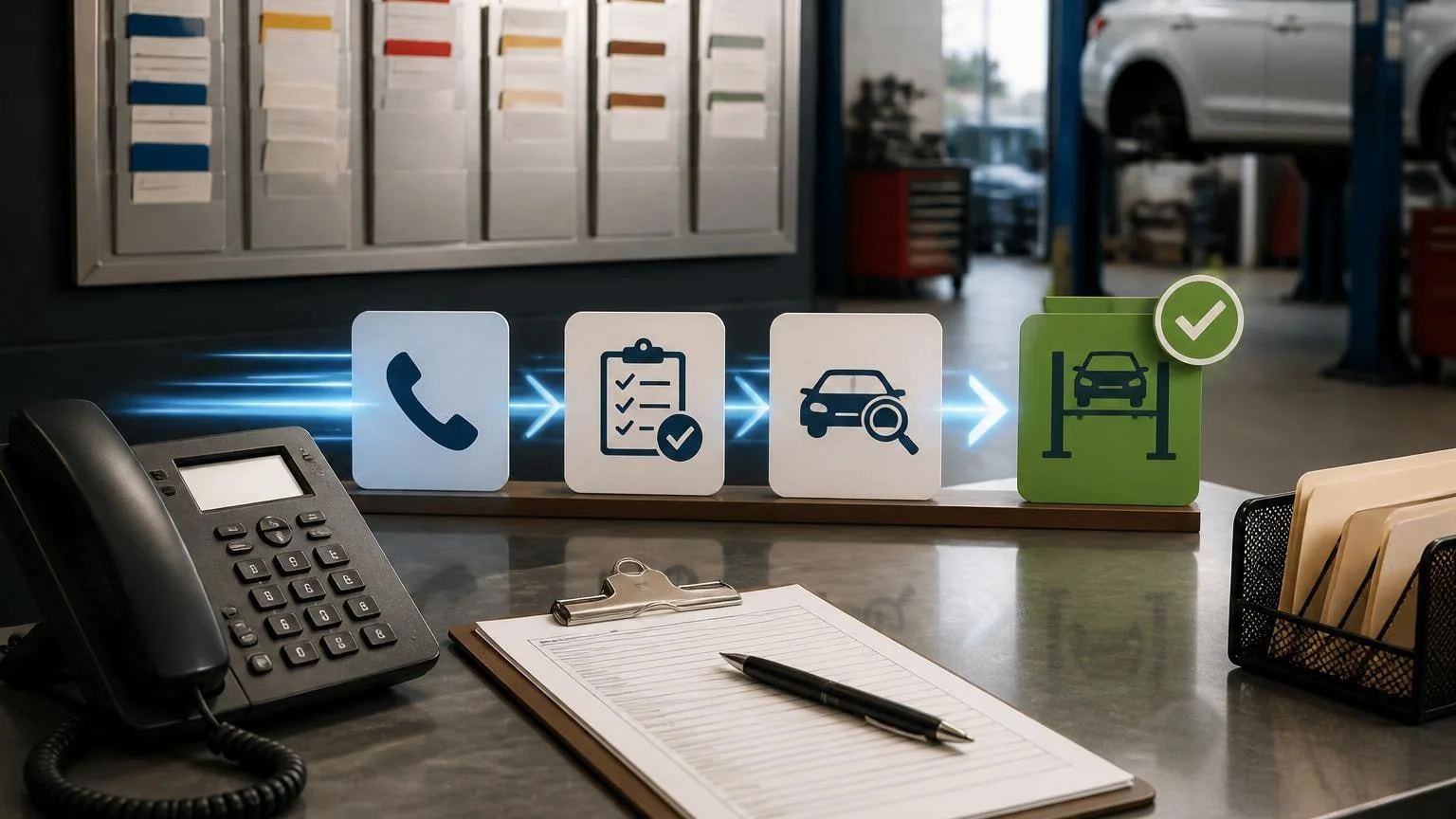
Independent auto repair shops rarely need AI to diagnose vehicles first. They need help when the service advisor is checking in a waiting customer, a technician needs approval on a repair order, two status calls are ringing in, and a new customer wants to know whether the shop can look at a brake noise today. The practical win is not “full automation.” It is capturing the call, collecting the right intake details, booking the right next appointment, and handing off a cleaner repair opportunity to the human team.
That is why the best first workflow for most shops is an AI service advisor focused on inbound call capture and appointment intake. Done well, it protects car count during the morning rush, reduces voicemail leakage after hours, and gives the front office cleaner notes instead of another vague callback slip.
Where auto repair intake actually breaks
The front counter in an auto shop is a collision point for different types of work that all feel urgent at once. A service advisor is expected to greet walk-ins, answer basic pricing questions, collect symptoms from new callers, confirm drop-off timing, explain diagnostic fees, relay updates, and keep the schedule realistic. When bays are busy, the phone becomes the first thing to slip.
That breakdown is expensive because the lost work is usually not obvious. It shows up as the customer who called the next shop after two rings and no answer, the rushed intake that never captured the real concern, the appointment booked without enough context, or the advisor who had to choose between the customer in front of them and the customer on the phone.
Auto repair is also more nuanced than a generic receptionist workflow. The shop does not just need name, phone number, and a time slot. It needs structured intake such as vehicle year/make/model, whether the car is drivable, whether the issue is warning-light related or symptom based, whether the customer wants a diagnostic appointment or routine maintenance, and whether the request belongs in a normal schedule, an urgent queue, or a human callback list.
What the first AI service advisor should actually handle
A strong first deployment is narrow. It should handle repetitive communication and routing work that follows clear rules, while leaving diagnosis, estimate judgment, warranty questions, and repair-sales conversations with staff.
Good first tasks
- Answer missed, overflow, lunch-break, and after-hours calls.
- Capture new-customer intake for common requests such as check-engine-light appointments, brake concerns, AC complaints, battery issues, oil changes, inspections, and tire service.
- Collect structured details: vehicle information, symptom summary, drivability status, preferred drop-off window, and contact preference.
- Book approved appointment types into the shop calendar or queue a request for staff review.
- Answer basic shop-policy questions such as hours, towing instructions, shuttle availability, payment methods, or whether the shop works on certain vehicle categories.
- Send confirmation texts and a clean call summary to the service desk.
Tasks that should stay with humans
- Promising a root-cause diagnosis from a verbal description alone.
- Quoting complex repair prices without a shop-approved rule set.
- Approving warranty, goodwill, or fleet-billing exceptions.
- Authorizing same-day work based on schedule guesses.
- Handling upset customers, disputed repairs, or comeback situations without escalation.
If the system is scoped this way, it behaves more like a disciplined intake coordinator than a fake master technician. That matters because the goal is better throughput and cleaner handoff, not pretending the shop has automated judgment it does not actually trust.
Example workflow: from a 7:12 a.m. brake-noise call to a bookable diagnostic slot
The clearest way to evaluate this use case is to follow one real workflow.
Trigger
A new customer calls at 7:12 a.m., before the front desk is fully staffed, saying their SUV started grinding when braking and they need to know whether the shop can see it today.
Context
The shop has approved intake rules for brake concerns. The AI service advisor can collect vehicle details, ask whether the vehicle is currently safe to drive, explain that a final repair quote requires inspection, offer approved diagnostic appointment windows, and route any true safety-risk answer to urgent human review.
Agent action
The agent answers immediately, captures the customer name, phone number, vehicle year/make/model, symptom summary, and whether the sound happens every time or only during hard braking. It asks whether the brake pedal feels soft, whether a warning light is on, and whether the vehicle is already parked or still being driven. Based on the shop’s rules, it does not attempt diagnosis. It explains that the shop can perform an inspection, offers the next approved drop-off windows, confirms the selected slot, sends a text confirmation, and writes a summary for the service advisor with an urgency flag.
Human handoff
When the advisor opens the queue, they see a structured note instead of a voicemail: probable brake concern, vehicle details, drivability status, selected drop-off time, and callback instructions if the shop wants to confirm anything. If the caller had reported severe pedal fade or said the vehicle was unsafe to drive, the workflow would have routed immediately to a human instead of finalizing routine booking.
That is the right pattern. The AI completes the repetitive intake work and the human team keeps control of judgment, prioritization, and revenue conversations.
Buyer considerations before you put this on live calls
Auto shops should be skeptical of any system that sounds impressive but cannot survive real service-drive conditions. The buyer checklist is operational, not cosmetic.
1. Can it follow shop-specific intake rules?
Your shop may treat a no-start, check-engine light, brake complaint, tow-in, diesel issue, or fleet account very differently. The system needs clear routing logic by job type, not one generic script for every call.
2. Can it stay inside approved promises?
The agent should never tell a caller a car will be fixed today, quote a complex repair from symptoms alone, or imply parts availability unless your system can verify those things reliably.
3. Does it create usable summaries?
A transcript dump is not enough. Advisors need concise handoff notes with vehicle details, reason for visit, urgency cues, appointment status, and the exact point where a human should pick up.
4. Can it respect the real schedule?
If your calendar logic is weak, the AI will create friction instead of reducing it. Approved appointment types, buffers, drop-off rules, and overflow handling need to be mapped before launch.
5. Does it escalate cleanly?
The system should recognize when a caller wants a human, when the issue sounds unsafe, when the customer is frustrated, or when the request falls outside policy.
Implementation path for a shop that wants a safe first win
The best rollout is staged.
- Start with overflow and after-hours coverage. This gives the shop immediate value without forcing the system onto every live interaction on day one.
- Limit the first appointment set. Routine maintenance, inspections, battery checks, tire service, and standard diagnostic requests are better first categories than complex repair sales.
- Define red-flag phrases. Build escalation rules for unsafe-to-drive language, tow requests, comeback complaints, warranty disputes, fleet billing, and angry callers.
- Standardize summaries. Decide exactly what must be captured on every handoff: caller identity, vehicle details, issue type, urgency, selected time, and unresolved questions.
- Review calls weekly. Early success comes from tuning real conversations, not assuming the first script is finished.
Once the shop trusts the intake layer, it can expand into estimate follow-up, declined-work reminders, appointment confirmations, or service-status communication. But the front door should work first.
Where this fits in a broader shop automation strategy
An AI service advisor is not the entire operating system for an auto repair business. It is the first high-friction communication workflow that often breaks before the rest of the day does. Shops that fix that layer usually learn quickly where the next bottleneck lives: follow-up on declined work, reminder sequences for recommended service, inbound status updates, or multi-location call consistency.
If you want a broader automation plan, connect this use case back to a wider small-business AI rollout. But if you want the best first operational win, start where the schedule gets lost: inbound intake, missed calls, and weak handoff between the phone and the service desk.