
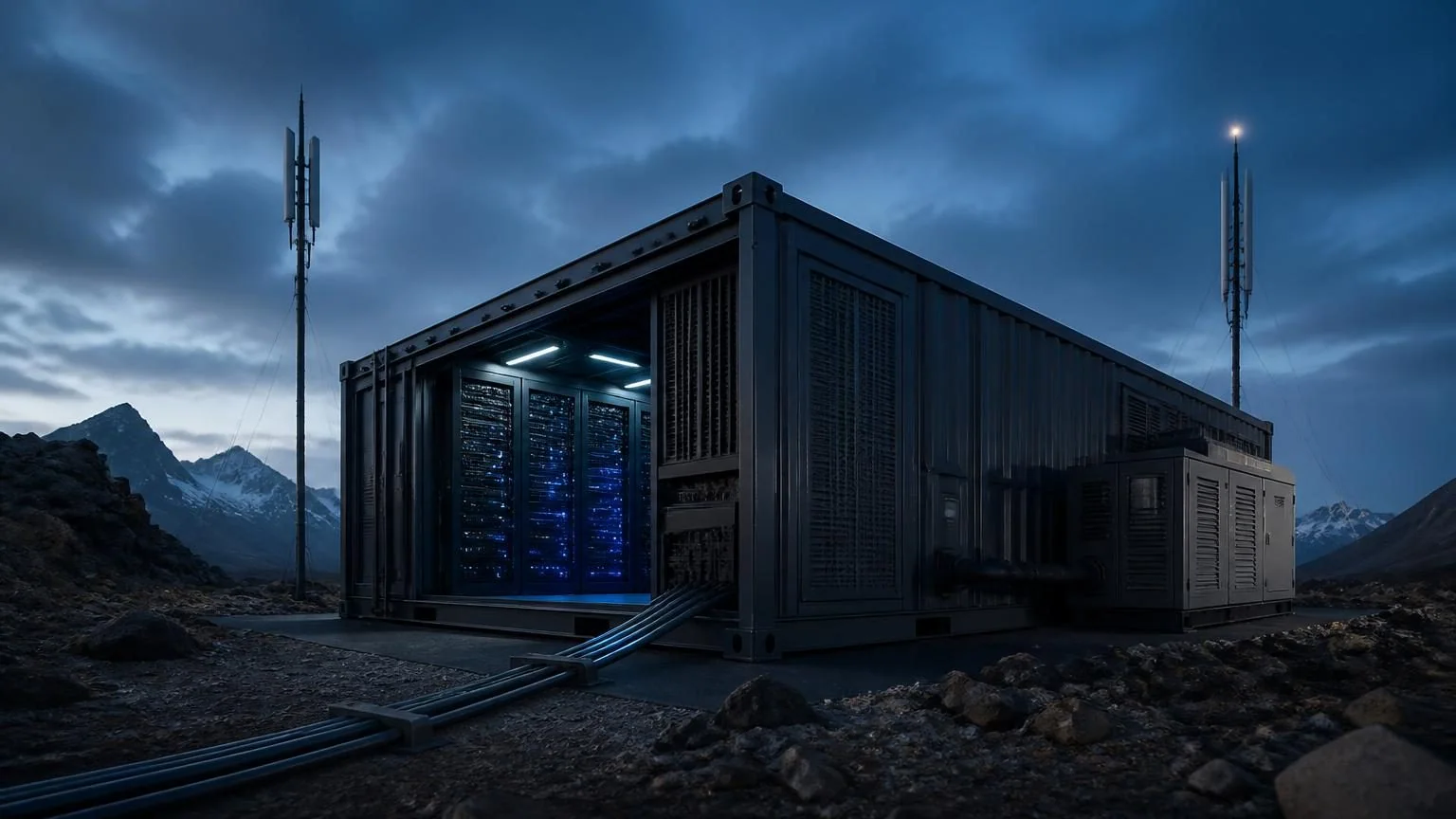
For years, the cloud architecture conversation has assumed a fixed destination: applications send data to a region, and the region sends answers back. Anduril’s Menace-I with AWS Outposts points to a different model. Announced on June 30, 2026, the system puts AWS Outposts racks inside a transportable shelter designed for disconnected and contested environments.
The product is not simply a portable server cabinet. Anduril describes Menace-I as integrated compute, communications, cooling, networking, security, and power for high-density workloads, including AI and C5ISR applications. Its published configurations span a single 42U core system to a 168U enhanced configuration for AI factories, sensor fusion, and targeting. The company says the shelter can be moved by truck, rail, airlift, or helicopter sling load, with a guided setup intended to take about 10 minutes.
The important shift is operational, not cosmetic
AWS Outposts extends AWS infrastructure, services, APIs, and tools to customer premises. In this partnership, that local-cloud idea is paired with a ruggedized, mobile operating environment. The objective is to keep applications and data processing available when reaching a distant region is slow, unreliable, or impossible.
That matters because many AI systems are only as useful as the data path around them. Video analytics, sensor fusion, autonomy support, planning tools, and command applications can require low-latency local processing. A model may be capable, but it cannot compensate for an unavailable network, missing power plan, or unaccredited hardware environment.
What enterprise AI teams can take from a defense product
Most businesses do not need a helicopter-transportable data center. They may, however, face a related design problem: how should a critical AI workflow behave when connectivity is degraded, a central platform is unreachable, or sensitive data must stay close to its source?
- Separate essential decisions from cloud-dependent enrichment. Identify the actions that must continue locally and the tasks that can wait for a connection.
- Treat local compute as part of the workflow. Edge hardware, identity, observability, update controls, and power resilience must be designed together.
- Plan for reconnect and recovery. Decide what is cached, what is queued, what gets reconciled, and who can approve a degraded-mode action.
Anduril says Menace-I has accumulated more than 50,000 fielded hours across global deployments. That does not make its architecture a direct template for commercial use. It does make the underlying lesson hard to ignore: for high-consequence AI, infrastructure resilience is a product requirement, not a facilities afterthought.
Why this is bigger than edge inference
The term edge AI often narrows the discussion to running a model closer to a camera, device, or factory floor. Menace-I broadens it again. Deployable AI requires a complete operating envelope: compute capacity, thermal management, power, connectivity, security boundaries, application operations, and a way to work through disruption.
That is also why the AWS relationship is consequential. It connects a familiar cloud operating model to a specialized physical deployment model. For organizations building distributed AI, the question is no longer only which model to use. It is which parts of the system can still make safe, useful decisions when the network and the fixed data center are not guaranteed.
A practical next step
Choose one AI workflow where delay, data movement, or connectivity loss would create real operational risk. Map its local inputs, required decisions, cloud dependencies, fallback mode, and recovery path. If the team cannot describe those five pieces, it is not ready to call the workflow resilient.
Menace-I is purpose-built for defense missions, but its message applies more widely: AI deployment is becoming a systems-engineering discipline. The winners will not only train or buy better models. They will make the surrounding infrastructure dependable enough for the environment where work actually happens.