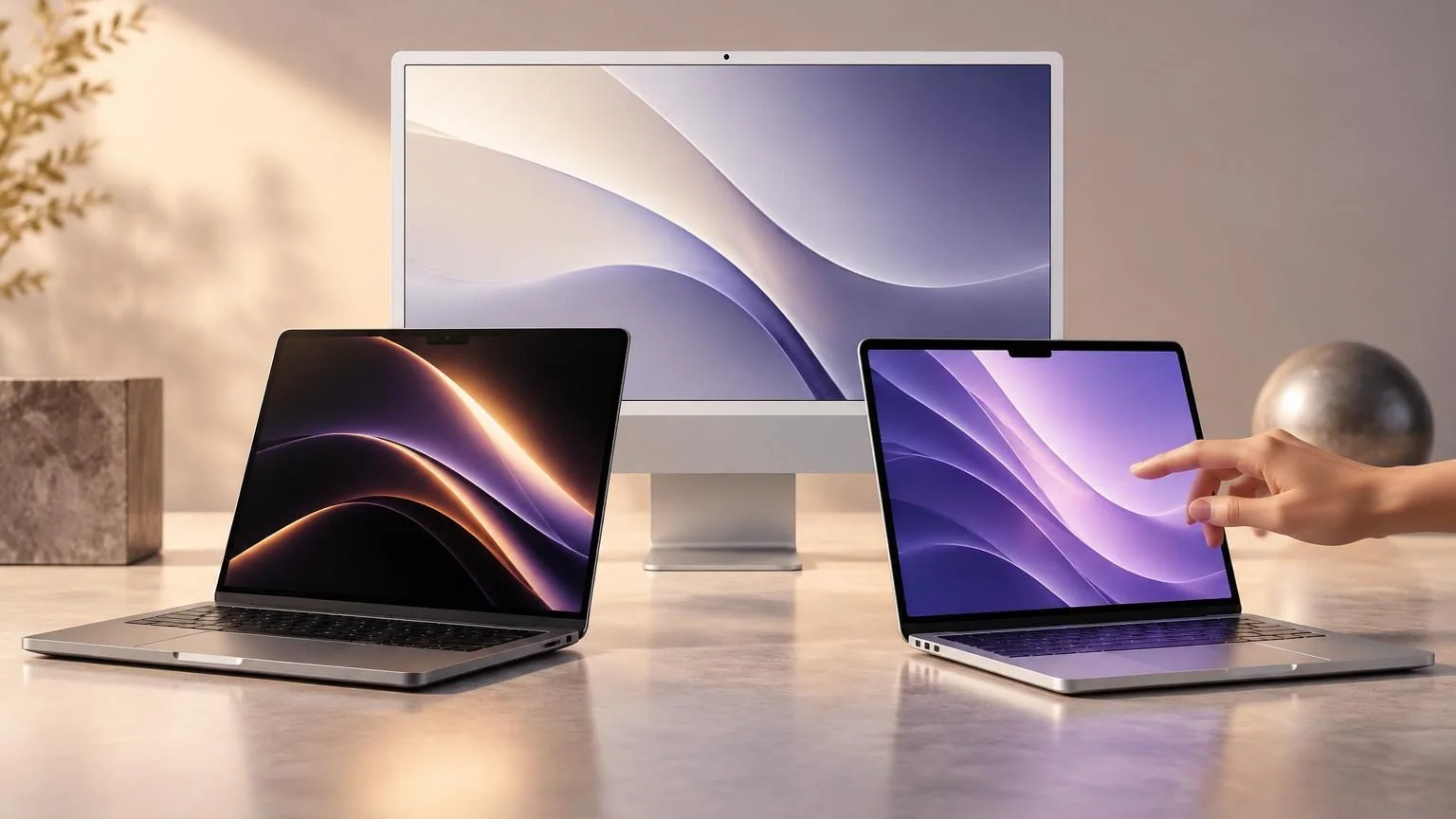
Apple’s late-October Mac announcements cover two distinct changes. On October 27, 2026, it introduced an M6-based 14-inch MacBook Pro and iMac. On October 28, it announced 14- and 16-inch MacBook Pro models with a touchscreen PROLED XDR display and M5 Pro or M5 Max chips. October 28 is the latest announcement date covered here.
M6 comes to the standard laptop and desktop
The M6 MacBook Pro announcement describes a 12-core CPU, 12-core GPU and Dual 16-core Neural Engine. The laptop starts with 16 GB of unified memory and supports configurations up to 32 GB. It retains the Liquid Retina XDR display.
Apple’s M6 iMac release updates the 24-inch desktop with the new chip, Wi-Fi 7 and Bluetooth 6. Apple discusses local AI workloads in both announcements. Its performance comparisons are vendor measurements against specified earlier systems, rather than a guarantee about every model or application.
For business users, these are compute and connectivity updates within familiar form factors. Choosing between them still starts with the working environment: a shared office workstation, a portable development setup or a desk dedicated to creative production.
Touch arrives on a different MacBook Pro line
The October 28 announcement adds tandem OLED, Touch and Dynamic Island to the PROLED MacBook Pro. These machines use M5 Pro and M5 Max, with configurations reaching 128 GB of unified memory. They should not be described as touchscreen M6 laptops.
Apple says the display supports P3 and Adobe RGB and up to 120 Hz refresh rates. It describes macOS translating touches into clicks for many existing apps, alongside APIs for experiences designed around Touch. That makes application behavior a separate consideration from owning a touchscreen.
The announced availability date is November 6, following October 28 preorders. As of November 1, these announcements therefore describe products awaiting their stated retail availability, rather than a completed customer rollout.
For local AI, memory and software matter together
Our operational assessment is that a chip’s generation number is an incomplete guide to local inference. A model must fit alongside its runtime and attention cache, and the software must support the hardware’s acceleration paths. A newer base chip and a larger Pro or Max memory configuration answer different constraints.
A practical evaluation should use the exact model, quantization and context length the team expects to run. Record prompt-processing time separately from response generation, then test while the normal browser, editor and collaboration tools remain open. A clean demonstration on an otherwise empty machine may conceal the capacity needed during an ordinary workday.
Keep the purchase tied to the actual bottleneck
For designers, the PROLED display and direct manipulation may matter more than an incremental model-speed improvement. For an internal document assistant, memory, runtime support and data handling may dominate. Neither use case is resolved by a generic claim that a machine is built for AI.
Teams should also check whether their chosen application performs inference locally, calls a hosted service or mixes both. Hardware capable of on-device inference does not establish that every AI feature keeps every request on the device.
Apple’s October updates expand the options, with separate paths for mainstream M6 computing and touchscreen professional work. The useful decision is which configuration removes a verified workflow limit, with display requirements and local-model requirements assessed individually.