
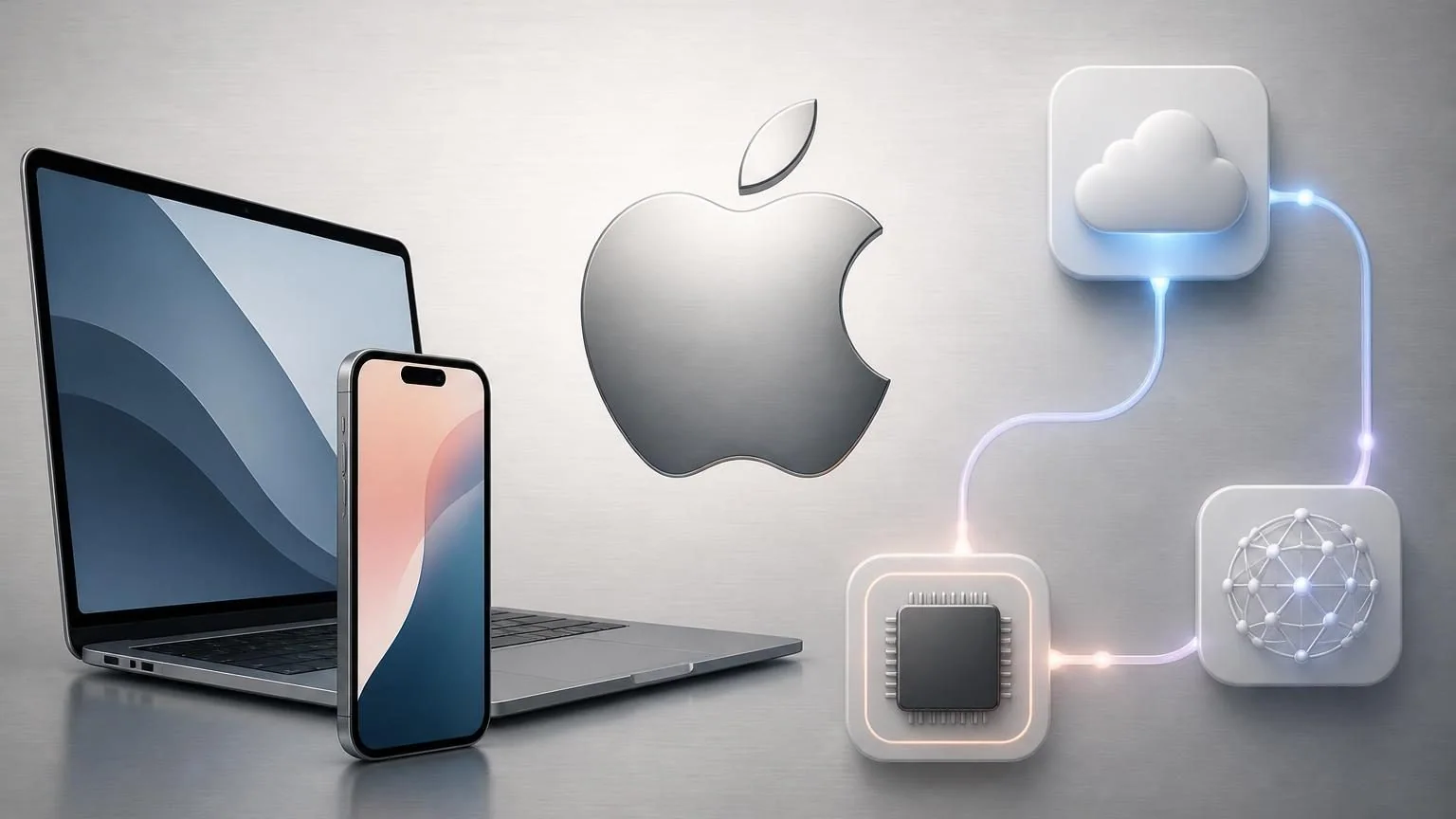
On June 9, 2026, Apple’s WWDC26 developer follow-through made the company’s AI push look much bigger than the Siri AI headlines from the day before. In updated Apple Developer materials and Platforms State of the Union recaps, Apple clarified that qualifying smaller developers can use Apple Foundation Models on Private Cloud Compute with no cloud API cost, that the Foundation Models framework can swap in outside providers like Claude and Gemini through the same Swift interface, and that new Dynamic Profiles and evaluation tooling are aimed at more agentic app workflows.
What Apple detailed after the keynote
The headline change is cost and access. Apple said developers enrolled in the App Store Small Business Program with fewer than 2 million first-time App Store downloads can use Apple Foundation Models running on Private Cloud Compute, or PCC, without separate cloud API charges. That matters because Apple is no longer asking smaller teams to choose between staying on-device with tighter model limits or taking on immediate cloud-model infrastructure costs.
Apple also pushed the Foundation Models framework well beyond a single-model story. The WWDC26 Apple Intelligence guide says developers can now work with Apple Foundation Models, cloud models like Claude and Gemini, or other providers that conform to Apple’s Language Model protocol. In practice, that means Apple is trying to make model choice look like a runtime decision inside one app architecture rather than a platform fork.
- Multimodal prompts now let apps pass images alongside text.
- Vision-backed tools such as OCR and barcode readers can be called directly from the model flow.
- Dynamic Profiles let developers swap models, instructions, and tools within a continuous session.
- The new Evaluations framework and updated Instruments support are meant to help teams test and tune these AI behaviors before shipping them.
Apple’s own model lineup also expanded. In its June 8 research post, the company said its third-generation Apple Foundation Models now span on-device systems and multiple server-side models on Private Cloud Compute, including a more capable cloud tier aimed at demanding reasoning and agentic tool use.
Why this matters more than another Siri follow-up
The key shift is that Apple is moving from assistant UX into application infrastructure. Last year, the story was mostly about Apple Intelligence features. This week, the developer story became much more concrete: a native Swift interface, a clearer split between on-device and cloud reasoning, integrated system tools, and a path to use outside model providers without rebuilding the rest of an app around a different API surface.
That matters for anyone building AI agents or automation workflows on Apple platforms. Apple’s documentation positions the on-device model as the fast, private, offline option, while Private Cloud Compute is the bigger reasoning tier for longer documents and more complex multiturn work. Apple’s own documentation describes PCC as offering a 32K context window and stronger reasoning, while keeping authentication and key management out of the developer’s hands.
The result is a more serious hybrid architecture. Developers can keep some work local, escalate harder tasks to Apple’s cloud models, and still preserve the option to route certain workloads to third-party providers when model quality, specialization, or economics make that the better choice. That is a much more relevant setup for real business software than a single assistant demo.
Business impact for app teams, AI agents, and automation builders
Smaller developers just got a cheaper entry point
Apple is clearly trying to lower the barrier for smaller app teams that want stronger model behavior without committing to a full external LLM stack on day one. Free PCC access for qualifying developers makes Apple’s platform more attractive for startups and independent software vendors that want to add summarization, image understanding, semantic search, or lightweight agent behaviors to apps already running across iPhone, iPad, Mac, and watchOS.
Model flexibility is becoming a platform feature
The more strategic move is the new provider abstraction. If Apple can make Apple models, Claude, Gemini, and other compatible providers look interchangeable inside one Swift framework, it reduces some of the lock-in risk that usually comes with platform-native AI tools. For enterprises, that means teams can think more in terms of workflow design, privacy boundaries, and evaluation discipline instead of making one permanent model bet up front.
Apple is giving agent builders more of the surrounding stack
Dynamic Profiles, built-in vision tools, Spotlight-backed retrieval paths, App Intents schemas, and evaluation tooling together look like an attempt to make Apple platforms a stronger execution surface for agentic software. The story is not that Apple has solved enterprise agents overnight. The story is that it is assembling more of the runtime pieces developers actually need: model selection, tool access, context handling, testing, profiling, and system-level discovery through Siri AI and Spotlight.
What to watch next
The next question is adoption. Apple still has to prove that developers will prefer its native framework over going directly to model vendors, that the entitlement and regional-availability rules around PCC will not slow momentum, and that the daily usage model for server-side Apple Intelligence will be workable for production apps. It also has to show that the new abstraction layer does not become too opinionated for teams building more complex agent systems.
But the June 9 developer picture is much clearer than the keynote alone suggested. Apple is no longer just trying to catch up in assistant interfaces. It is trying to turn iPhone, iPad, Mac, and other Apple surfaces into a more credible runtime for AI agents, hybrid reasoning, and automation-heavy app experiences. For businesses building AI software, that makes WWDC26 a platform story, not only a Siri story.