
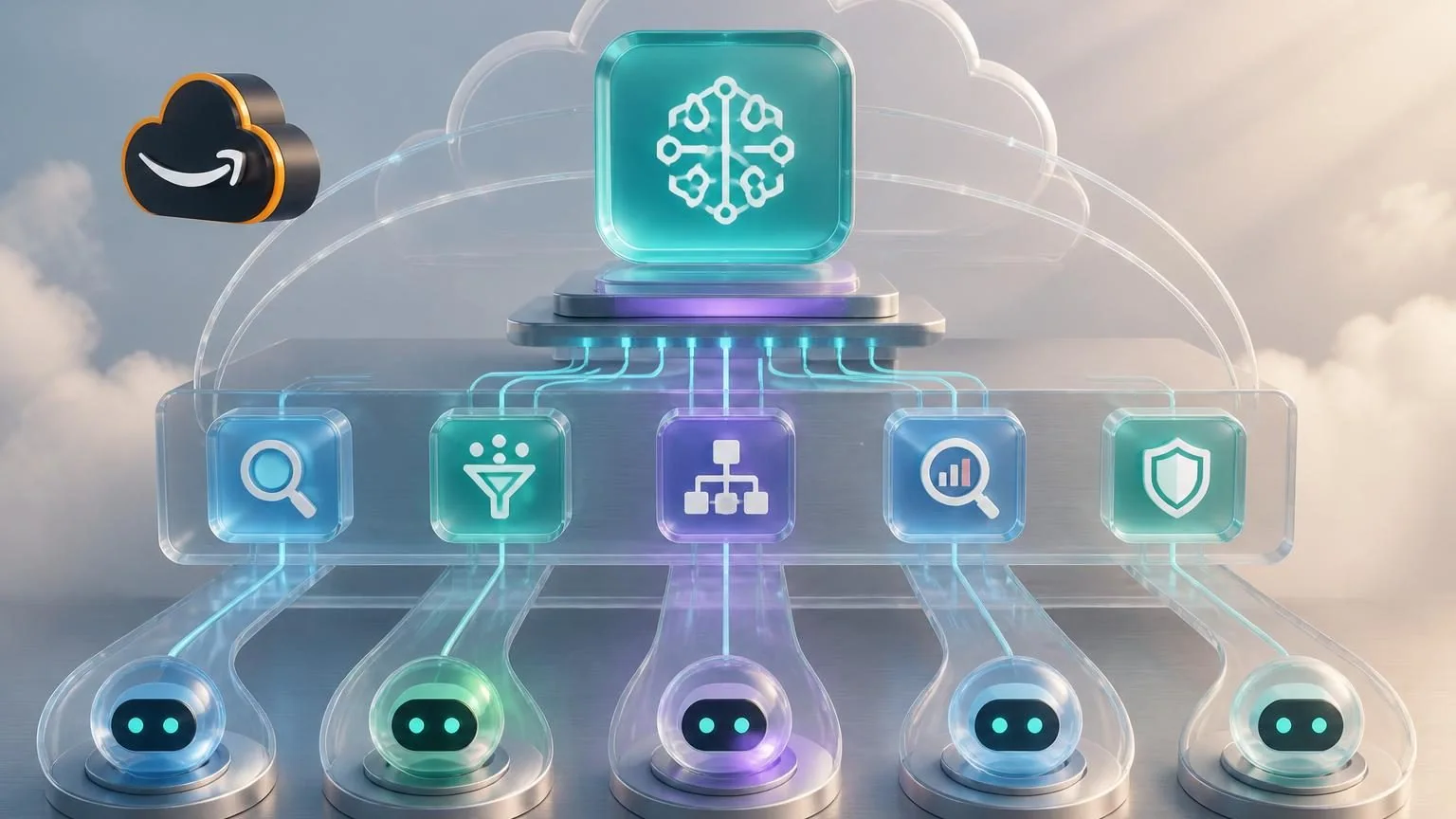
On June 17, 2026, AWS used its New York Summit to expand Amazon Bedrock AgentCore with a managed harness, managed knowledge base, web search, and production optimization. On July 1, AWS followed with higher default runtime quotas and four more regions. The bigger story is that AWS is no longer pitching agents as a loose set of features. It is packaging the runtime, grounding, retrieval, security, and improvement loop into something enterprises can standardize on.
AWS moved AgentCore past the prototype stage
Most companies do not fail to ship agents because they lack a model. They fail because production agents need orchestration, session state, permissions, retrieval, current web access, observability, and a safe path to iteration. AgentCore is AWS’s answer to that operational gap.
The Bedrock AgentCore developer guide now describes the platform as a way to build, deploy, and operate agents securely at scale with any framework and any model. That matters because it shifts AWS’s pitch from “use our model layer” to “run your agent system here, even if your stack is mixed.”
What AWS actually launched in June and July
- Managed harness, generally available: AWS says the harness runs the agent loop, tool execution, context handling, state persistence, failure recovery, and session isolation as a managed layer.
- Managed Knowledge Base: AWS added prebuilt connectors, Smart Parsing, and an Agentic Retriever aimed at multi-step enterprise queries across internal data sources.
- Web Search on AgentCore: Agents can now pull current web results with titles, URLs, snippets, and publication dates through a managed MCP-compatible connector, without routing search queries to an external provider outside AWS.
- Optimization capabilities: AgentCore can turn production traces into failure analysis, recommendations, batch evaluations, and A/B tests, which is a much stronger production signal than simple chat logs or latency dashboards.
- Gateway security: AWS added WAF support for AgentCore Gateway, giving security teams a single place to apply web protections across downstream agents and tools.
- Scale and footprint: On July 1, AWS raised default runtime quotas and expanded AgentCore to four more regions, a sign that the product is being prepared for broader real-world load rather than narrow demos.
Why this matters more than a feature roundup
Individually, none of these launches wins the agent market. Together, they form a credible enterprise control plane.
The hard part of agent adoption in 2026 is not choosing between Claude, GPT, Gemini, Nova, or another model. It is deciding how your agents will access company knowledge, ground themselves in current information, stay inside governance boundaries, survive long-running tasks, and improve after silent failures. AWS is trying to own that layer.
That is an important shift for buyers. If AgentCore keeps its framework and model flexibility, enterprises may care less about which frontier model starts the workflow and more about which platform their cloud, security, and platform teams can approve for production.
What business AI teams should do next
If you are evaluating agent platforms after this AWS push, ask five practical questions before you compare model benchmarks:
- How will the agent access internal documents, SaaS systems, and permissions without custom connector sprawl?
- How will it get fresh web context for time-sensitive tasks?
- How will you inspect failures that do not throw obvious errors?
- How will security teams apply controls at the gateway and runtime layers?
- How easily can you switch models without rebuilding the surrounding workflow stack?
AWS’s June and July releases do not guarantee Bedrock AgentCore becomes the default answer. But they do make it a more serious option for enterprises that want agents to look less like an experiment and more like governed infrastructure.
For Nerova’s audience, that is the real takeaway: the agent market is starting to split into two layers. Frontier models still matter, but the faster-growing opportunity is the infrastructure and workflow layer that turns those models into dependable business systems.