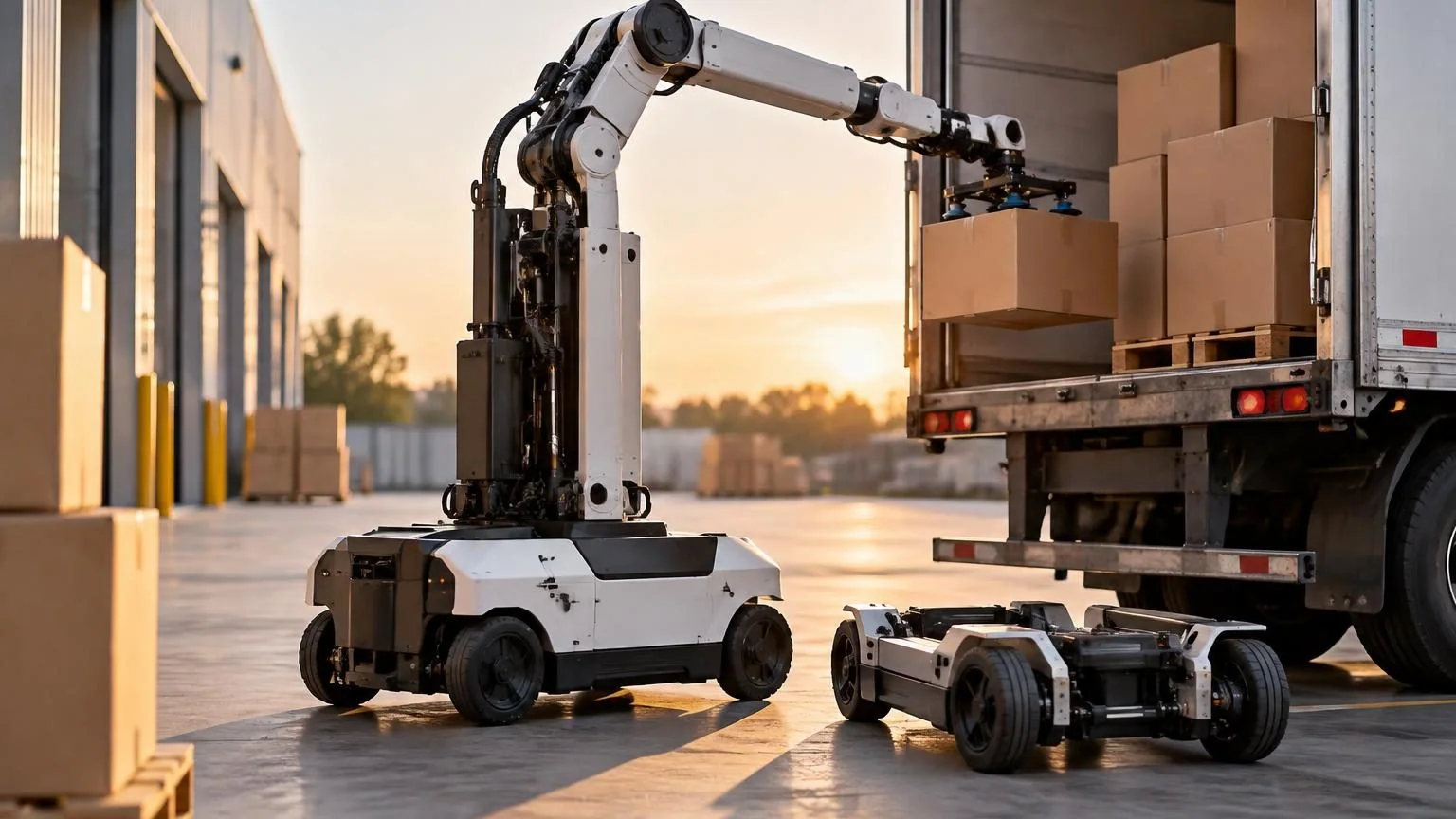
Boston Dynamics unveiled Stretch Gen 2 on November 3, 2026, updating its autonomous trailer-unloading robot with an emphasis on durability and easier service. The company says the redesign draws on more than 100,000 operating hours and tens of millions of boxes handled by earlier deployments.
What changed in the hardware
The company describes tougher connectors, an upgraded gripper, continuous-rotation joints, and an 81% reduction in internal cabling. Modular service changes are intended to shorten repairs; Boston Dynamics says a swerve-drive replacement now takes about an hour rather than a full day. New diagnostics aim to put more routine maintenance within the customer’s own team.
Boston Dynamics lists unloading rates up to 1,000 cases per hour, while explicitly noting that case weight and stacking conditions affect performance. Its Stretch product materials describe the intended warehouse workflow. The headline rate should therefore be treated as a conditional capability rather than a guaranteed average at every dock.
Why reliability is a product feature
Our interpretation is that this release makes the service interval part of the robotics story. A robot that performs an impressive sequence during a demonstration still needs to repeat useful work across ordinary shifts. The time spent waiting for a repair can matter as much as the time spent moving a box.
That makes maintenance design worth examining directly. A replaceable module, an accessible connector, and a clear diagnostic can change how quickly a local team restores operation. The practical question is whether the complete workflow becomes dependable enough for the facility’s schedule.
Evaluate the dock, not just the robot
A useful site evaluation should use representative loads, including the conditions that slow down unloading. Record successful transfers, exceptions, human interventions, and recovery time. Keep those measurements beside the peak rate so a good run does not hide recurring disruptions.
The handoff to the rest of the warehouse also deserves attention. An unloading system can work well while downstream equipment or procedures limit the overall benefit. A pilot should follow cases far enough through the workflow to establish where time is saved and where work accumulates.
The next evidence to watch
The most informative follow-up will be operating results from the revised hardware over sustained use. Boston Dynamics has identified specific mechanical and service changes, giving customers concrete claims to evaluate. Stretch Gen 2’s significance is in that operational focus: an industrial robot designed around the realities of keeping freight moving after the initial installation.