
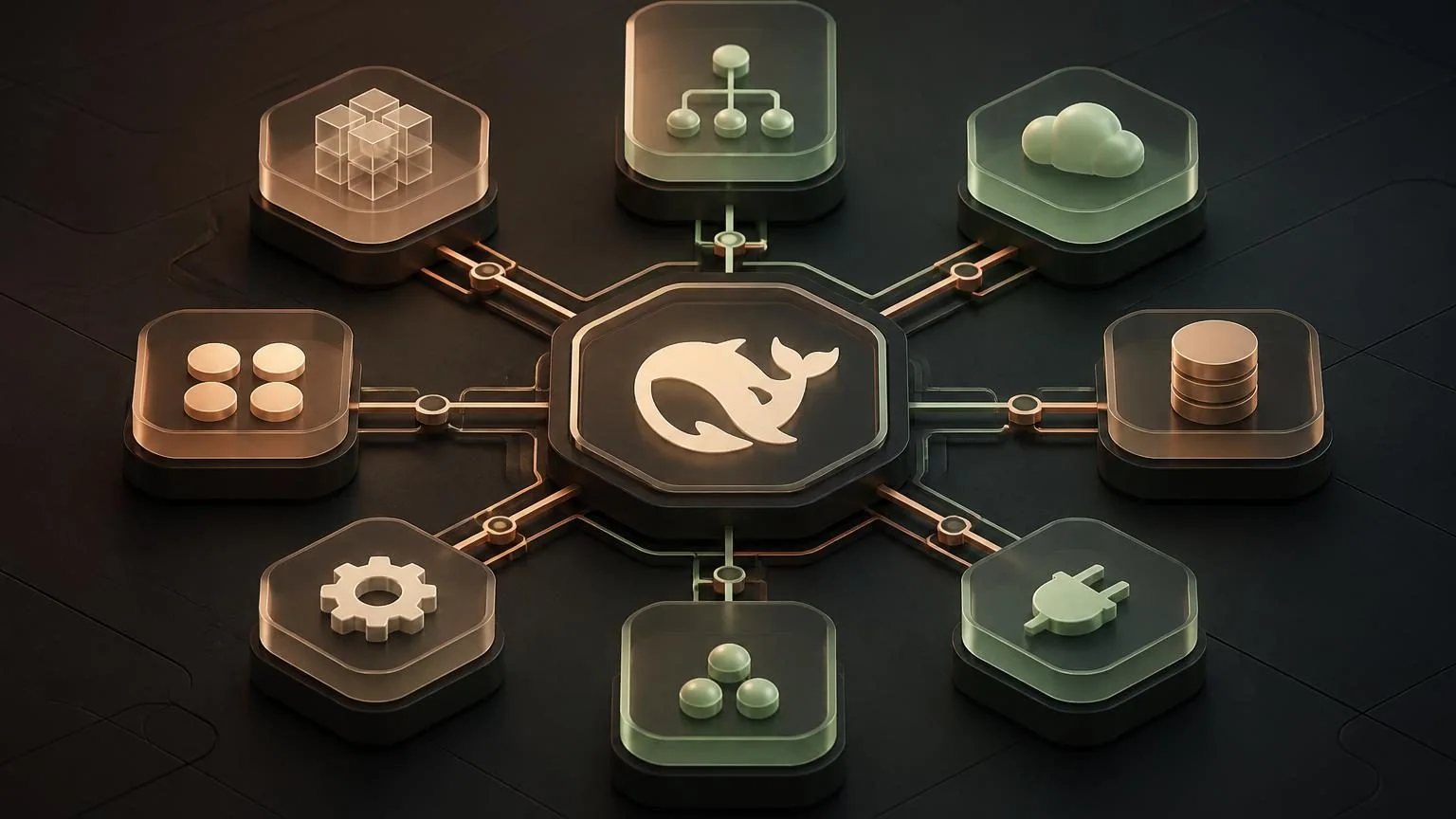
DeepSeek has introduced DeepSeek Harness, an open-source agent harness in developer preview. Its central design choice is unusually broad: models, tools, skills, sessions, sandboxes, storage, loops, scheduling, and the user interface are all treated as plugins.
That makes the project relevant to developers who do not want an agent runtime to dictate every operational choice. DeepSeek says the Cordis-based architecture lets teams select, replace, or extend capabilities through configuration rather than by modifying the Harness source code.
What DeepSeek Harness is for
A model can generate text or propose actions, but an agent also needs a runtime that supplies context, tools, state, execution controls, and a way to inspect what happened. DeepSeek positions Harness as that surrounding layer. The project includes Standard, Code, Minimal, and Creator modes, ranging from a fuller coding-agent toolset to a stripped-down benchmarking environment and a mode for experimenting with plugins and presets.
The traceability feature deserves attention. DeepSeek says the session log records the prompts, reasoning, tool calls and results, subagent scheduling, and context injections seen during a run. For teams evaluating agents beyond a demo, that kind of record can make debugging, review, and reproduction more practical.
Where to download DeepSeek Harness
The fastest local route is npm. Install Node.js, then run npx @deepseek-ai/dsh web. DeepSeek says this starts a local web interface on port 3080 by default.
Developers who want the full repository can download it from the official GitHub project and run git clone https://github.com/deepseek-ai/deepseek-harness.git, followed by pnpm install, pnpm run build, and pnpm dsh web. The repository is published under the MIT license.
Why the release matters
Agent frameworks often make useful defaults inseparable from their own opinionated stack. DeepSeek Harness is betting that composability is the better starting point: swap a model, sandbox, storage layer, or workflow component without rebuilding the runtime around it.
That flexibility also raises the usual preview-stage caution. DeepSeek explicitly warns that compatibility-breaking changes are expected. Teams should treat it as an evaluation platform, isolate experiments, and verify the security and observability behavior of every plugin they choose before moving a workflow into production.
A practical next step
Try the npm quick start for a contained local evaluation, then identify which parts of an agent workflow actually need to be interchangeable. The valuable question is not whether every component can be swapped. It is whether that control helps a team build a more reliable, auditable AI worker.