
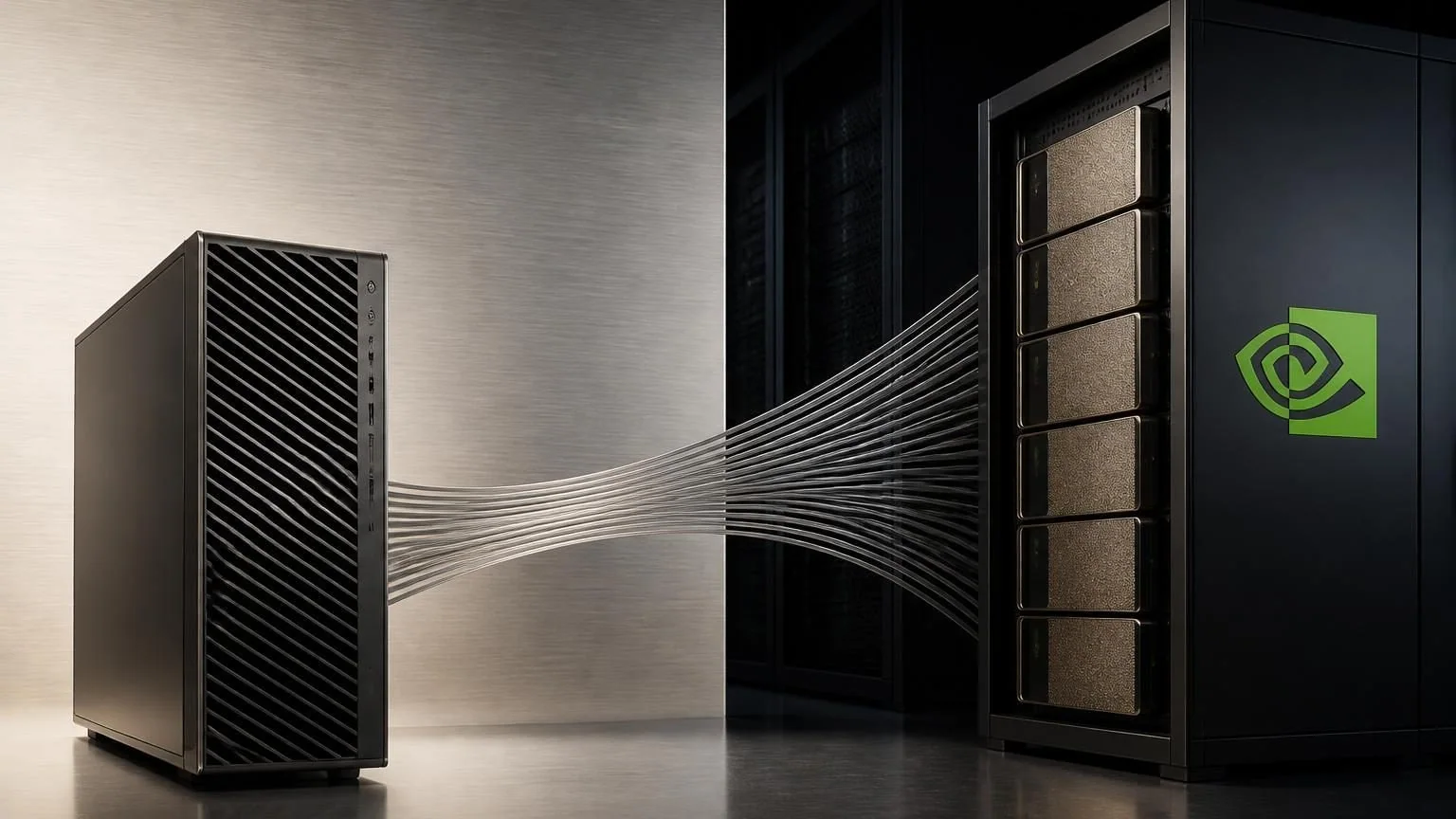
More than two weeks after Dell Technologies World opened on May 18, 2026, one of the more useful missed AI infrastructure stories is still not the liquid-cooling headline or the usual server refresh. It is Dell Deskside Agentic AI, the local agent stack Dell introduced with NVIDIA to let workgroups build, test, and run agentic workflows on high-performance workstations before scaling them into the data center. That is still worth covering now because the main enterprise AI question in early June is no longer whether agents are impressive. It is where they should run, how much that runtime costs, and how tightly companies can govern data, tools, and long-running behavior.
Dell’s May 18 launch was really about a new deployment tier
Dell presented Deskside Agentic AI as part of its broader Dell AI Factory with NVIDIA expansion at Dell Technologies World in Las Vegas on May 18, 2026. The core pitch was not “buy a more powerful workstation.” It was “give teams a local, secure, predictable environment for agentic AI instead of forcing every serious workflow into a cloud-first model.”
The launch tied together Dell high-performance workstations, NVIDIA NemoClaw, and NVIDIA OpenShell. Dell said the setup is designed to support agentic workloads across a wide model range, from smaller workhorse deployments up to trillion-parameter-class systems depending on the configuration, while preserving a consistent path from deskside systems to Dell PowerEdge XE servers.
- Local agent execution: workgroups can stand up autonomous workflows without sending every prompt and tool call back to public cloud APIs.
- Governed runtime: OpenShell gives Dell a sandboxed agent runtime that can carry privacy and policy controls from workstation pilots into larger infrastructure.
- Production bridge: Dell-NVIDIA AI-Q 2.0 was positioned as a ready-made route for multi-agent research and decision workflows, especially in regulated environments.
That combination made the announcement more consequential than it looked on event day. Dell was effectively inserting a middle layer into the enterprise AI stack: not laptop experimentation, not giant cluster deployment, but governed local execution for teams that need real agents before they need full data-center scale.
Why the deskside detail matters more than another Dell World product burst
The real signal in the launch was economic and operational, not cosmetic. Dell argued that organizations can reach break-even against public cloud API costs in as little as three months on some agentic workloads. It also framed Deskside Agentic AI as a way to convert unpredictable token spending into controlled infrastructure investment for software engineering, research, and regulated work.
That matters because long-running agents change the cost equation. A normal chatbot may tolerate cloud variability. A coding agent, research agent, or internal analyst agent that loops across tools and documents for hours does not. Once agents become persistent, inference location becomes a budget decision, not just an architecture preference.
The other big shift is data control. Dell’s messaging leaned hard into the idea that local execution keeps sensitive enterprise data inside the environment where it already lives. That is especially important for organizations that like open-weight models but do not want to trade lower per-token costs for weaker governance or uncertain data handling. In that sense, the launch was a response to three enterprise objections at once: cloud bill shock, data sovereignty, and runtime trust.
Where businesses are likely to use this first
This is not a general-purpose PC story. The likely early users are small technical and operational groups that have real agent demand but are not ready to route everything through a centralized AI platform.
Software and engineering teams
Dell explicitly targeted software engineering. That makes sense. Coding and validation agents burn through tokens quickly, touch proprietary code, and often need long-running sessions. A local-first setup is easier to justify here than in lighter assistant use cases.
Academic, research, and knowledge-heavy groups
Dell also named academic research and other specialized research workflows. These teams often need high-throughput document work, experimentation with open models, and more predictable cost ceilings than API-based usage gives them.
Regulated industries
Financial services, public sector, healthcare, and manufacturing are the clearest enterprise fit. These environments care about data residency, auditability, and controlled workflow design. A deskside-to-data-center model lets them start with contained local deployments and only scale once the workflow is stable enough to justify bigger infrastructure.
This is the practical reason the announcement still matters now. Dell was not selling autonomy as magic. It was selling a controlled adoption path for teams that want useful agents without accepting all the risks of a cloud-only or pilot-only approach.
Why this missed story looks bigger in early June
Two weeks later, the Dell launch looks less like a side demo and more like a statement about where enterprise AI deployment is heading. Dell used the rest of Technologies World to frame AI as infrastructure, not just software, pairing Deskside Agentic AI with broader AI Factory, data-platform, rack, storage, and ecosystem announcements. That makes the deskside piece easier to read in context: it is the first rung of a larger deskside-to-data-center operating model.
That framing is important for buyers. Enterprises are no longer choosing only between a public API and a giant internal cluster. Vendors are starting to offer a middle layer where teams can prove a workflow near the data, keep governance tight, and scale into heavier infrastructure without changing the runtime model completely.
For Nerova readers, that is the real takeaway. If an agent workflow is high-volume, touches sensitive internal data, or needs long-running behavior with tighter human oversight, the cheapest-looking public cloud path may not be the smartest first deployment path. Dell’s May 18 announcement still matters because it turned that tradeoff into a product category.
The business impact is really about rollout sequence
The missed-news value here is not that Dell launched one more AI workstation bundle. It is that Dell made a stronger case for sequencing enterprise agent adoption differently: local first for control, hybrid next for scale, governed runtimes throughout. That is a much more believable path to production than the start-with-an-API-and-figure-out-governance-later model that dominated earlier AI waves.
In other words, Dell’s Deskside Agentic AI launch matters in June 2026 because it helped define the deployment layer between experimentation and full AI factory scale. For enterprises trying to decide where agents actually belong, that is not a side story anymore. It is the story.