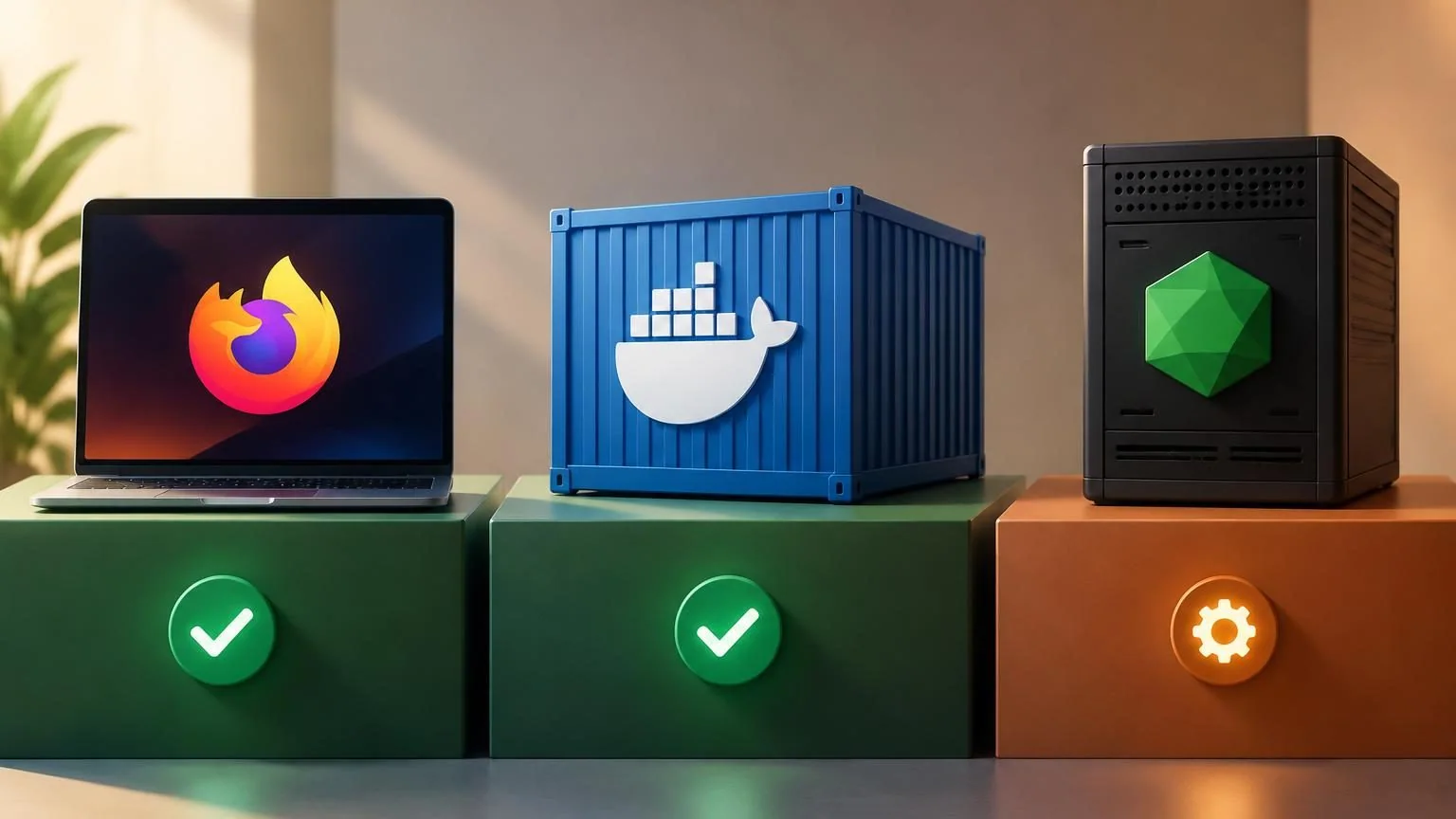
Three November 3 security notices affect common development and browsing environments. Mozilla and Docker published available fixes. Node.js provided advance notice of releases expected the following week. Treating those as the same event would obscure what administrators can actually install today.
Firefox ships a high-impact correction
Mozilla’s MFSA-2026-123 identifies CVE-2026-120572, an incorrect-boundary-condition issue in the browser’s Layout: Block and Inline component. The advisory rates its impact high and lists Firefox 159.0.1 as the fixed release.
The published notice is concise. It does not establish an active-exploitation campaign, and this article does not infer one from the severity label. Browser operators should confirm the installed corrected build through their normal update channel and complete any restart required to run it.
Docker Desktop repairs isolation and kernel issues
Docker Desktop 4.98.0’s November 3 notes list a Linux IPv4 TCP use-after-free correction and CVE-2026-112917, an AF_VSOCK restriction bypass involving a container on the WSL 2 backend. The latter fix requires WSL 3.0.3 or later, making the host dependency part of the acceptance check.
The same release corrects Windows file-sharing path matching and removes a previously installed privileged helper on Mac. Docker notes that Desktop releases roll out gradually, typically within a week. These changes should not be confused with the separate credential-logging correction shipped in October.
Node.js gives preparation time
The Node.js project’s November 3 pre-announcement schedules security releases for the 26.x, 24.x, and 22.x lines on or shortly after November 11. It rates the highest-severity issue in each line high. The notice does not yet provide corrected build numbers or full vulnerability details.
An advance announcement is a planning signal, not evidence that the promised patches are already available. Teams should revisit the official release notice when the updates ship and choose the corrected version for their supported line.
Verify the environment that actually runs
Our operational analysis is to inventory applications, managed desktops, developer machines, build images, and long-lived runners separately. Updating a laptop’s Node installation does not update a container image or a bundled runtime in another product.
For Docker’s WSL-dependent fix, record both Desktop and WSL versions. Test a representative workload after maintenance and check file-sharing boundaries used by the organization. A version upgrade should preserve legitimate development while enforcing the intended restrictions.
For the upcoming Node release, prepare the compatibility checks and rebuild ownership now. Once available, verify the runtime in the deployed service rather than only the package used during build. Keep the difference between installed, built, and running versions visible in the maintenance record.
The shared lesson is precise patch accounting: available corrections can be applied and verified, while scheduled corrections require a ready owner and a follow-up against the actual release.