
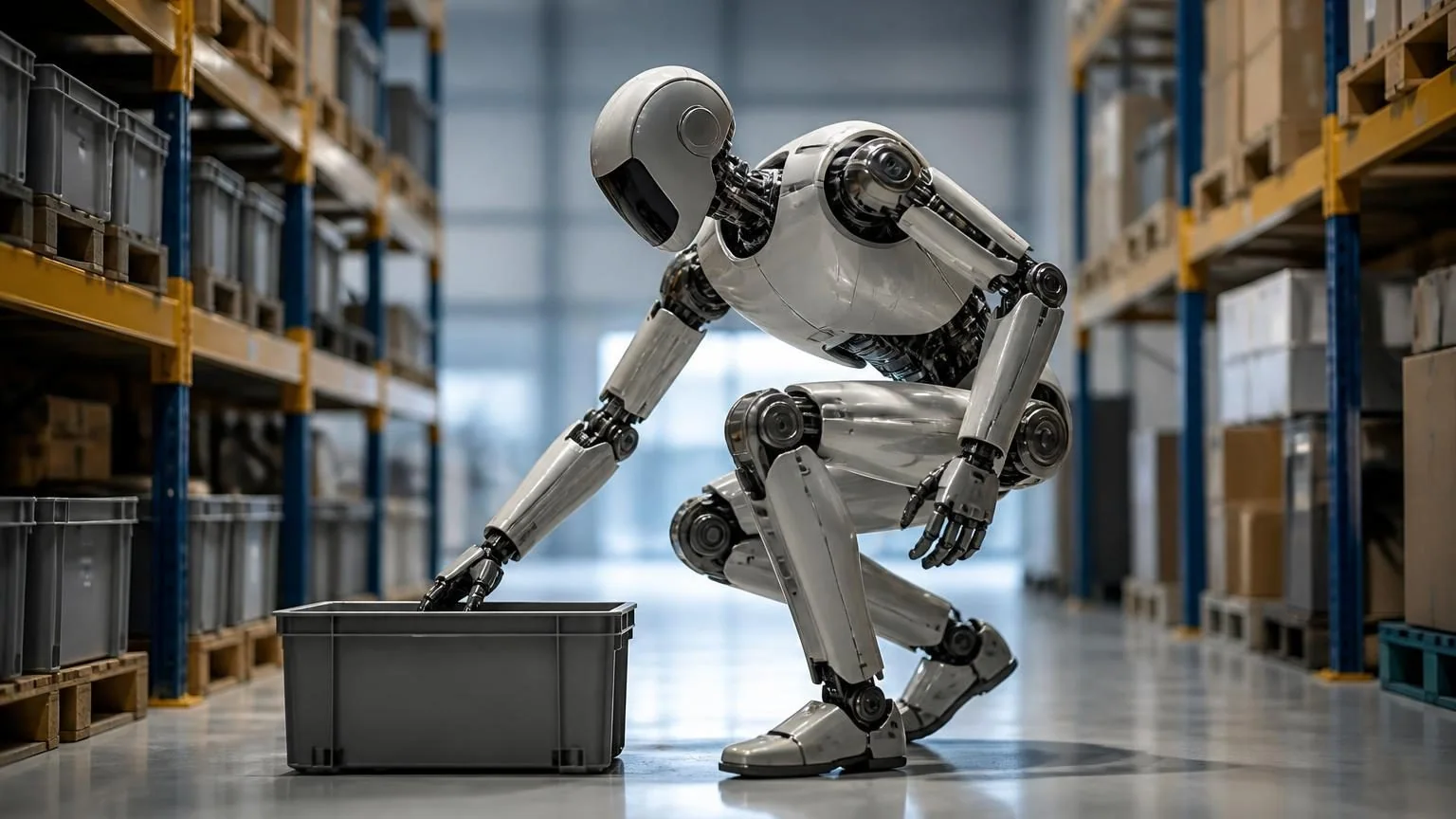
Google DeepMind announced Gemini Robotics 2 on July 30, 2026, positioning it as a vision-language-action model for robots ranging from tabletop systems to humanoids. Its notable shift is whole-body control: a robot can balance, step, squat and bend while manipulating objects rather than acting only from a fixed stance.
That does not make general-purpose humanoid automation a plug-and-play purchase. It does make physical AI more relevant to enterprise automation roadmaps—especially where a defined task combines movement, visual inspection and manipulation.
What Gemini Robotics 2 changes
Google says the private-preview model can control different robot forms, including full humanoids and dual-arm systems, and can adapt its behavior as conditions change. Its published evaluations show meaningful variation by task: some manipulation and dexterity tasks remain far from dependable enough for unattended production work.
The important business implication is not a claim of universal robot capability. It is a potential reduction in the amount of bespoke control software needed when a company wants to test similar task logic across different hardware.
Where an enterprise pilot may make sense
Prioritize work that is bounded, repeatable and easy to measure: replenishing a known station, moving standardized totes, basic kitting, or capturing visual evidence for an inspection workflow. Start where failures can be safely contained and where a human can remain in the loop.
A poor first use case is an open-ended role with high safety consequences, highly variable objects, crowded shared spaces or a business case that depends on near-perfect uptime. The model is in private preview, so availability and integration constraints must be part of the evaluation.
A practical physical-AI readiness test
- Define the unit of work. Specify the object types, starting conditions, completion signal and permitted recovery actions.
- Measure the exception rate. Track human interventions, unsafe states, task failures and time-to-recovery—not just demo success.
- Separate intelligence from deployment. Assess the model, robot hardware, safety controls, facility changes and operating ownership as one system.
- Keep the digital workflow connected. A robot task creates value when its result updates the systems that schedule work, verify quality and handle exceptions.
The near-term opportunity is disciplined, not dramatic
Gemini Robotics 2 is a credible signal that foundation-model competition is extending into physical operations. But enterprises should treat it as a reason to map candidate workflows and data flows now, not as proof that every physical process is ready to automate.
The winners will likely begin with a narrow task, a clear fallback path and an operating model that joins physical execution with digital agents for orchestration, reporting and escalation.