Google DeepMind announced Genie 4 on October 27, 2026, adding native audio and live natural-language steering to interactive world simulation. Access begins as a limited research preview. The announcement points toward richer creative and agent-training environments, while leaving broader developer availability unresolved.
What access did the October 27 announcement establish?
Separate four things that can otherwise sound like the same release:
- Announcement: Google publicly introduced the research on October 27.
- Research preview: rollout had begun for a limited group of trusted testers.
- Consumer and API access: Google AI Ultra subscribers in Project Genie, and early-access partners through the Gemini API and Google AI Studio, were described as coming soon—not general availability.
- Downloadable weights: the announcement pages provide no weight download or self-hosting license. They do not establish an open-weight release.
Those are the verified announcement terms reviewed as of November 1. Neither dated announcement supplies a firm broader-release date or Genie 4 pricing. A planned API route is not evidence that an ordinary API account can invoke the model today.
Why Gemini matters as much as the generated world
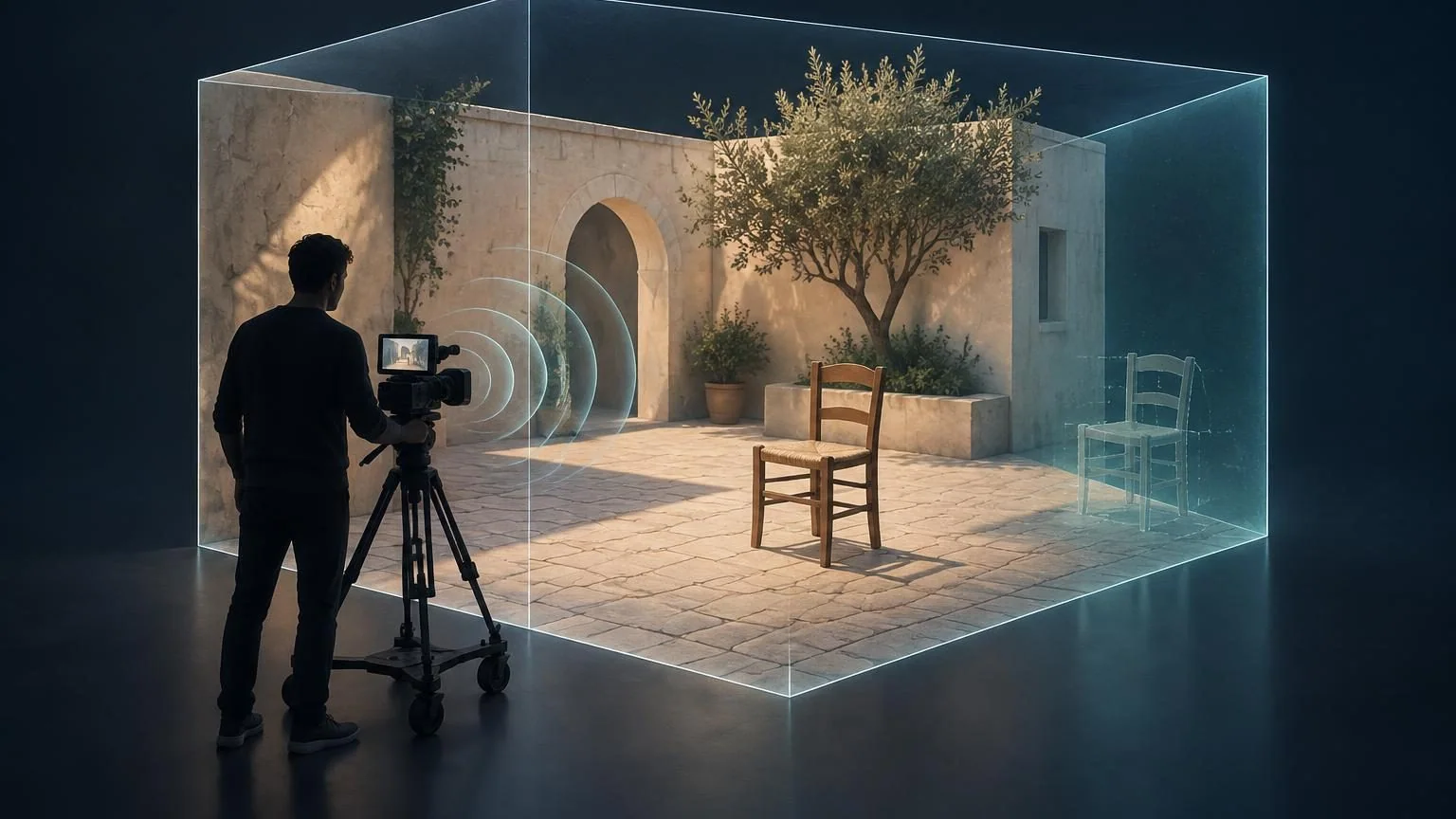
Google's model page describes worlds that users can reshape while they run: redirect a camera, change weather or introduce characters. Sound is generated natively, including environmental audio and speech. Gemini Omni supports appearance and behavior; other Gemini models contribute reasoning and continuity. These are Google's capability descriptions, not results from Nerova testing.
DeepMind's technical explanation names Gemini 3.8 Flash as a guiding agent that observes frames, decomposes goals and checks progress. A separate experiment combines Gemini 4 Argon and Genie 4 to simulate Apptronik's Apollo humanoid playing checkers. The example illustrates task-directed generation; it does not establish successful transfer to a physical robot.
Our analysis: the interesting architectural shift is a planner working alongside a generator, rather than a generator simply producing a longer clip. That creates two evaluation questions: did the planner choose sensible steps, and did the simulated environment preserve the conditions needed to judge those steps? A visually persuasive ending should not automatically count as task success.
The useful business boundary is exploration, not certification
DeepMind reports trusted-tester exploration of filmmaking previsualization, interactive prototypes and enterprise scenario generation. These are early workflow investigations, not published customer ROI findings.
For a creative team, our assessment is that the useful pilot would be narrow: can people agree on blocking, camera movement or a scene's mood faster? Treat the simulation as an editable sketch. Measure time to an approved concept, rather than assuming the generated experience is a finished production asset.
For robotics or manufacturing, the acceptance bar should be different. A scenario can help an engineer imagine a failure without proving its probability, forces or consequences. Before using generated scenes to evaluate an agent, keep an independent record of intended object positions, allowed actions and success criteria. Otherwise, a changing environment could conceal a mistake rather than expose it.
What the limitations mean for the next rollout
Google's model page acknowledges drifting details and object permanence, difficulty modeling multiple independent agents, imperfect real-world locations, text-rendering problems and audio inaccuracies. It describes continuous interaction lasting a few minutes rather than extended sessions, and labels recordings illustrative and shortened. These caveats matter more for evaluation than attractive demo footage.
Our practical conclusion is to keep any initial assessment short, observable and reversible. Save the starting description, record interventions, and have a reviewer flag continuity failures separately from agent failures. Do not use an imagined reconstruction as documentary evidence or a physically validated digital twin.
The next meaningful milestone is not another impressive scene. Watch for a dated access expansion, usable developer documentation and explicit operating terms. Until those are established, plan an experiment around the preview's constraints—not a production dependency around its promise.