
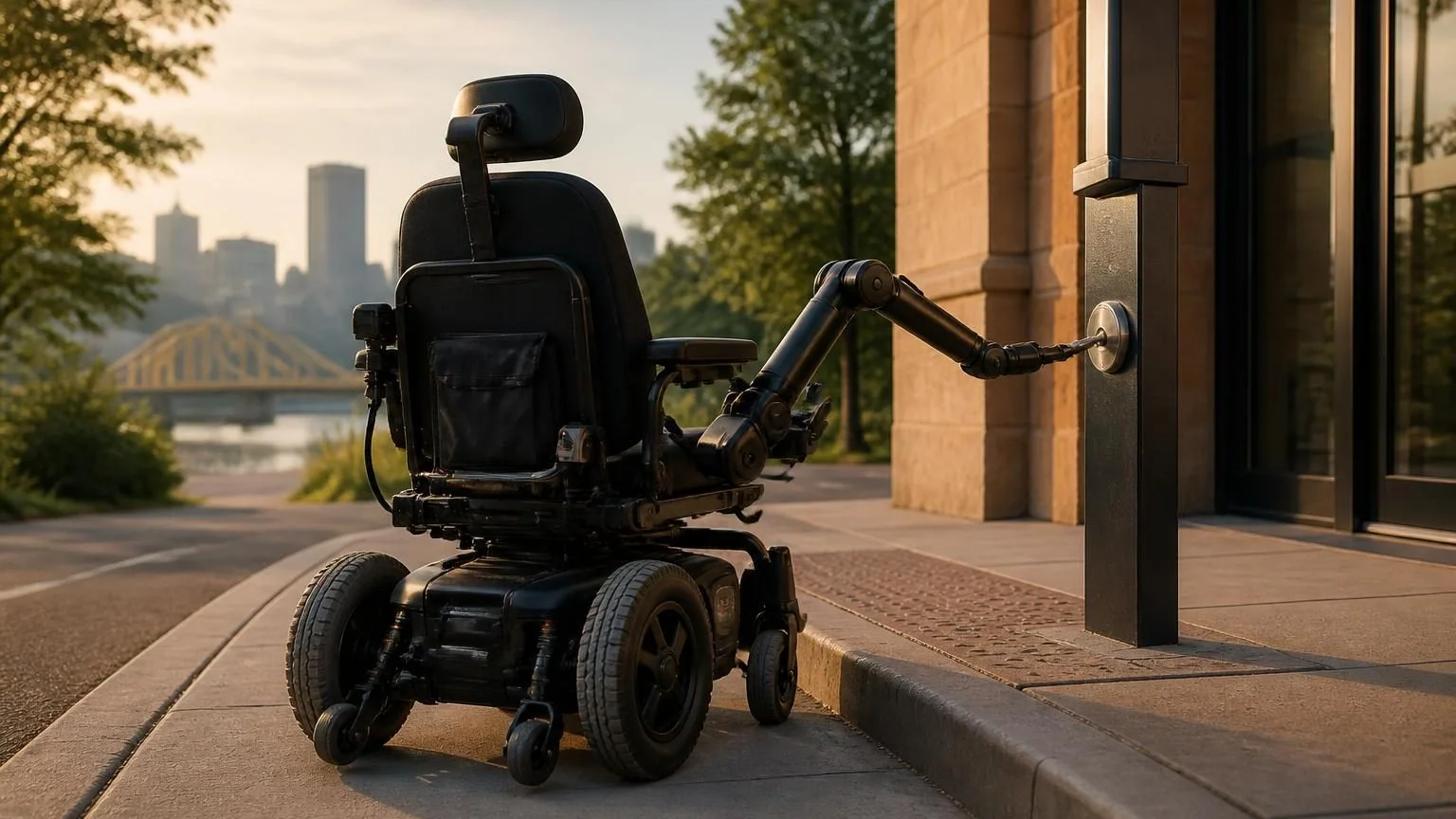
AI’s next important interface may not be a chat window. It may be a curb, a door button, or a cup on a table.
On July 27, Meta AI published details of its work with the University of Pittsburgh’s Human Engineering Research Laboratories on RAMMP, a robotic assistive mobility and manipulation platform. The project combines a powered mobility base, a robotic arm, sensing, and a digital-twin development environment. Meta says the team is integrating its DINO and Segment Anything vision models to help the system understand nearby objects and surroundings.
That sounds technical. The practical point is much simpler: assistive robotics has to interpret an unpredictable physical world quickly enough to be useful, and reliably enough to be trusted.
The benchmark is daily life
University of Pittsburgh researchers demonstrated a RAMMP prototype in April 2026 that could negotiate curbs, open doors, retrieve a drink, and bring it to a user. The project is backed by an ARPA-H award of up to $41.5 million over five years and includes university and industry partners.
Those examples matter because they are not neatly bounded lab tasks. A curb has uneven edges. A cup can be partly obscured. A door button can sit in a different place than expected. Connectivity can fail. The user cannot be asked to become a robotics operator every time the environment changes.
Meta’s update emphasizes running perception models on constrained, battery-powered devices. That means balancing model detail against heat, power, weight, latency, and predictable behavior. In physical AI, a model that is impressive but unavailable when a connection drops is not enough.
On-device perception is a product decision
RAMMP’s use of on-device vision points to a broader design principle. When AI helps with movement or manipulation, response time, privacy, and graceful failure become core product features. The question is not only whether a model can recognize a cup. It is whether the whole system can recognize it promptly, communicate its confidence, preserve the user’s agency, and fail safely when uncertain.
The project also combines visual context with voice and touch inputs. That is a better pattern than treating autonomy as the goal. The goal is lower cognitive burden with meaningful control still in the hands of the person using the device.
Why this matters beyond wheelchairs
RAMMP is an early but concrete example of where AI agents, computer vision, edge compute, robotics, and human-centered design meet. The same discipline will matter in warehouses, field service, hospitals, and industrial sites. Physical systems need more than a capable model. They need clear permissions, dependable sensing, local operation where appropriate, recovery paths, and human override.
For business leaders, this is the useful takeaway: do not evaluate physical AI as a demo of model intelligence. Evaluate it as an end-to-end workflow in messy conditions. Identify the action it supports, the data and sensors it needs, the decisions it can make alone, the moment it must ask for help, and the consequence of being wrong.
AI is becoming more useful when it leaves the screen. But the real advance is not a robot that looks autonomous. It is a system that makes everyday independence more achievable without demanding that people adapt to the machine.
A practical evaluation checklist
- Start with the environment: Test against real lighting, obstacles, objects, connectivity, and time pressure.
- Define user control: Make it clear what the system can do automatically, what it proposes, and how a person stops or redirects it.
- Measure reliable completion: Track successful task completion and safe recovery, not only model accuracy.
- Design for local constraints: Account for battery, latency, privacy, hardware limits, and offline operation from the beginning.
RAMMP’s promise is not that AI will replace human judgment. It is that better perception and carefully designed assistance can reduce friction in the moments that shape independence.