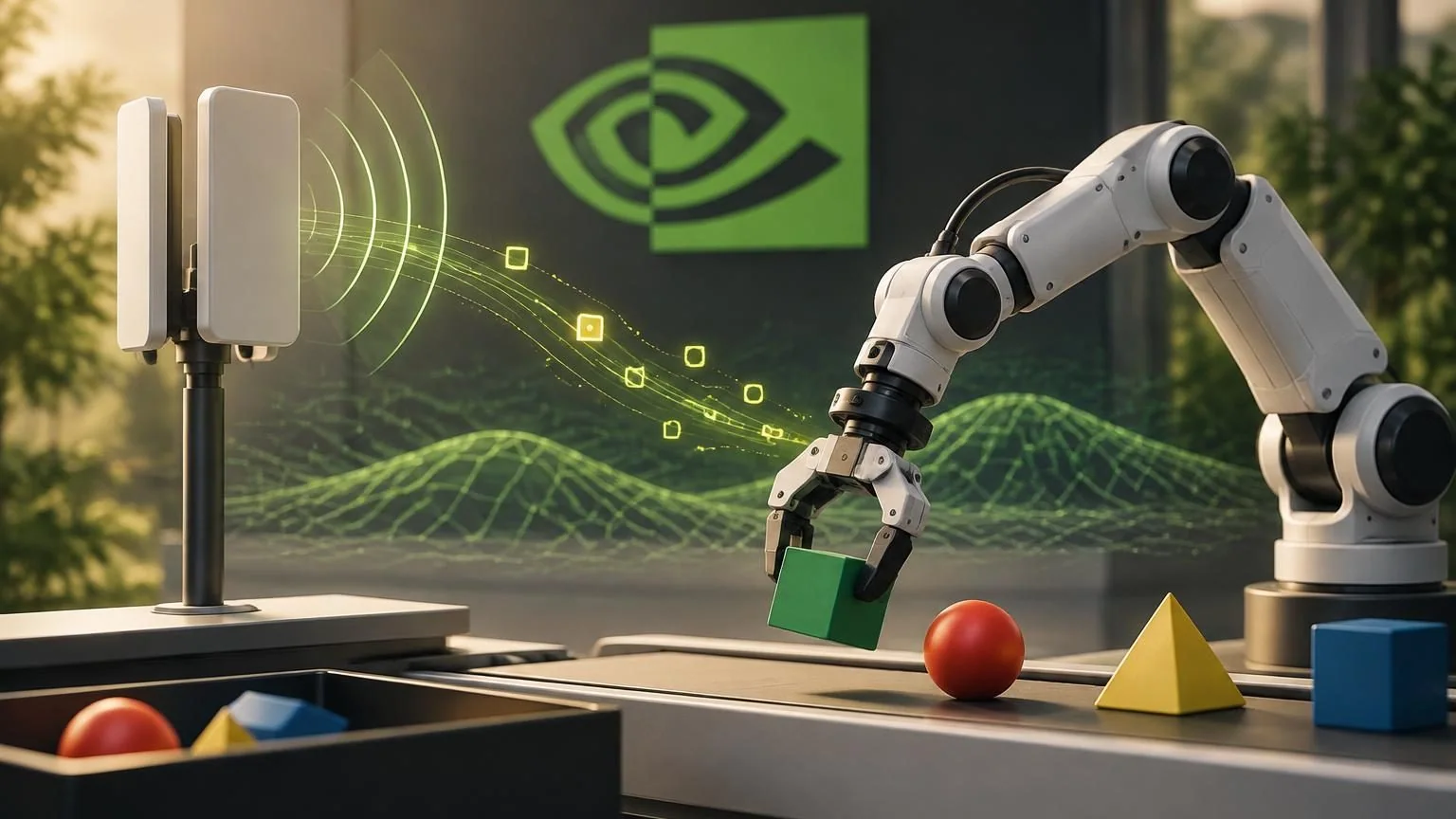
NVIDIA published a November 6, 2026 progress report on research using its open Aerial and Sionna wireless tools. The update connects communications experiments with robotics, signal reception, and network energy management. It describes work toward future networks rather than the launch of a commercial 6G service.
A research update, with physical experiments
Aerial was open-sourced a year before this announcement. Sionna’s official repository describes tools for ray tracing, physical-layer communications, and system-level network simulation. Together, the projects offer ways to study designs before and alongside experiments with real radios.
One example highlighted by NVIDIA comes from King’s College London. A camera-equipped robot arm sends compact descriptions of objects and relationships rather than repeatedly transmitting whole images. The researchers’ paper describes the goal-oriented communications testbed and evaluates data transmission, task completion time, and success probability. NVIDIA reports a task-time reduction of up to 52.6% in the cited experiments. That result belongs to the tested setup.
Why the task can change the network question
Our interpretation is that this work asks a useful question: what information does the receiving system need to make its next decision? A robot arranging objects may benefit from a compact, timely update about a changed position. A different task may need the full visual record. The right representation depends on the decision being made.
This also changes how a test should be judged. Transmitting fewer bytes is helpful only if the receiving system retains enough information to act correctly. A comparison should therefore report success and recovery behavior alongside transmission volume and speed. A fast failed action is still a failed action.
Simulation and deployment have different jobs
A simulator can help a research team repeat conditions and compare alternative designs. A physical experiment then introduces details that a simplified environment may omit. Keeping both stages visible makes it easier to identify which part of a result is repeatable and where assumptions need further testing.
For developers watching this work, the useful next step is to read the experiment definition before adopting the headline figure. Check the robot task, the communication baseline, the introduced faults, and the conditions under which recovery succeeded. Those details decide whether a result resembles a proposed application.
What to watch next
The most valuable follow-up will be reproducible experiments, documented limitations, and evidence across more operating conditions. NVIDIA’s update shows how open wireless tools are being used to connect communications research with useful physical tasks. It does not settle a future standard or guarantee that any particular result transfers unchanged to a factory network.