
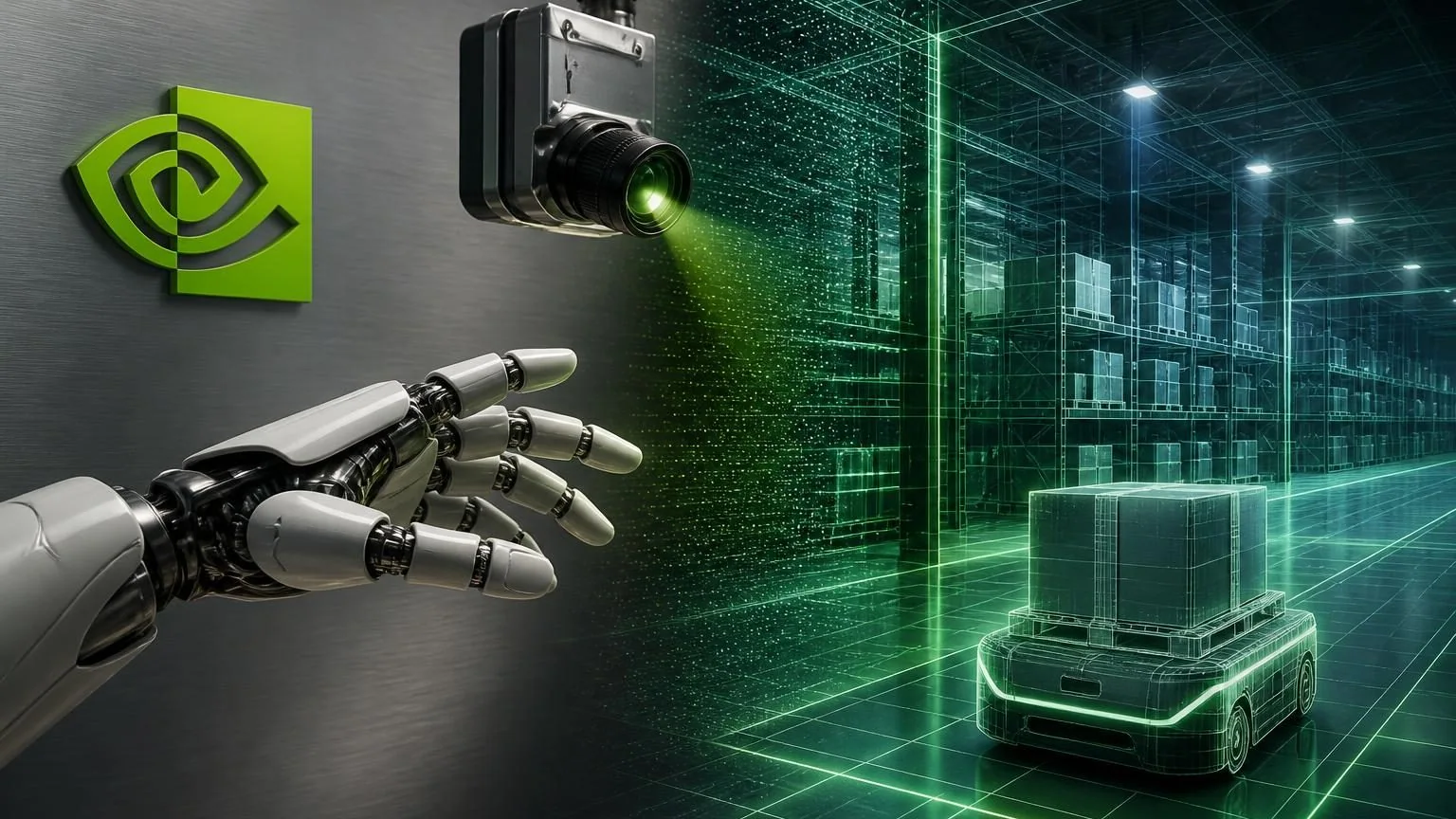
On June 1, 2026, NVIDIA introduced Cosmos 3 as an open omnimodal world model for physical AI, with open model access through Hugging Face and supporting code, datasets, and tooling across NVIDIA’s broader Cosmos stack. The release is aimed at robots, autonomous vehicles, and vision AI systems that need to understand a scene, predict what happens next, and generate action outputs from the same model family.
That makes Cosmos 3 different from a normal enterprise-model launch. This is not another text-first assistant or coding model. NVIDIA is positioning it as a foundation for agents that perceive and act in the physical world, combining reasoning, world generation, and action prediction in one architecture rather than spreading those jobs across several separate model types.
What NVIDIA released around June 1
The Cosmos 3 release includes two main open model sizes: Cosmos 3 Nano, a 16B model designed for more efficient inference, and Cosmos 3 Super, a 64B model aimed at higher-quality physical reasoning and synthetic data generation. NVIDIA and Hugging Face also published Diffusers support, open synthetic-data resources, and post-training recipes intended for robotics, warehouse, driving, and other physical-AI workflows.
NVIDIA’s technical material describes Cosmos 3 as a unified model that can work across text, image, video, audio, and action data. In practical terms, that means a team can use the same model family as a vision-language reasoner, a world model for future-state simulation, or a policy-oriented action model for robot-learning workflows.
That unification matters because earlier Cosmos releases were more fragmented. NVIDIA’s own launch writeups frame Cosmos 3 as the point where world generation, scene reasoning, and action generation move into one omnimodel instead of separate Predict, Transfer, Reason, and Policy tracks.
Why Cosmos 3 is a different model category from most open releases
The key shift is not simply that Cosmos 3 is multimodal. Many recent models are multimodal. The more important claim is that Cosmos 3 is built for physical context: motion, causality, spatial relationships, future-state prediction, and action trajectories. That puts it closer to a world-model stack for embodied systems than to the general business-assistant category that dominates most AI search traffic.
NVIDIA says the model uses a mixture-of-transformers design that separates reasoning and generation roles while letting them interact inside one system. For businesses, the practical implication is straightforward: Cosmos 3 is being sold as infrastructure for perception-and-action loops, not only for content generation or question answering.
This is why the most credible near-term use cases are narrow and operational. Examples include synthetic data generation for warehouse safety, action-conditioned robot training, scene understanding for industrial cameras, anomaly reasoning in traffic or logistics footage, and simulation-heavy physical workflows where collecting edge-case real-world data is slow or expensive.
That also means teams should avoid reading Cosmos 3 as a direct competitor to office copilots, customer-service agents, or coding models. It is more useful to think of it as an upstream model layer for physical systems and vision-heavy agents that need richer world understanding before they can take action.
The real deployment and evaluation questions
The biggest business mistake would be to stop at the demo. Cosmos 3 may be open, but an open model is not the same thing as an immediately deployable physical-AI product. The harder questions start after the announcement.
- What are you actually building? Synthetic data generation, scene reasoning, policy learning, and real-time edge action are different deployment problems, even if NVIDIA groups them under one Cosmos umbrella.
- How much domain post-training will be required? NVIDIA released post-training recipes, but most real deployments still depend on embodiment-specific data, camera layouts, safety constraints, and task definitions.
- What part of the stack needs to run in production? A team generating warehouse training footage has a different serving problem from a team trying to use Cosmos outputs inside a live robotics loop.
- How will you evaluate physical correctness? A model that produces plausible video or reasoning traces is not automatically good enough for policy execution, simulation validity, or safety review.
- What is the operational runtime? NVIDIA is offering NIM microservices and has positioned Nano for more efficient inference, but real-world rollout still depends on latency, hardware cost, and integration with simulation or control systems.
Those questions matter because physical AI has a wider gap than standard software automation between a compelling research artifact and a production system with measurable ROI. Cosmos 3 may reduce that gap, but it does not remove it.
What business teams should watch next
For most companies, the near-term value is not “replace office workflows with robots.” It is more likely to appear in industrial vision, synthetic data generation, smart-space monitoring, robotics R&D, and safety-sensitive simulation work. Businesses with warehouses, factory environments, vehicle fleets, or camera-heavy operations should pay closer attention than companies looking for generic back-office automation.
For everyone else, Cosmos 3 is still strategically important because it shows where agent infrastructure is heading. If text agents were the first wave, models that can perceive, simulate, and plan around real-world environments may become the next layer for physical operations. But that curve is uneven. Most businesses will still get faster returns from software agents, workflow automation, and governed internal AI systems before they get material value from embodied or robotics-heavy stacks.
The right reading, then, is not that physical AI has suddenly become easy. It is that NVIDIA has made the open model layer more serious. Cosmos 3 gives robotics and vision-AI builders a stronger shared starting point, and it gives enterprise teams a cleaner way to separate genuine physical-AI opportunities from marketing noise.
That distinction is likely to matter more over the next year than any benchmark screenshot. The companies that benefit first will be the ones with real simulation needs, clear evaluation loops, and a practical plan for where physical-world reasoning actually creates business leverage.