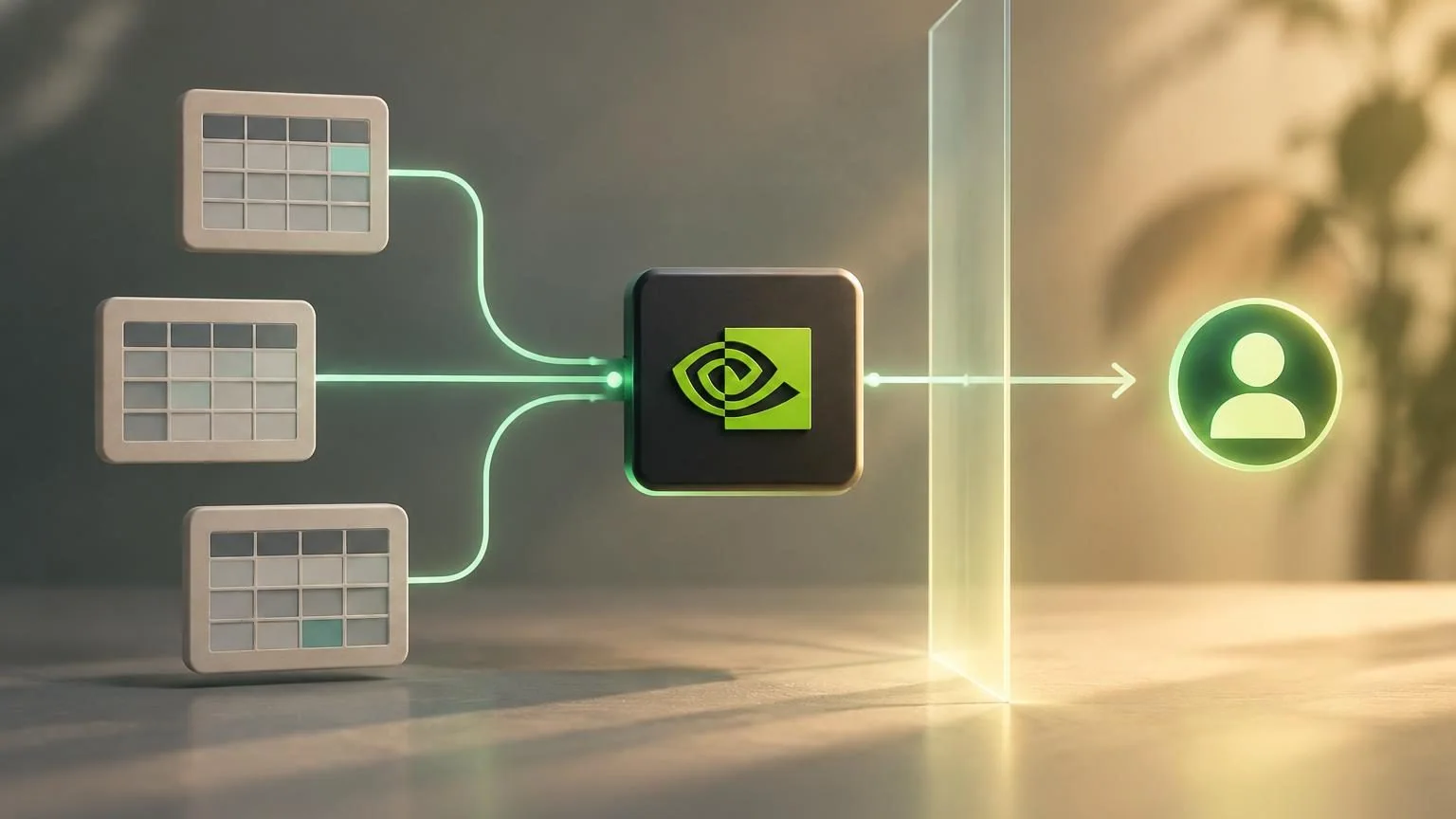
NVIDIA published its Kumo Relational technical announcement on October 21, 2026, placing predictive modeling over connected business tables within its broader open-model expansion. The announcement describes a way to make predictions from relational data without the usual task-specific training process. Earlier public milestones and the current deployment options still need to be distinguished.
October 21 was an announcement, not the starting line
The underlying KumoRFM-2 paper was submitted to arXiv on April 14, 2026. It describes relational in-context learning and optional fine-tuning. NVIDIA’s current Hugging Face model card explicitly identifies Kumo Relational as based on KumoRFM-2. The paper’s date establishes the research milestone, not the date downloadable NVIDIA weights became available.
Other milestones also predate October 21. NVIDIA’s NGC catalog records the v1.0 container release as August 18, 2026. Its current overview dates v1.1 Hugging Face weights to September 23, 2026, while the repository’s visible commit history labels a release commit September 28. Those records do not establish one reconciled first-public-download day; both place the weights before the October announcement. NGC dates container v1.1.0 only to October 2026, without specifying its release day.
One documentation inconsistency deserves attention: the older NVIDIA API reference gives April 14, 2025 as the source-announcement date while linking to the paper submitted April 14, 2026. The original arXiv submission history is the stronger evidence for that research date.
What businesses can actually access
This is more than a future preview promise. As checked November 1, NVIDIA Build provides a hosted API prototyping path and deployment instructions for the downloadable NIM container. That confirms an access route, not a newly verified October 21 API launch date, production service guarantee or entitlement for every account.
Downloadable weights are a separate option: the Hugging Face card documents GPU inference through structured-data-models, with model weights under OpenMDW 1.1 and upstream TabICLv2 BSD-3-Clause notices. The same card says no Hugging Face Inference Provider currently deploys this model. A downloadable checkpoint therefore should not be confused with a hosted Hugging Face endpoint.
Version selection matters. NGC’s v1.1 profile supports classification and regression and permits commercial and non-commercial use subject to its terms. The older v1.0 model remains restricted to non-commercial research or evaluation. Its additional forecasting and temporal-link-prediction capabilities do not carry over to the v1.1 NIM profile. Check the selected artifact’s included terms rather than transferring permissions or capabilities between versions.
Relational prediction changes the agent’s job
Kumo Relational uses historical labeled examples and relationships between tables as inference-time context. NVIDIA describes Predictive Query Language, or PQL, as the interface for specifying a prediction. The model reasons over related records without requiring manual flattening into one feature table. “No training required” means no task-specific training is necessary for this inference path—not that business data, historical outcomes or preparation disappear.
Our operational interpretation: a retention agent could request a churn prediction, then route selected accounts to a human reviewer. The prediction and the intervention should remain separate decisions. A risk score should not automatically authorize discounts, customer messages or account restrictions.
For a pilot, define one outcome and prediction horizon, select only information available at the decision timestamp, and reserve later outcomes for evaluation. Compare the resulting ranked work queue with the existing process before allowing the agent to act. This tests whether predictions improve an actual decision, rather than merely producing plausible scores.
The evidence is promising, not a replacement guarantee
NVIDIA reports evaluations across 41 tasks and 15 databases, including RelBench and SAP SALT. It reports an 8% mean-reciprocal-rank improvement over AutoGluon ensembles on SALT. These are vendor-reported comparisons against evaluated baselines, not our tests or evidence that every production pipeline will improve.
NVIDIA also identifies limits: task-specific supervised models can remain stronger with very large training sets, and useful predictive signals must lie within limited relational hops. Our conclusion is narrower than “replace existing ML”: evaluate Kumo Relational where linked historical records matter, measure end-to-end data preparation and inference, and retain the incumbent pipeline until business-level results justify a change.