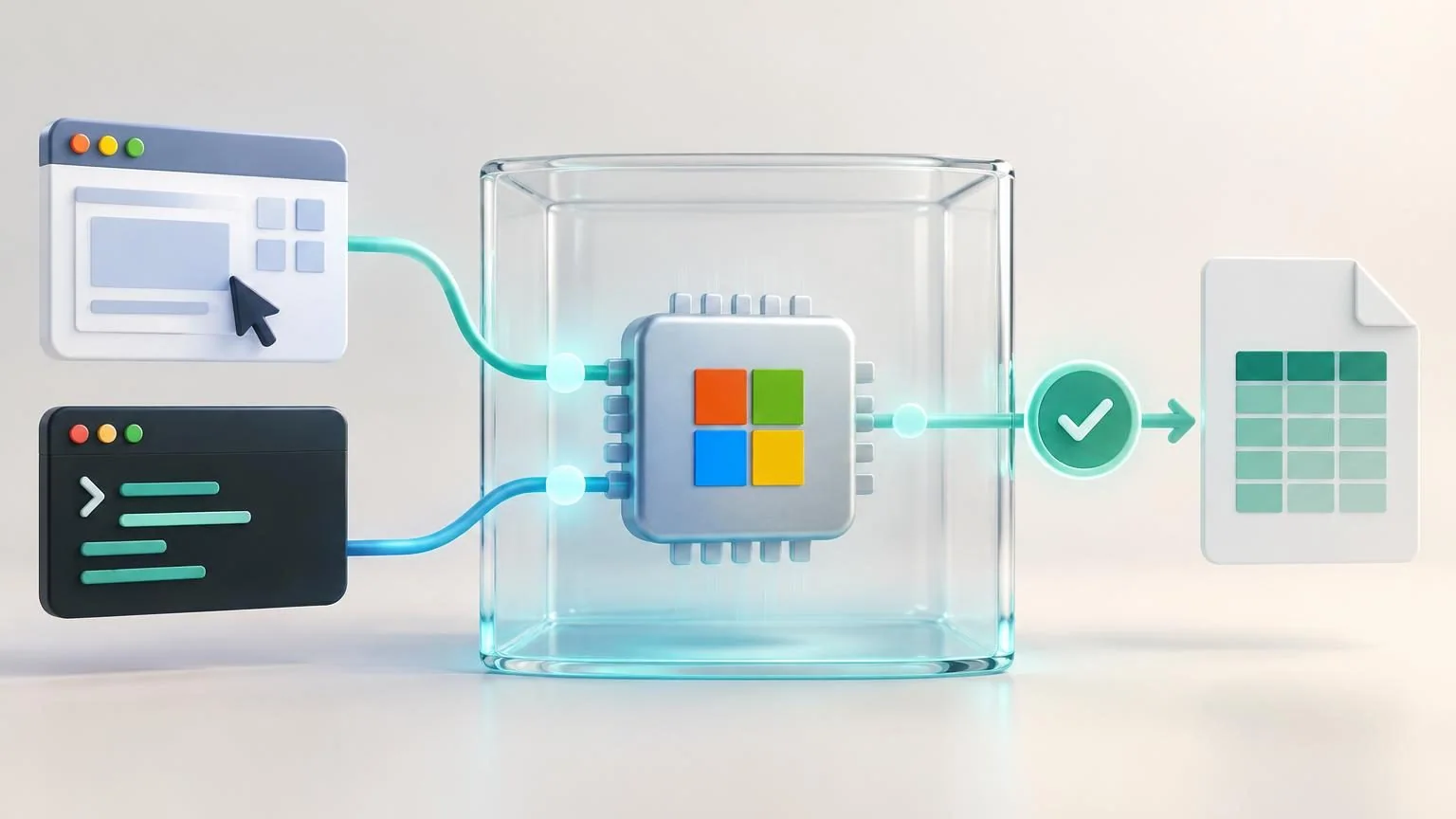
Microsoft published Mage-VL-Cowork model weights on October 30, 2026, alongside its model card and OSWorld evaluation reference. The repository’s dated release commit establishes an actual downloadable release, not merely a promise of future access.
What shipped—and what did not
The Hugging Face repository contains two safetensors weight shards totaling approximately 9.48 GB, plus configuration, tokenizer and modeling files. It lists an Apache-2.0 license. These are downloadable artifacts, rather than a waitlist or preview-only demonstration.
Keep four milestones separate. Public release: October 30 is verified by the repository history. Announcement: that commit does not establish the timestamp of a separate Microsoft press announcement. Preview: the documented distribution is a research model release, not an identified managed-service preview. API access: as checked November 1, Hugging Face lists no deployed Inference Provider; Microsoft documents self-hosted inference instead. A local inference endpoint is not evidence of a Microsoft-hosted commercial API.
One policy chooses between the screen and the shell
Microsoft’s project page describes a single policy with two action channels. Screenshot-based GUI interaction handles visual layouts and live application state; terminal execution handles structured documents, spreadsheets and presentations. Channel selection happens within the model, rather than through an external routing model.
Microsoft illustrates the distinction with LibreOffice Calc and GIMP demonstrations: programmatic spreadsheet editing on one hand, visual editing followed by file verification on the other. Those are publisher demonstrations, not tests performed by Nerova.
Our operational interpretation: the interesting opportunity is not simply replacing clicks. It is separating work that requires seeing an application from work better expressed as a file transformation. For a proposed reporting workflow, for example, a pilot could test whether a saved workbook remains correct after an edit and whether its rendered chart still matches the intended output. Neither check should substitute for the other.
The 66% result is evidence, not a deployment guarantee
Microsoft reports 66.0% on OSWorld-Verified: a two-run average across 361 held-out tasks, excluding Google Drive, with a 50-step budget and its hybrid harness. That is a publisher-reported result, not an independent Nerova measurement or a promise of success on business applications.
Our reading is that a substantial unsuccessful remainder makes unattended deployment premature without task-specific evidence. The useful purchasing question is therefore narrower than whether the model “beats” a larger one: can it complete your permitted workflow, detect a bad result, and stop before an irreversible action? Benchmark coverage cannot answer that question for a proprietary desktop environment.
Downloadable weights still leave integration work
Microsoft documents a custom llava_onevision2 architecture, remote-code loading and a dependency-pinned SGLang container tagged 0.1.0. Its active context window is 32,768 tokens. Treat those documented components as the starting point, rather than assuming any generic vision-model loader will reproduce the agent.
The safety guidance is equally consequential: Microsoft specifies isolated, disposable environments, scoped authorization, human confirmation for irreversible actions, credential protection and restricted network access. Shell capability expands what the agent can change, not merely how efficiently it clicks.
For a business evaluation, we recommend copied files in a resettable virtual machine, explicit output checks, and a human approval boundary before any external submission. Record completion, recovery attempts and review time—not just generation speed. The next evidence worth watching is reproducible performance on representative workflows and a clearly documented hosted offering, if one appears. Neither should be assumed from the October 30 weight release.