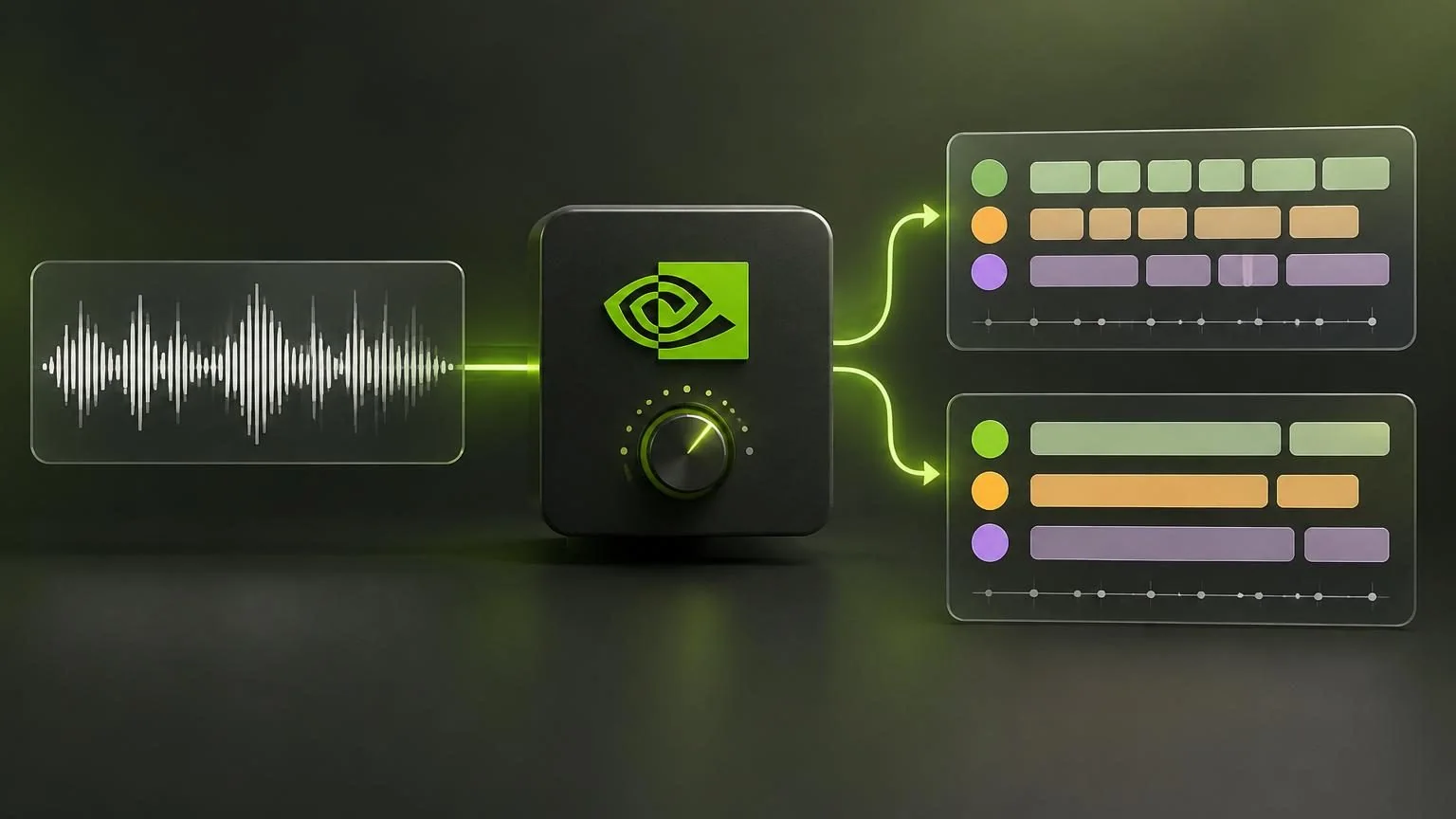
NVIDIA released Nemotron 3.5 Transcribe on October 28, 2026, giving users natural-language control over how recorded speech becomes text. The open-weight model supports different transcript styles, speaker attribution, and multilingual tasks. Its focus on recorded audio distinguishes it from a live streaming recognizer.
What changed: the transcript becomes a requested output
Instead of committing to one transcription convention, the model accepts instructions for verbatim wording, readable written form, contextual vocabulary, speaker attribution and optional word-level timestamps. NVIDIA’s research announcement describes recordings up to one hour long and transcription across 40 languages, with style selected per request rather than through retraining.
The language coverage is not uniform across tasks. NVIDIA’s October 28 launch post specifies translation between English and 31 languages, speaker attribution in 13 languages, and labels for up to eight speakers. A business should not read “40 languages” as a promise that every language receives every capability.
Underneath, the model combines a speech encoder and diarization component with the Nemotron 3.5 Lightning mixture-of-experts backbone. NVIDIA lists approximately 34 billion total parameters, including the audio encoder, with about 4.3 billion active. Active parameters describe computation, not the full memory footprint required to deploy the weights.
Announcement, demo, API and weights are different milestones
As checked on November 1, 2026, the access picture is:
- Announcement: NVIDIA’s research page and launch article are dated October 28, 2026.
- Preview experience: NVIDIA links interactive Hugging Face and ModelScope demos. These are ways to inspect behavior, not evidence that a production endpoint has a particular service guarantee.
- Hosted API access: NVIDIA names Baseten, DeepInfra and Simplismart as hosted endpoint options. Separately, the model card describes an OpenAI-compatible API through self-hosted vLLM or SGLang-Omni; protocol compatibility is not an NVIDIA-managed API availability promise.
- Downloadable weights: the BF16 checkpoint has a public file repository. Current NVIDIA documentation also lists FP8 and NVFP4 releases under OpenMDW-1.1.
There is an important timing wrinkle: the launch article’s throughput passage describes NVFP4 as forthcoming, while current documentation lists it as released. That supports reporting current availability separately from launch-day wording—not retroactively claiming every variant was downloadable at announcement time.
Why instruction control matters after the call
Our operational reading is that the most useful change is a clearer contract between transcription and downstream agents. A quality-review workflow might need hesitations preserved; a searchable meeting archive might need readable numbers and fewer disfluencies. Those are different outputs, not necessarily different models. NVIDIA explicitly supports both conventions.
For a multilingual support pilot, we would retain the original recording, version the transcription instruction, and keep translations separate from original-language transcripts. Supply a relevant product-name glossary, but compare results against the audio before allowing extracted commitments to update customer records. These are proposed deployment controls, not results from a Nerova test; NVIDIA itself recommends checking names, speaker changes and answers.
The limitations that should shape a rollout
Recorded audio is the boundary. NVIDIA’s documentation says internal 30-second encoder chunks do not make this a streaming model. Audio question answering and spoken-instruction following were evaluated only in English; reliability in other transcription languages is not established.
Multilingual breadth also does not eliminate mixed-language errors. NVIDIA’s technical report explicitly identifies code-switching across many language pairs as a weakness. Its model card warns about hallucinated speech, incorrect language choice and speaker-attribution errors. Speaker labels distinguish voices within a recording; they do not establish real-world identity.
Finally, do not turn vendor throughput into a latency or cost forecast. NVIDIA’s launch measurement used short clips at high concurrency, and the model card says optimized NIM serving performance is not reproduced by the release-day open-source implementation. The practical next step is a recorded-audio pilot measuring correction effort and downstream mistakes—not a live-call migration justified by headline speed.